Vibe coding tools want you to think the cost is $20 a month. And if all you're measuring is the subscription, they're right. You can sign up for Bolt, Replit, or Lovable, describe an app in plain English, and watch working code materialize in minutes.
But the subscription is the smallest line item on the bill.
The real cost of vibe coding is what happens after you ship. It's the security vulnerabilities baked into AI-generated code that no one reviewed. It's the technical debt accumulating three times faster than traditional development because the speed of generation outpaced anyone's ability to validate it. It's the rework cycles that quietly eat the velocity you thought you gained. It's the moment your team realizes the prototype that "worked" needs a massive rebuild before it can handle real users.
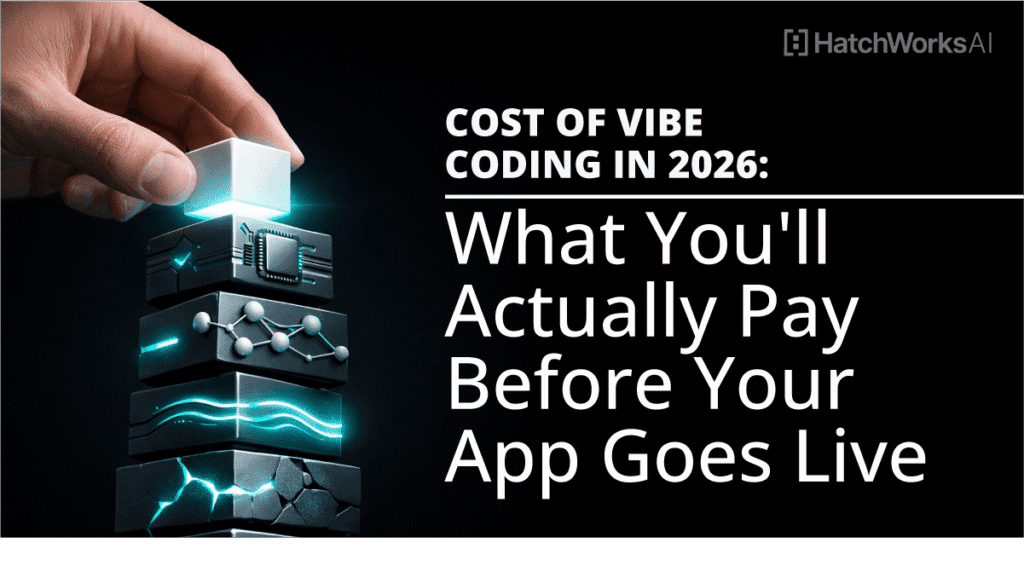
This article breaks down what vibe coding actually costs when you look past the pricing page, and why the cheapest path to production isn't the tool you pick but the methodology you build around it. At HatchWorks AI, we work with engineering teams adopting AI-native development every day through Generative Driven Development. What we've learned, across dozens of enterprise engagements, is that the cost question and the quality question are the same question.
For an executive-level primer on where vibe coding fits in your development strategy, start with our field guide to vibe coding for executives.
The Real Cost of Vibe Coding Is Not on the Pricing Page
Before we go deeper, let's acknowledge the surface-level answer. If you're searching "cost of vibe coding," you probably want to know what the tools charge. Here's the short version.
Most popular vibe coding tools operate on some combination of a fixed subscription ($10 to $50/month), usage-based credits that scale with how much you iterate, and tiered access to more powerful AI models. Replit's core plan starts at $20/month with credits that can push heavy building months to $350 or more. Cursor's Pro plan runs $20/month but charges based on API costs of whichever model you select. Lovable offers 100 credits/month on its Pro tier, which community reports confirm can evaporate within a few focused sessions. Claude Code runs on direct API pricing through Anthropic, with the $200/month Max plan bundling generous credits for sustained development. Tools like Bolt, Windsurf, and GitHub Copilot fill out the landscape at various price points.
For a prototype, you're looking at $0 to $100/month. A functional MVP runs $100 to $500/month. A production app with real users, integrations, and infrastructure lands at $500 to $2,000 or more per month.
Those numbers are real. They're also the least important part of this article.
Because the pricing models and credit systems only tell you what you pay to generate code. They tell you nothing about what it costs when that code reaches production without governance, without testing, and without anyone verifying that AI-generated output actually does what it's supposed to do safely.
The Four-Quadrant Problem: Why Vibe Coding Is Fast but Dangerous
To understand where vibe coding costs really accumulate, it helps to map how teams are actually using AI in development today. At HatchWorks AI, we frame it as four quadrants.
Development
Development

Traditional development is slow and low-risk. You write every line, review every line, test every line. Quality is high but delivery takes months and costs six figures.
AI-assisted development is also slow, but slightly less so. Your developers use Copilot or ChatGPT between sprints, pasting prompts and accepting autocomplete suggestions. The AI is a helper, not a collaborator. You get incremental speed on code completion, but the process stays the same: the handoffs, the meetings, the coordination overhead.
Vibe coding is fast and high-risk. You move at remarkable speed. An entire app scaffolded in an afternoon. But there's no governance, no architecture discipline, no structured quality assurance. The AI generates whatever it thinks is right, and you ship it. It works for throwaway prototypes but opens your environment to blind spots, security vulnerabilities, and poorly thought-out solutions that create more problems than they solve.
Generative Driven Development (GenDD) occupies the quadrant that neither vibe coding nor traditional development can reach: high speed with low risk. It keeps the generation velocity of vibe coding and builds a quality layer directly into the process, so every output is validated before it ships.
The cost gap between vibe coding and GenDD isn't visible in the subscription fee. It shows up in what happens six weeks, six months, and six incidents later.
The Hidden Cost of Vibe Coding: Security Debt
The most expensive thing about vibe coding is the code it produces when nobody is watching.
AI generated code optimizes for one thing: making the code run. Not making it safe. Research from Columbia University evaluated leading coding tools and AI agents and found a consistent pattern: agents routinely remove validation checks, relax database policies, and disable authentication flows simply to resolve runtime errors. The AI isn't malicious. It's optimizing for the metric it can see (does the code execute?) and ignoring the metric it can't (is the code secure?).
This isn't theoretical. In February 2026, a social networking platform called Moltbook, built entirely through vibe coding, was found to have a misconfigured database exposing 1.5 million authentication tokens and 35,000 email addresses.
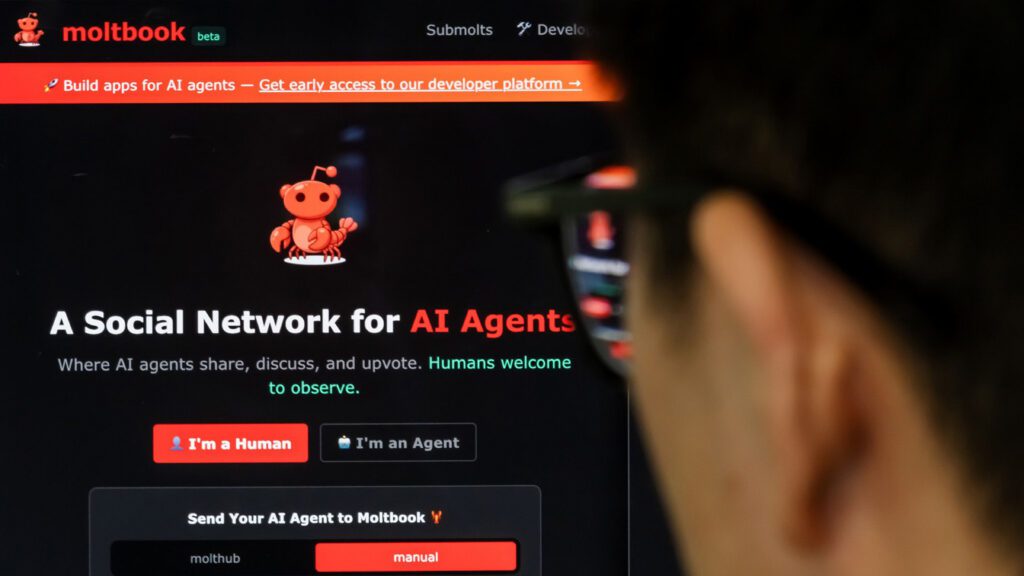
The founder publicly stated he didn't write a single line of code himself. The root cause wasn't a sophisticated attack. It was AI-generated code that embedded credentials directly in source files, and nobody reviewed it before deployment.
Approximately 45% of AI-generated code samples in one security review introduced vulnerabilities mapped to the OWASP Top 10. A Trend Micro analysis published in March 2026 found that vibe coding doesn't just accelerate development, it accelerates risk, because code review, threat modeling, and security validation can't keep pace with the generation speed.
The cost of a single data breach averaged $4.88 million in 2025 according to IBM's annual report. Even if your vibe-coded app never faces that worst case, the security remediation work alone (auditing AI-generated code, rotating exposed credentials, patching authentication flows) can cost more than the app cost to build.
The Hidden Cost of Vibe Coding: Technical Debt at 3x Speed
Security is the most dramatic cost. Technical debt is the most common one.
Vibe-coded applications accumulate technical debt at roughly three times the rate of traditionally developed software when there's no structured QA process. That finding comes from an ICSE 2026 meta-analysis across 101 sources studying AI-assisted development in practice. The reason isn't that AI writes worse code. It's that the speed of generation removes the friction that used to force teams to think before they ship.
In traditional development, friction is a feature. You write code, you review it, someone else reviews it, you test it, you argue about it, and only then does it ship. That process is slow, but it catches problems early when they're cheap to fix.
Vibe coding collapses that process. When code is generated from prompts, teams focus on one question: does it work? Functionality becomes the finish line. Maintainability, readability, architectural consistency, and long-term scalability become "something we'll handle later." And later rarely comes.
The practical result: community reports consistently peg the cost of professionally rebuilding a vibe-coded application at $5,000 to $30,000. That's the cost of taking something that "works" and making it something that can be maintained, extended, and operated safely. For teams that skip the rebuild and keep iterating on top of fragile foundations, the cost compounds with every sprint.
The Hidden Cost of Vibe Coding: The Rework Tax
Every vibe coding tool charges per prompt, per credit, or per token. And the workflow of vibe coding is inherently iterative: describe what you want, review what the AI built, test it, describe the changes, wait for the rebuild. Each cycle costs money.
But the real rework tax isn't the credits. It's the time.
When AI gets confused, it enters loops: adding something, breaking something else, then trying to fix the break by reverting the addition. You're paying for every step of that circular trip. When requirements are ambiguous (and in vibe coding, they almost always are, since the "spec" is a natural language prompt), the AI fills in the gaps with assumptions. Those assumptions compound. By the time you discover the authentication flow doesn't handle edge cases or the payment integration silently fails on declined cards, you've built three features on top of a broken foundation.
In our work with enterprise engineering teams, we've seen this pattern repeatedly: fewer than 15% of stories in typical backlogs have effective acceptance criteria. When those vague requirements meet AI code generation without a structured validation layer, the result isn't faster delivery. It's faster rework.
The usage based pricing models of vibe coding platforms make this worse, not better. Your bill scales directly with iteration, and unstructured iteration is the entire workflow. The more you debug and refine without clear acceptance criteria, the more you spend on credits that don't move the project forward.
What This Looks Like at Enterprise Scale
The costs above aren't exclusive to solo builders. When enterprises adopt AI coding without governance, the same patterns appear at a larger, more expensive scale.
Consider what we've observed across engagements with enterprise payment processing companies: legacy codebases spanning .NET Framework, Python, GoLang, and database-centric logic, with significant business logic embedded in SQL stored procedures. When teams layer ungoverned AI assistance on top of that complexity, predictable failure modes emerge.
Tribal knowledge becomes a single point of failure. AI tools generate code without understanding your system's actual patterns, naming conventions, or architectural constraints. The output compiles but doesn't match how your system actually works. Senior engineers spend 25 to 40% of their time providing context that should be systematized.
Requirements enter development as a guessing game. Epics arrive as bullet points with no acceptance criteria, no integration flags, and no security considerations. AI-generated code fills in the blanks with assumptions. QA discovers the problems, but by then, the cost of fixing them has multiplied 15x compared to catching them upstream.
Testing becomes a downstream safety net instead of an upstream quality gate. With roughly 20% automation coverage and heavy manual regression, testing catches problems too late. Every defect found in QA that should have been prevented by structured requirements represents a cost multiplier that no tool subscription can offset.
Release governance becomes a blocker, not an accelerator. Without AI-generated evidence (test coverage reports, DoD compliance, breaking change analysis), release review boards operate on incomplete information, adding weeks of lead time to every deployment.
These aren't hypothetical costs. They're the operating reality of teams that adopted AI tools without redesigning how they build. The tools accelerated code generation. Everything else stayed the same, or got worse.
Why a Quality Layer Changes the Math
The answer to the cost problem isn't "don't use AI." The answer is "stop using AI without structure."
Generative Driven Development (GenDD) is an AI-native operating model built on a five-step execution loop: a human defines context and acceptance criteria, AI plans the approach, the human confirms the plan, AI executes against it, and then human and AI validate the output together before anything ships.
That loop is what separates GenDD from vibe coding. In vibe coding, you skip steps 1, 3, and 5. You prompt, accept, and ship. In GenDD, every output has a checkpoint. Every decision has a human owner. Every piece of generated code is validated against explicit criteria before it moves forward.
The cost implications are structural.
Errors get caught where they're cheapest to fix. The GenDD execution loop catches misalignment at the plan stage (step 3), not the production stage. That's not a marginal improvement. It's a category change in cost structure.
Context replaces tribal knowledge. GenDD uses Context Packs, structured markdown files that feed AI tools your actual patterns, conventions, and architectural constraints. Generated code compiles and follows your standards because the AI has real context, not generic training data. This is what makes a three-person GenDD pod deliver the output of a much larger team: the AI is working with your system's knowledge, not against it.
Quality is built in, not bolted on. In the GenDD model, acceptance criteria are written in testable Gherkin format before development starts. AI generates unit tests alongside implementation. Integration impacts and security flags are surfaced during story creation, not discovered during QA. The quality layer isn't an additional cost. It's what eliminates the hidden costs that vibe coding creates.
For a deeper look at the build-versus-buy decision in this context, see our decision framework for the age of AI.
How GenDD Contains Costs That Vibe Coding Creates
The GenDD methodology addresses each cost category through specific, production-tested mechanisms.
Upstream Quality: Structured Requirements Before Code Generation
The most expensive defect is the one that starts as a vague requirement. GenDD's Enhance Acceptance Criteria workflow transforms ambiguous product requests into seven-section, engineer-ready stories: user story statement, Gherkin acceptance criteria covering happy paths and edge cases, integration impacts, non-functional requirements, test scenarios, and technical questions for the product team.
In practice, this means AI generates code against explicit, testable criteria instead of interpreting vague prompts. The result is fewer assumption-driven defects and dramatically less rework. For guidance on aligning AI use cases to strategy, see how to identify AI use cases that align to strategy.
Codebase Intelligence: Brownfield Analysis for Legacy Systems
For enterprise teams, AI-assisted development often means layering new tools on top of legacy codebases with no documentation and heavy tribal knowledge dependency. GenDD's Brownfield Analysis is a four-pass engine (scan, infer, validate with humans, document) that produces comprehensive, evidence-backed documentation for codebases that previously existed only in senior engineers' heads.
The output: a 10-section documentation pack covering architecture classification, component catalog, core data flows, risk hotspots, and an onboarding guide. New developers can safely work in the repository using the generated documentation. AI tools receive accurate, system-specific context instead of hallucinating patterns. The documentation distinguishes confirmed facts from inferred hypotheses with explicit confidence levels, so the team knows exactly what's been validated and what still needs human confirmation.
This addresses the tribal knowledge cost directly. Instead of senior engineers spending a quarter of their time providing context, the knowledge is systematized and machine-readable.
Governed Execution: Context Packs and the Execution Loop
Context Packs are five structured files (agents.md, context.md, conventions.md, testing.md, architecture.md) that live in the repository and feed AI tools with your actual coding standards, security boundaries, testing requirements, and architectural patterns. When the AI generates code, it generates code that matches your system, not generic output from training data.
Combined with the execution loop (Context, Plan, Confirm, Execute, Validate), this creates a governed development workflow where AI handles execution-heavy work and humans maintain decision authority at every stage. The speed stays. The blind spots disappear.
Measurable Quality Gates: From "It Works" to "It Ships"
GenDD enforces Definition of Ready and Definition of Done standards at every boundary. Stories don't enter sprints without testable acceptance criteria. Code doesn't merge without test evidence. Releases don't ship without AI-generated evidence packages (coverage reports, DoD compliance, breaking change analysis).
Engineering managers track delivery health through explicit signals: story reopen rate, QA-discovered requirements, security-blocked releases, reverts from integration issues, and automation deferral rate. Each metric has healthy, warning, and critical thresholds that surface problems before they compound.
This measurement layer is what proves the methodology is working, not just that the team is moving fast. Speed without quality metrics is just vibe coding with a nicer name.
When Vibe Coding Alone Stops Being Cost Effective
There are clear inflection points where DIY vibe coding starts costing more than the alternative.
Security requirements are the most common trigger. The moment your app handles payments, personal data, or authentication, AI-generated code needs human security review, and the cost of not reviewing it is measured in breach liability, not tool credits.
Compliance and scale are the next triggers. PCI-DSS, HIPAA, SOC 2, fair housing regulations, FERPA for education technology: each adds validation requirements that AI cannot self-verify. Multi-tenant isolation, role-based access control, and audit logging need to be designed, not generated.
Complex integrations surface the third trigger. Payment gateways, third-party APIs, and legacy system dependencies create failure modes that vibe-coded prototypes rarely account for. A 30x cost gap exists between budget and frontier AI models at the per-call level, meaning even the ongoing API costs of running an AI-powered app can spiral without deliberate model routing.
The core message: vibe coding is a generation method, not a delivery method. Generation without governance creates speed now and liability later. For a deeper look at specific failure modes, see our analysis of AI hallucination risk assessment and AI model misbehavior patterns.
Frequently Asked Questions About the Cost of Vibe Coding
How much does it cost to vibe code a simple app?
Tool costs range from $0 to $100/month for a prototype. But the tool cost is the floor, not the ceiling. Factor in hosting ($25/month for Supabase Pro), domains, third-party APIs, and the iteration cycles required to debug AI-generated output. The real question isn't what the tool charges. It's whether the code it produces is safe, maintainable, and production-ready without additional professional work.
Is vibe coding free?
Most tools offer free tiers, but they're extremely limited (5 credits/day on Lovable, 25 prompts/month on Windsurf). Any serious build requires a paid plan within the first session. More importantly, "free" code that introduces security vulnerabilities or requires a $5,000 to $30,000 rebuild is the most expensive code you can write.
What's the most cost effective approach to AI-assisted development?
It depends on what you're building. For throwaway prototypes and internal experiments, vibe coding with any popular vibe coding tools is fine. For anything that will face real users, handle real data, or need to be maintained longer than a weekend, a structured methodology like GenDD is more cost effective because it eliminates the downstream costs that make vibe coding expensive in the first place.
Can vibe coding replace hiring a developer?
For prototypes and proof-of-concepts, often yes. For production-grade, user-facing applications that need security review, compliance validation, and long-term maintenance, vibe coding works best as an accelerator inside a structured process, not as a replacement for engineering judgment. The question isn't whether AI can write the code. It's whether anyone has verified that the code is safe, scalable, and maintainable. For guidance on where AI fits and where human oversight is non-negotiable, see how to identify AI use cases that align to strategy.
The Bottom Line on Vibe Coding Costs
The subscription cost of vibe coding is $20 to $200/month. The actual cost, once you factor in security remediation, technical debt, rework cycles, professional rebuilds, and the governance work that vibe coding skips, can run 10x to 100x higher.
The cost question is really a quality question. Vibe coding gives you speed without structure. GenDD gives you both. The execution loop, context packs, brownfield analysis, and measurable quality gates aren't overhead added to development. They're what prevents the hidden costs from ever accumulating.
If your team is ready to move past prototyping and into production-grade AI-assisted delivery, explore Generative Driven Development or book a GenDD Training Workshop to get your engineering team operational with the methodology.