Every AI-assisted development pitch includes the same reassurance: "Don't worry, there's a human in the loop."
Then the AI generates 200 lines of code in 20 seconds, and the reassurance meets reality. A human reviewer, reading every diff at the pace AI produces them, becomes the thing that slows the system down. Teams feel this friction immediately, and leaders respond one of two ways. Both are wrong.
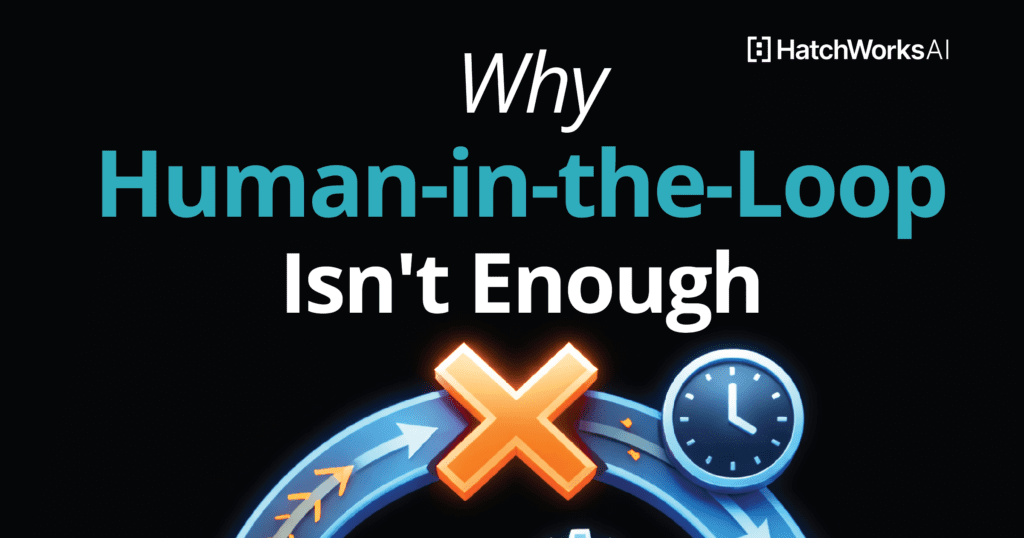
The first wrong answer is to pull the human out of the loop. Accept and ship. The AI moves fast, the code ships fast, and security flaws, convention drift, and architectural debt ship right along with it.
The second wrong answer is to leave the human in the loop but give them nothing to work with. They become a rubber stamp on 200-line diffs they can't meaningfully read. The review is theater. The outcomes look the same as the first answer, just with more meetings.
Neither answer scales. "Human-in-the-loop" is a principle, not a process. It doesn't tell you where in the loop the human sits, what they're deciding, what authority they have to override, or what AI and agents they have alongside them to review at AI speed. Without those answers, the human is either a bottleneck or a bystander.
The fix isn't fewer humans. It's better-equipped humans. Humans who decide at the points where judgment actually matters, and who run AI and agents alongside them to handle the validation, convention checking, and test generation that used to require line-by-line reading. That's what the Execution Loop operationalizes.
The Real Problem: Ungoverned AI Is the Default
Most engineering teams using AI today operate in one of two modes.
Mode 1: Vibe coding. A developer prompts an AI assistant, accepts the output, and ships it. There's no structured review against project conventions. No validation that the generated code matches the architecture. No confirmation step between "AI suggested this" and "this is now in production." The developer is technically in the loop. They're just not doing anything structural while they're there.
Mode 2: Ad-hoc assistance. The team uses GitHub Copilot or Cursor, but every developer configures it differently. There are no shared conventions feeding the AI. No consistent quality gates. The AI generates code that compiles but doesn't follow the team's patterns, because nobody told it what those patterns are.
Both modes have a human in the loop. Neither mode has governed AI development.
The consequences are predictable and measurable. Research consistently shows that AI-generated code carries significantly higher rates of security vulnerabilities, code duplication, and architectural inconsistency than code written with structured oversight. One study found that developers using AI assistants without governance were more likely to ship insecure code. Not because the tools are bad, but because speed removes the friction where mistakes get caught.
The friction that normally exists in software development (writing tests, reviewing changes, documenting decisions) exists for a reason. It's where you catch mistakes.
This isn't an argument against AI-assisted development. It's an argument against unstructured AI-assisted development. The question isn't whether to use AI. It's whether you have a repeatable, governed cycle that makes every AI interaction trustworthy.
What Governed AI Development Actually Looks Like
Generative-Driven Development (GenDD) answers this with a five-step Execution Loop that applies to every task, every role, and every interaction with AI across the SDLC:
Context → Plan → Confirm → Execute → Validate
This isn't a workflow diagram for a wall. It's the operational rhythm that every member of a GenDD Pod runs, whether they're generating acceptance criteria, writing backend services, or producing architecture documentation.
Each step has a specific purpose, a defined human/AI boundary, and a clear output that feeds the next step.
| Step | What Happens | Who Owns It |
|---|---|---|
| Context | AI is loaded with repository-specific conventions, architecture, and constraints via Context Packs | Human sets up; AI consumes |
| Plan | AI proposes an approach: a test suite structure, a refactoring plan, a set of acceptance criteria | AI generates; Human reviews |
| Confirm | Human reviews the plan, adjusts scope, catches misalignment before any code is written | Human decides |
| Execute | AI generates the artifact (code, tests, documentation) governed by the Context Pack | AI generates; Human monitors |
| Validate | Output is checked against conventions, tests are run, and the artifact is verified against acceptance criteria | Human + AI collaborate |
The critical insight: every step produces an artifact that the next step consumes. Context Packs feed the Plan. The Plan feeds the Confirm conversation. The confirmed plan feeds Execution. And Validation produces evidence that either closes the loop or sends it back to Plan.
This is what separates a governed cycle from a vague commitment to oversight.
The Step Most Teams Skip (and Why It Costs Them)
Look at the loop again. The step that distinguishes governed AI development from vibe coding is Confirm.
Confirm is where a human reviews the AI's proposed plan before execution begins. Not after. Not during code review. Before a single line of generated code exists.
Here's what skipping Confirm looks like in practice:
Without Confirm: A developer prompts Cursor to "add payment retry logic." The AI generates 200 lines of code that technically work but use a retry pattern inconsistent with the existing codebase, miss the circuit breaker the team already implemented, and introduce a new dependency the architecture doesn't support. The developer commits it. Code review catches some issues. QA catches others. The rest make it to production.
With Confirm: The same developer prompts Cursor, but the AI (loaded with the project's Context Pack) first proposes a plan: "I'll extend the existing RetryPolicy in Services/PaymentService.cs, use the circuit breaker registered in Startup.cs, and follow the AAA test pattern in testing.md. Here's my approach." The developer reads the plan, confirms alignment, and then the AI executes. The generated code matches the architecture because the plan was validated before execution started.
The difference isn't speed. Both take roughly the same time. The difference is rework. Teams we've worked with, including the Vanco Payment Solutions engagement, consistently find that the primary SDLC constraint is input quality, not engineering speed. When fewer than 15% of stories use acceptance criteria effectively and 10–15% of active work is rework, the bottleneck isn't how fast you can generate code. It's how accurately you can direct the generation.
Confirm solves this. It's the checkpoint where human judgment meets AI capability, before mistakes compound.
Same Loop, Different Inputs: How Each Pod Role Runs It
One of the most common objections to structured AI workflows is that they only work for coding tasks. The Execution Loop disproves this. Every role in a GenDD Pod runs the same five-step cycle. The inputs and outputs change, but the rhythm doesn't.
The Architect's Loop
- Context: Brownfield Analysis documentation, C4 diagrams, architecture.md from the Context Pack
- Plan: AI proposes architecture classification, identifies integration risks, drafts ADR structure
- Confirm: Architect validates the classification, confirms service boundaries, adjusts risk assessment
- Execute: AI generates C4 Mermaid diagrams, tech debt inventory, quality attribute scorecard
- Validate: Architect reviews generated diagrams against deployed reality, confirms accuracy
The Architect Playbook operationalizes this with eight phases that map directly to the loop. The AI doesn't make architecture decisions. It provides the analysis that makes architecture decisions faster and better-informed.
The QA Engineer's Loop
- Context: Gherkin acceptance criteria from the story, testing.md conventions, existing test inventory
- Plan: AI proposes test coverage: which scenarios to cover, which edge cases to include, which test patterns to use
- Confirm: QA reviews proposed coverage against the test gap matrix, adjusts priorities
- Execute: AI generates unit tests (AAA pattern, MethodName_Scenario_ExpectedResult naming), integration tests, and Playwright E2E suites
- Validate: QA runs generated tests, verifies they pass, checks coverage against Definition of Done
The Product Owner's Loop
- Context: Business capability from the Epic, domain terminology from context.md, existing codebase patterns
- Plan: AI proposes structured story with seven sections: user story statement, Gherkin ACs, edge cases, integration impacts, NFRs, test scenarios, technical questions
- Confirm: PO reviews generated ACs, validates edge cases against business intent, adjusts scope boundaries
- Execute: AI formats the Jira-ready output with labels and cross-references
- Validate: ACs are validated against the live application using Playwright MCP before sprint commitment
The pattern holds for every role. Backend developers, frontend developers, DBAs, DevOps engineers, security engineers, tech leads: they all run the same loop with role-specific Context Packs and playbooks. This consistency is what makes the methodology scalable. You don't need 18 different processes. You need one loop and 18 sets of inputs.
Context Packs: The Engine That Makes the Loop Work
The Execution Loop falls apart without quality context. If the AI doesn't know your conventions, your architecture, or your testing standards, even a confirmed plan will produce output that misses the mark.
This is why GenDD uses Context Packs: five standardized markdown files that live in the repository and feed AI tools the specific knowledge they need.
| File | What It Contains | What It Prevents |
|---|---|---|
| agents.md | Security rules, compliance boundaries, forbidden patterns | AI generating code that violates PCI/PII constraints |
| context.md | Business concepts, integrations, domain terminology | AI hallucinating domain logic or missing multi-tenant rules |
| conventions.md | Naming conventions, file structure, error handling patterns | AI generating code that compiles but doesn't match team standards |
| testing.md | Test frameworks, naming patterns, coverage targets | AI writing tests that use the wrong framework or naming convention |
| architecture.md | System type, components, data flow, deployment model | AI proposing solutions that conflict with existing architecture |
Context Packs replace tribal knowledge with machine-readable knowledge. They turn the "context" step of the Execution Loop from "hope the AI figures it out" into "the AI has been explicitly told how this team works."
And they're not static. The GenDD framework includes a recurring Refresh Context Pack playbook that updates these files quarterly or after major changes, because stale context is almost as dangerous as no context.
For teams ready to go deeper on how Context Packs and the full GenDD methodology work together, the GenDD eBook walks through the complete framework with implementation guidance.
The Human/AI Boundary: Not a Line, a Spectrum
The Execution Loop doesn't treat human involvement as binary. GenDD defines three levels of human/AI interaction that apply at every step:
Human Decision. The human makes the call. AI may provide options or analysis, but the decision authority rests with the person. Examples: architecture decisions, release approval, business prioritization, security sign-off.
AI Assist. AI generates a draft, recommendation, or analysis. A human reviews, adjusts, and approves before it moves forward. Examples: acceptance criteria generation, C4 diagram creation, test gap analysis, story enhancement.
AI Automate. AI executes a governed, repeatable task. Human oversight exists but not line-by-line review. Examples: unit test generation from Gherkin ACs, convention validation during PR, release evidence compilation.
The key word in every case is governed. Even AI Automate tasks operate within the constraints defined by Context Packs and validated through the loop's Confirm step. Automation without governance is just faster failure.
This three-tier model maps to every SDLC stage. At Vanco, for example, the boundary is explicit in every playbook:
- Business problem identification → Human Decision
- Epic structuring from bullet points → Human Decision with AI Assist
- Unit test generation from Gherkin ACs → AI Automate with Human Review
- Release GO/NO-GO → Human Decision
The boundary isn't about trust in AI. It's about where human judgment adds irreplaceable value and where AI execution is more consistent, faster, and less error-prone than manual effort.
From 8–12 People to 3 Experts: Why the Loop Enables Smaller Teams
Traditional development teams scale by adding people. More requirements ambiguity? Add a BA. More bugs? Add QA. More integration issues? Add another senior engineer.
The GenDD Pod model flips this. A Pod of three experts (typically an architect/tech lead, a senior developer, and a QA specialist) replaces an 8–12 person team by running the Execution Loop across every role's playbook.
This works because the loop eliminates the activities that require headcount:
- Context Packs eliminate tribal knowledge transfer. New team members don't need 6 months of shadowing. The AI has the same context on day one.
- Structured requirements eliminate refinement thrash. AI-enhanced stories arrive with Gherkin ACs, edge cases, and integration flags. The team doesn't spend sprint time discovering requirements.
- Governed test generation eliminates the manual testing bottleneck. AI generates unit, integration, and E2E tests from structured ACs. QA focuses on exploratory testing and complex edge cases.
- The Confirm step eliminates downstream rework. Plans are validated before execution. Code matches conventions because the AI was told what the conventions are.
The Pod doesn't work harder. It works within a system designed to make every human decision better-informed and every AI execution more precise.
For teams exploring how to adopt this model, the GenDD Training Workshop provides hands-on guidance for building and running Pods within existing organizations.
Start Running the Loop
The Execution Loop isn't theoretical. It's running today across real engagements with real legacy codebases, real compliance constraints, and real delivery pressure.
If your team is using AI without a governed cycle, if "human-in-the-loop" is a slide in your deck but not a structural checkpoint in your workflow, the gap between your AI investment and your AI outcomes will keep growing.
Context → Plan → Confirm → Execute → Validate.
Five steps. One loop. Every role. Every task.
That's governed AI development. And it's the difference between AI that accelerates your team and AI that accelerates your technical debt.