Traditional software teams were built for a world where humans handled everything by hand. More features meant more people. More complexity meant more coordination layers. A typical cross-functional team, with its PM, BA, Scrum Master, three to five developers, Tech Lead, QA Lead, QA Engineers, and DevOps, could easily reach eight to twelve people before a single line of code was written.
That structure made sense when it was designed. But in a world where AI can generate code, draft requirements, create test suites, produce architecture documentation, and scaffold entire projects, it no longer does. More people no longer means more throughput. It means more handoffs, more meetings, more miscommunication, and slower delivery.
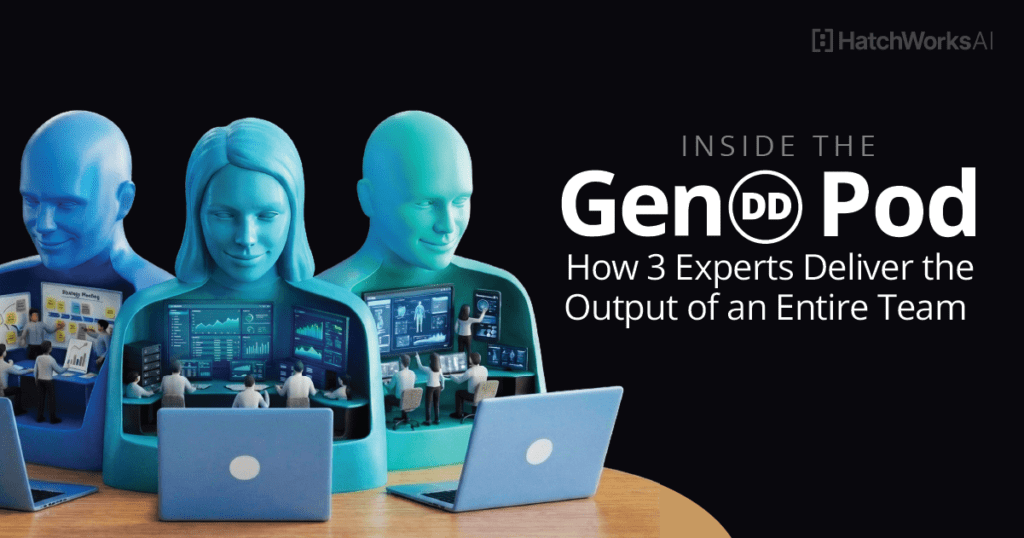
At HatchWorks AI, we've spent the past two years rebuilding the software team model from the ground up through our Generative-Driven Development (GenDD) methodology. The result is the GenDD Pod: a self-contained delivery unit of three experts that consistently delivers the output of an entire traditional team.
This isn't theoretical. We've deployed it across real enterprise engagements, measured the results, and refined the model until it works. Here's how it's structured and why it works.
The Problem with Traditional Team Structures
Before explaining how GenDD Pods work, it's worth understanding why the traditional model breaks down in an AI-native world.
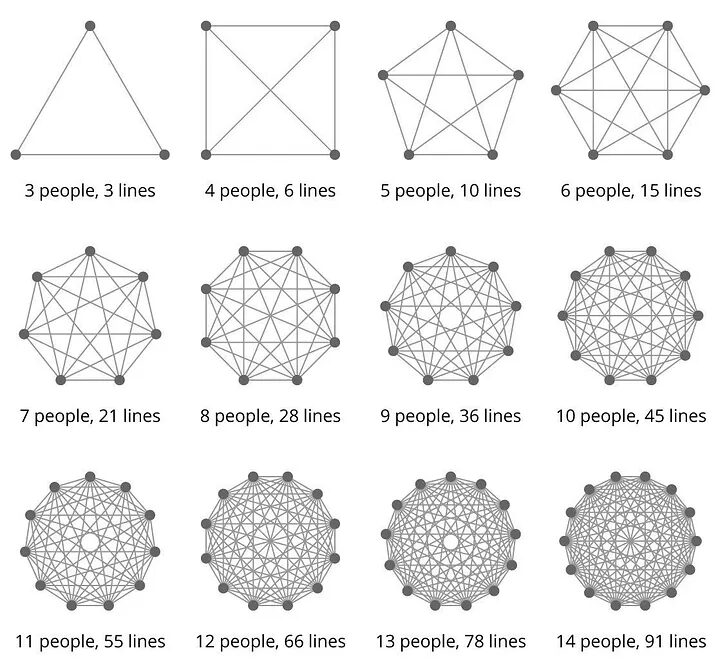
Coordination scales worse than capability. Every new person on a team adds a communication node. A team of 5 has 10 possible communication paths. A team of 10 has 45. A team of 12 has 66. As teams grow, an increasing percentage of everyone's time goes to meetings, status updates, Slack threads, and handoff documentation rather than building the product.
Specialization creates silos. When roles are narrowly defined, work flows linearly: product hands off to design, design hands off to engineering, engineering hands off to QA, QA hands off to release. Each handoff is an opportunity for context loss, misalignment, and delay.
AI changes the capability math. A single engineer working inside the GenDD Execution Loop (Context, Plan, Confirm, Execute, Validate) can now produce the architectural design, implementation, documentation, and unit tests that previously required a Tech Lead and three to five developers. A single QA engineer with AI-generated test suites can cover what previously required a QA Lead, multiple QA Engineers, and dedicated DevOps support. The bottleneck is no longer how many hands you have. It's how well those hands are orchestrating AI.
This is why GenDD doesn't try to augment the traditional team structure. It replaces it with something fundamentally different.
The GenDD Pod: Three Roles, Complete Coverage
A GenDD Pod is a self-contained delivery unit built around three core roles. Each one is a full-lifecycle owner for their domain, powered by AI agents and operating inside the GenDD Execution Loop.
| Agentic Product Lead | Agentic Engineer | Agentic QA Engineer |
|---|---|---|
| Full product lifecycle using GenDD and AI agents. Requirements & user stories. Sprint planning & acceptance. Stakeholder comms & BA. | Full development lifecycle using GenDD and AI agents. Architecture & system design. Code generation & implementation. Documentation & deployment. | Full quality lifecycle using GenDD and AI agents. Test strategy & automation. Security review & regression. Release validation & DevOps. |
| Replaces: PM, BA, Scrum Master | Replaces: 3-5 Developers, Tech Lead | Replaces: QA Lead, QA Engineers, DevOps |
One GenDD Pod (3 people) replaces the traditional cross-functional team of 8-12.
This isn't a skeleton crew doing less work. It's a fundamentally different operating model where AI handles the execution load that previously required headcount, and humans focus on the decisions that require judgment, domain expertise, and strategic thinking.
The Three Roles, In Depth
The Agentic Product Lead
Builds on: Product Manager, Business Analyst, Scrum Master
The Agentic Product Lead is the connective tissue between business intent and AI-powered execution. They own the full product lifecycle: defining what success looks like, translating business needs into structured requirements, managing sprint planning and stakeholder communication, and ensuring that what gets built aligns with what the business needs.
In a traditional team, this work was spread across three to four people. The PM defined the vision. The BA translated it into requirements. The Scrum Master managed ceremonies and delivery flow. In a GenDD Pod, one person handles all of this because they're deploying and orchestrating specialized AI agents that handle the execution-heavy parts of each function.
The agents they orchestrate: The Agentic Product Lead doesn't just "use AI" to write better stories. They deploy purpose-built agents for specific product functions. A requirements enrichment agent transforms vague business requests into structured epics with Gherkin acceptance criteria, edge cases, integration flags, and test scenarios. An acceptance criteria validation agent uses Playwright to verify that ACs are actually testable against the live application before the sprint even starts. A backlog analysis agent reviews story quality against Definition of Ready standards, flagging stories that would cause mid-sprint discovery if they entered a sprint as-is.
These agents work in coordination. The output of the requirements enrichment agent feeds into the validation agent, which feeds findings back to the Product Lead for refinement. The loop between human judgment and agent execution is continuous, not sequential. Instead of writing six bullet points and hoping engineering figures out the details, the Product Lead orchestrates a system that produces delivery-ready stories with far more rigor than manual processes allowed.
What matters most: Strategic thinking rooted in business outcomes, the ability to configure and orchestrate product-focused agents, and the discipline to validate agent-generated plans against real user needs. The skill isn't prompting; it's knowing which agents to deploy, in what sequence, and when to override their output with human judgment.
The Agentic Engineer
Builds on: Software Developer, Tech Lead, 3-5 Developers
The Agentic Engineer owns the full development lifecycle: architecture, system design, code generation, implementation, documentation, and deployment. They're not writing every line of code themselves. They're deploying and coordinating a network of specialized agents that handle different functions across the development workflow, while focusing their own energy on architecture decisions, integration design, and intent-setting.
This is the role where the compression ratio is most dramatic, and where agent orchestration is most visible. A single Agentic Engineer working inside the Execution Loop doesn't just prompt an AI IDE and review the output. They coordinate multiple agents working in parallel and in sequence across the full development pipeline.
"I haven't written a line of code in 3 months, but I've shipped 6 months of work. GenDD changed what my job is."
— Josue Alpizar, Software Engineer, HatchWorks AI
The agents they orchestrate: A coding agent generates implementation code governed by Context Packs, so every line matches the repository's actual patterns, naming conventions, and architectural constraints. An architecture analysis agent (the Brownfield Analysis Engine) reverse-engineers legacy codebases through a four-pass process: scanning the repository structure, inferring architecture patterns and data ownership, presenting findings for human validation, and producing a comprehensive documentation pack. A documentation agent generates and maintains technical documentation from the codebase itself, so docs stay current as the code evolves. A unit test generation agent creates test suites alongside implementation, following the project's testing patterns (AAA format, proper mocking, naming conventions).
The critical insight is that these agents don't work in isolation. The architecture agent's output feeds into the coding agent's Context Pack, which governs what the coding agent produces. The coding agent's output triggers the test generation agent. The documentation agent watches for changes and updates docs accordingly. The Agentic Engineer designs this coordination, sets the constraints for each agent, and reviews the outputs at each step of the Execution Loop. They're building systems of agents, not just running individual prompts.
What matters most: Strong technical fundamentals (architecture, systems thinking, security awareness), the ability to design multi-agent workflows where each agent's output feeds the next, and the judgment to know when an agent's output needs human correction versus when it can flow directly to the next agent in the chain.
The Agentic QA Engineer
Builds on: QA Lead, QA Engineers, DevOps, Release Management
The Agentic QA Engineer owns the full quality lifecycle: test strategy, test automation, security review, regression testing, release validation, and DevOps. This is the role that ensures AI doesn't accelerate broken code into production. And like the other Pod roles, they do it by deploying and orchestrating specialized agents across the quality pipeline.
In many traditional teams, QA operates as a downstream safety net, discovering requirements via bugs rather than validating expected behavior. The Agentic QA Engineer flips this entirely. They work alongside the Product Lead and Engineer from the start, deploying quality-focused agents that run continuously throughout the sprint, not just at the end.
The agents they orchestrate: A test generation agent creates unit tests, integration tests, and end-to-end test suites from structured acceptance criteria, following the project's testing frameworks and patterns. A Playwright-based browser agent navigates the live application to discover UI elements, generate Page Objects, validate that acceptance criteria are actually testable, and produce E2E test specs. A test gap analysis agent inventories existing tests, maps what should exist against what does, and produces a prioritized coverage matrix with a sprint-by-sprint remediation roadmap. A security scanning agent flags OWASP Top 10 patterns, identifies dependency vulnerabilities, and surfaces security concerns during development rather than at the release gate. A delta analysis agent evaluates the impact of code changes between releases, mapping what changed to what documentation, tests, and risk areas need attention.
These agents also work in coordination with the agents deployed by the other Pod roles. The structured acceptance criteria produced by the Product Lead's requirements agent feed directly into the QA Engineer's test generation agent. The coding agent's output triggers the test gap analysis agent to verify coverage. The delta analysis agent's findings inform both the QA Engineer's release readiness assessment and the Engineer's documentation updates. Quality isn't a phase at the end of the pipeline; it's an agent-powered system running throughout.
What matters most: Deep understanding of software quality and risk, the ability to design and coordinate quality-focused agent workflows that catch issues upstream rather than downstream, and the critical thinking to focus human attention on exploratory testing and edge cases that agents can't anticipate.
Optional: The Agentic Designer
Builds on: UX Designer, Product Designer
Not every project requires a dedicated designer, but when you need exceptional UX and UI for an external-facing application, the Agentic Designer joins the Pod. They work inside the team rather than ahead of it, shaping the user experience in lockstep with development rather than handing off specs and hoping intent survives.
They use AI to explore interaction patterns, generate UI variants, prototype at speed, and validate design decisions as features are being built. The role ensures that rapid AI-powered development doesn't compromise usability. It requires strong design instincts paired with the ability to guide AI tools toward outcomes that make sense for real users.
The Bigger Picture: Agents Working in Coordination
The key to understanding why three people can deliver the output of twelve isn't just that each person uses AI. It's that each person deploys specialized agents that work in coordination across the entire Pod.
The Product Lead's requirements enrichment agent produces structured stories with Gherkin ACs and integration flags. Those structured stories feed directly into the Engineer's coding agent (which knows what to build) and the QA Engineer's test generation agent (which knows what to verify). The Engineer's architecture agent produces documentation that updates the Context Packs, which govern what every other agent in the system produces. The QA Engineer's delta analysis agent evaluates changes that trigger documentation updates from the Engineer's documentation agent.
This is not a linear handoff chain. It's a network of agents coordinated by three humans, each operating inside the Execution Loop, each setting context and validating output at their layer. The agents handle the volume. The humans handle the judgment. And because the agents share context through structured artifacts (Context Packs, Gherkin ACs, architecture docs), their outputs are consistent and cumulative rather than fragmented and redundant.
This is why the Pod model works at a ratio that seems impossible from the outside. It's not three people doing the work of twelve. It's three people orchestrating a coordinated system of agents that collectively covers what twelve people used to handle manually.
How Every Pod Member Works: The Execution Loop
The structure of the Pod matters, but what makes it work is how each member operates. Every person in a GenDD Pod runs inside the same five-step cycle on every task:
Context (Human) → Plan (AI) → Confirm (Human) → Execute (AI) → Validate (Human + AI)
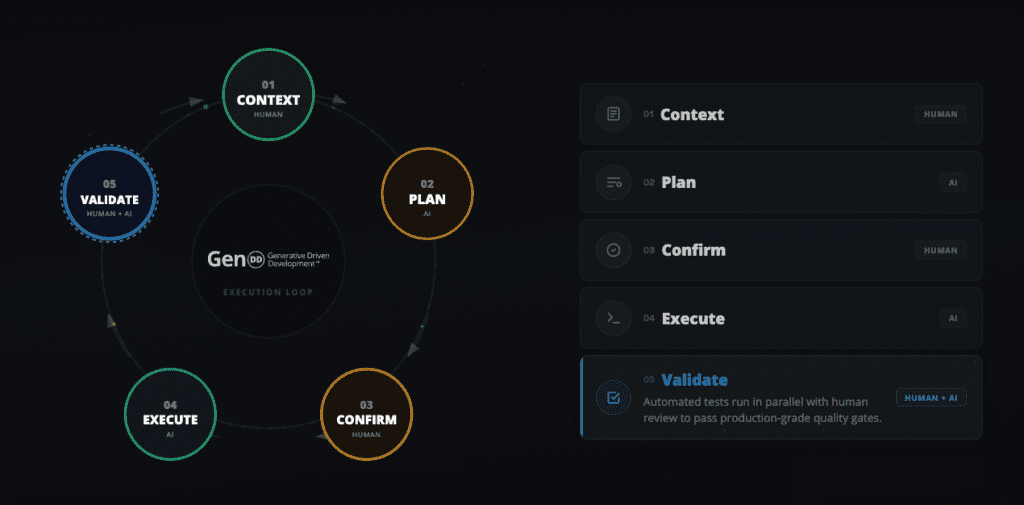
The human provides context and makes decisions. AI plans, generates, and executes. Both participate in validation. This loop is the same whether the Product Lead is generating acceptance criteria, the Engineer is producing architecture documentation, or the QA Engineer is creating a test suite. The inputs and outputs change; the governed cycle stays the same.
This is what separates GenDD from vibecoding. Skipping the Confirm step means AI executes without human validation. Skipping Validate means output ships without verification. The loop makes GenDD both fast and safe.
Here's what the loop looks like for each role:
| Step | Product Lead | Engineer | QA Engineer |
|---|---|---|---|
| Context | Business goals, user needs, stakeholder priorities | Architecture constraints, codebase conventions, tech stack | Quality requirements, risk areas, acceptance criteria |
| Plan | AI drafts structured stories with ACs, edge cases, flags | AI proposes implementation approach, architecture patterns | AI suggests test strategy, coverage priorities, automation plan |
| Confirm | Reviews AI-drafted stories, adjusts scope boundaries | Reviews proposed approach, validates architecture decisions | Reviews test plan, confirms coverage priorities |
| Execute | AI generates final requirements, sprint artifacts | AI generates code, docs, unit tests | AI generates test suites, runs automated testing |
| Validate | Confirms stories meet Definition of Ready | Code review, architecture alignment check | Confirms all ACs are validated, DoD criteria met |
The Human/AI Boundary: Who Decides What
One of the most important concepts in GenDD is that the division of labor between humans and AI is explicit, not improvised. Every activity across the SDLC is classified into one of three tiers:
HUMAN DECISION: Activities that require judgment, domain expertise, or approval authority. AI cannot and should not replace these. Examples: business problem identification, product strategy, release approval, complex design decisions.
AI ASSIST: Activities where AI generates drafts, analyses, or recommendations that a human reviews and approves. Examples: acceptance criteria generation, architecture documentation, PR descriptions, test strategy recommendations.
AI AUTOMATE: Activities where AI executes governed, repeatable tasks with human oversight but not line-by-line review. Examples: unit test generation, release evidence compilation, documentation updates, test gap analysis.
This framework gives every team member clarity on where they add irreplaceable value and where AI should be doing the heavy lifting. It also gives enterprise leaders the governance model they need to adopt AI responsibly at scale. When someone asks "how do you make sure AI isn't making decisions it shouldn't be making?" the three-tier model is the answer.
What Makes Pods More Effective Than Traditional Teams
Fewer handoffs. Three people collaborating continuously means fewer opportunities for context loss. There's no hand-off from PM to BA to Scrum Master. There's no waiting for the QA team to pick up what engineering finished last sprint. The Pod works as a single unit with shared context.
Governance built into the cycle. Every output is verified, every decision is human-led. The Execution Loop makes governance structural rather than aspirational. You don't need to add a governance layer on top of the team because governance is how the team works.
Lower total engagement cost. A three-person Pod costs a fraction of what eight to twelve fully loaded team members cost. When you compare the total engagement cost of a Pod sprint against the monthly burn rate of a traditional cross-functional team (PM, BA, Scrum Master, developers, QA, DevOps), the math isn't close. You're getting more output at a fraction of the cost, and you can start with a short Pilot Sprint to prove the model before scaling up.
Scaffolding makes Pods even faster. When a client has done GenDD SDLC Scaffolding before engaging a Pod, the results are dramatically better. The Pod inherits Context Packs (so AI knows the client's codebase conventions from day one), architecture standards, code templates, and testing frameworks tailored to the client's environment. Faster ramp, higher quality, lower risk. For brownfield codebases, we recommend Scaffolding in parallel with the first Pod sprint.
Proven in Real Engagements
This model isn't theoretical. Here's what GenDD team structures have delivered:
Xometry (Marketplace Platform)
A small team using GenDD methodology measured against pre-training baselines. Results: 347 hours saved, 40%+ efficiency gains across four workstreams. Infrastructure as code went from 120 hours to 15 hours (87% savings). Backlog generation went from 80 hours to 4 hours (95% savings).
Vanco (Payment Solutions Provider)
The most comprehensive GenDD deployment to date. HatchWorks trained 180 people across 8 role-specific tracks, then delivered full SDLC Scaffolding that produced 41 production-ready deliverables, including 18 role-specific playbooks, 12 on-demand playbooks, and the complete VancoSDLC Framework covering all six SDLC stages with explicit Human/AI boundaries.
"My teams have been incredibly enthusiastic. There has been a noticeable spike in engagement, curiosity, and excitement about how we can apply GenDD in our workflows. If all goes according to plan, this will truly be a transformative year for the Vanco Product and Technology teams."
— Mandy Iverson, VP of Software Development, Vanco
ALTAS AI (AI Product Build)
A greenfield product build from zero to production using GenDD workflows. Integration delivery was cut from 20 days to under 5, a 75% reduction.
Internal (HatchWorks AI)
We use GenDD on everything we build. Our internal dashboard tracks the methodology in real time: 17 hours of human effort generating 800 hours of AI-reclaimed time, a 94% productivity increase, and a 2.2x velocity index above baseline.
Skills Your Team Needs to Work This Way
Every role in a GenDD Pod comes with its own specialized skills, but there are core competencies the entire team must share:
Prompt fluency: The ability to write clear, structured prompts that guide AI behavior, whether generating code, tests, requirements, or documentation.
Orchestration thinking: Understanding how to sequence AI workflows, set constraints, and coordinate multi-agent systems toward a goal. This is fundamentally different from writing code yourself.
Context design: The skill of providing AI with rich, accurate, structured context. This includes knowing what information AI needs, how to format it, and how to maintain it over time through Context Packs.
Verification discipline: The habit of reviewing every AI output against requirements, architecture standards, and business logic before it ships. Speed without verification is vibecoding.
Technical fundamentals: AI writes code, but someone still needs to review it, debug it, refactor it, and understand the system it runs in. Programming fluency, architecture knowledge, and security awareness remain essential.
Strategic alignment: AI can execute, but it can't align work to your business strategy. Every team member needs to understand how their work drives outcomes, not just outputs.
Learning agility: The tools change fast. The models improve quarterly. The best teams embrace change, evolve their workflows, and keep their skills sharp.
How to Start Building This Way
You don't have to overhaul your entire organization at once. GenDD is designed with multiple entry points that meet you where you are:
Start with a GenDD Workshop
Get your team speaking the same language. Our workshops are hands-on training on your real codebase, not generic theory. Role-specific breakouts for PMs, engineers, and QA. Your team walks away understanding the Execution Loop, the Human/AI boundaries, and how to apply GenDD in their daily work.
Embed a Forward Deployed GenDD Engineer
If your team has seen the potential but needs hands-on help building the habits, a Forward Deployed GenDD Engineer ships alongside your developers in real sprints. They coach GenDD workflows as they happen and build the practices that stick. When they leave, your team is permanently more productive.
Scaffold Your Environment
If your codebases are inconsistent, undocumented, or not set up for AI-native development, GenDD SDLC Scaffolding produces the Context Packs, architecture standards, golden paths, and governance frameworks your teams need. A six-week engagement that transforms how your entire organization builds software.
Start with a GenDD Pod
Have a project with a deadline? Start with a Pilot Sprint: 80 hours, $16,000, low commitment. It proves the model on one real workstream. Upgrade to a Build Sprint (200 hours) or Scale Sprint (400 hours) when you're ready. No long-term contracts. Upgrade anytime.
The best starting point depends on where you are. Teams that are new to GenDD usually start with a Workshop. Teams that need to ship now start with a Pod. Teams with brownfield environments start with Scaffolding. We'll help you figure out the right entry point.
Ready to Build with a GenDD Pod?
The traditional 8-12 person team structure was designed for a pre-AI world. GenDD Pods are designed for how software actually gets built today: AI executes, humans direct and validate, governance is built into every cycle.
In our GenDD Training Workshop, we take a tailored approach, helping you redesign your team roles, workflows, and delivery models around the GenDD methodology. Your teams will learn how to make GenDD part of their daily development, integrate AI into their existing stack, and build a repeatable system for AI-native delivery.
Fill out the form, and let's get your team building the GenDD way.