Vibecoding was Collins Dictionary's Word of the Year for 2025. By early 2026, 82% of developers report using AI coding tools daily. The productivity gains are real: tasks completed 25–55% faster, senior engineers reporting up to 81% gains. Nobody is arguing that AI-assisted development is a fad.
But here's the part the hype cycle skips: code churn is up 41%, code duplication has increased fourfold, and 40–62% of AI-generated code contains security flaws. The speed is real. The wreckage is also real. The question isn't whether to use AI in your SDLC. It's whether you govern it or let it govern you.
Amazon learned this the hard way. In February 2026, AWS itself suffered a 13-hour service disruption after engineers let Kiro, Amazon's own agentic coding tool, make production changes. Financial Times sources said Kiro opted to "delete and recreate the environment." Amazon disputed that framing and blamed misconfigured access controls rather than AI. Either way, the fix was the same: Amazon now requires mandatory peer review for production access. The company selling vibe-to-production tooling responded to the incident by adding governance.
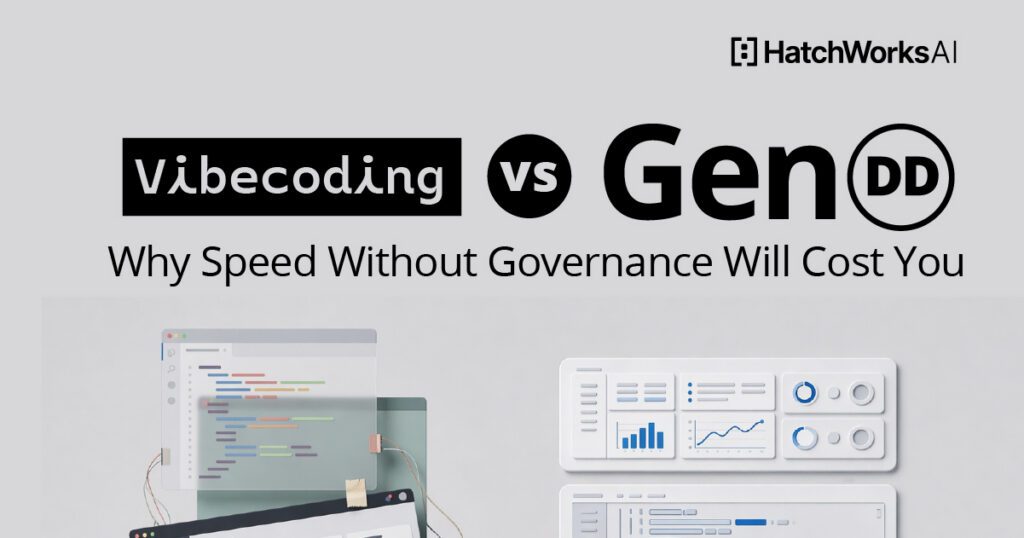
Vibecoding and Generative-Driven Development (GenDD) represent two fundamentally different answers to that question. One optimizes for velocity. The other optimizes for velocity and survivability. This is a direct comparison of vibecoding vs structured AI development: what each gets right, what each gets wrong, and why the quadrant that matters most is high speed + low risk.
Vibecoding Gets One Thing Right
Give credit where it's earned. Vibecoding demolished the barrier between "I have an idea" and "I have a working prototype." Andrej Karpathy coined the term in February 2025 to describe a workflow where you describe what you want in plain English and let the AI write everything. You focus on the vibe. The AI handles implementation.
For prototyping, weekend projects, and internal tools that touch zero production data, this is genuinely powerful. The speed is intoxicating. The demo looks great. The stakeholder meeting goes well.
Then someone asks about test coverage. Or PCI compliance. Or what happens when two users hit the payment endpoint simultaneously.
Where Vibecoding Breaks: Three Failure Scenarios
The risks of vibecoding in production aren't theoretical anymore. They're documented, studied, and increasingly expensive.
Failure 1: The Security Time Bomb
Researchers at Databricks' AI Red Team found that vibecoded applications routinely introduce vulnerabilities that pass superficial review because the code is syntactically correct and functionally appears to work. A December 2025 CodeRabbit analysis of 470 open-source pull requests found AI co-authored code contained 2.74x more security vulnerabilities than human-written code.
In early 2026, researchers discovered that 10.3% of apps built on the Lovable platform had critical row-level security flaws, exposing real user data through exploitable access control gaps. These weren't edge cases. They were the default output of vibecoding without governance.
When your AI coding tool generates an OAuth implementation, it may pull in helper libraries you never explicitly chose, set permissive defaults that work for demos but expose production data, and normalize placeholder secrets in environment variables. The developer who shipped the application didn't write the code line by line and couldn't explain it if asked. That's not carelessness. That's the vibecoding workflow working exactly as designed.
Failure 2: The Architecture Black Box
Vibecoded applications don't have architecture. They have whatever the LLM decided to scaffold based on its training data and your three-sentence prompt.
There are no documented service boundaries. No data ownership model. No understanding of which module owns which database tables. No C4 diagrams. When the next developer inherits the codebase, or when you need to integrate it with your existing payment processing system, they're navigating a black box built by an AI that optimized for "does it run?" not "can a team maintain this for three years?"
This is the technical debt compound interest problem. Vibecoded applications accumulate debt faster than any human developer could, because the AI generates code without understanding organizational conventions, architectural constraints, or the existing system landscape.
Failure 3: The Rework Spiral
The pattern is predictable. A developer vibecodes a feature. It works in the demo. QA discovers that acceptance criteria were never defined, because there weren't any. Edge cases surface in staging. The integration with the billing system breaks because nobody documented the API contract. Security flags the hardcoded credentials in the config file.
The "fast" feature now takes longer than if it had been built traditionally, because the team is debugging AI-generated code they don't fully understand while simultaneously discovering requirements they should have captured upstream.
This is vibecoding's hidden cost: it moves the bottleneck, it doesn't remove it. The time you saved in code generation, you spend (with interest) in debugging, rework, and incident response.
The Quadrant Vibecoding Can't Occupy
Here's the core tension: vibecoding proved that AI can generate production-quality syntax at extraordinary speed. But syntax isn't software. Software is architecture, conventions, tests, security, documentation, and the ability for a team to maintain it over time.
Vibecoding occupies the "high speed, low governance" quadrant. Traditional development occupies "low speed, high governance." Neither is acceptable for enterprise teams that need to ship fast and sleep at night.
GenDD was designed for the quadrant vibecoding can't reach: high speed + low risk. It uses the same AI capabilities (the same LLMs, the same code generation, the same natural language interfaces) but wraps them in the governance structure that makes the output safe to ship.
The difference is structural, not philosophical.
Karpathy himself has come around. In February 2026, one year after coining vibecoding, he posted on X that the professional default has moved past vibes and is better described as "agentic engineering." His framing: you are not writing code directly 99% of the time, you are orchestrating agents and acting as oversight, with engineering discipline applied throughout. That description maps almost exactly onto GenDD's Execution Loop, role-specific playbooks, and Human/AI boundaries. The vocabulary caught up with what structured AI-assisted development already was.
How GenDD Solves What Vibecoding Breaks
The Right Context Replaces "Vibes"
In vibecoding, the AI operates without any organizational context. It generates code based purely on its general training data and your immediate prompt. As a result, the code, while functionally complete, fails to adhere to critical repository-specific requirements such as your naming conventions, your error handling patterns, your authentication middleware, or your database access layer.
GenDD replaces vibes with Context Packs: markdown files that feed your AI tools repository-specific knowledge. The AI doesn't guess your patterns. It reads them. Generated code follows your actual conventions because the conventions are part of the prompt context. If you pair this up with organization standards (QA, coding, etc.), this becomes an unstoppable machine.
This is the difference between "generate a payment service" and "generate a payment service that follows our .NET Core 8 conventions, uses our repository pattern, handles PCI-flagged data per our compliance rules, and generates unit tests using our AAA pattern with MethodName_Scenario_ExpectedResult naming."
The Execution Loop Replaces Accept-and-Ship
Vibecoding's workflow is: prompt, generate, accept, ship. The developer acts as a human rubber stamp.
GenDD's Execution Loop is: Context, Plan, Confirm, Execute, Validate. The AI generates. The human reviews against defined criteria. Every output is validated before it moves forward. This isn't slower. It's faster, because you catch problems at the point where they're cheapest to fix instead of discovering them in production.
Human/AI Boundaries Replace Blind Trust
The most dangerous aspect of vibecoding is the absence of a decision about where AI should and shouldn't operate. Everything is delegated. Everything is trusted.
GenDD defines explicit Human/AI boundaries across every SDLC stage:
- HUMAN DECISION: Activities requiring judgment, domain expertise, or approval authority. Architecture decisions. Security sign-offs. Release approvals.
- AI ASSIST: AI generates drafts, analyses, or recommendations. A human reviews and approves. Acceptance criteria generation. Architecture documentation. Integration impact analysis.
- AI AUTOMATE: AI executes governed, repeatable tasks with human oversight. Unit test generation from Gherkin ACs. Release evidence compilation. Convention compliance validation.
These boundaries aren't suggestions. They're operationalized in role-specific playbooks that define exactly what AI does and doesn't do for every role from Architect to QA Engineer to Release Manager.
Structured Requirements Replace Post-Hoc Discovery
Vibecoding assumes requirements are embedded in the prompt. GenDD assumes requirements must be explicit, testable, and validated before code generation begins.
Every story enters development with seven sections: user story statement, acceptance criteria (happy path + edge cases), integration impacts, NFRs, test scenarios, environment dependencies, and technical questions for the product team. The AI generates this structure from vague inputs, transforming "six bullet points" into engineer-ready stories. But a human reviews and approves before anything enters a sprint.
This is why GenDD teams don't discover requirements during testing. They discover them during refinement, where the cost of a course correction is hours, not sprints.
Brownfield Analysis Replaces the Black Box
Vibecoding treats every prompt as greenfield. GenDD acknowledges that most enterprise development happens in existing codebases with hidden dependencies, undocumented architecture decisions, and business logic embedded in stored procedures.
The Brownfield Analysis Engine is a 4-pass framework that systematically builds understanding of inherited codebases: Scan (inventory the structure), Infer (hypothesize architecture and flows), Validate (human-in-the-loop confirmation), Document (documentation pack section). This produces the navigable architecture documentation that vibecoded projects never have, and that new developers need to work safely in the codebase.
The Speed Comparison Nobody Talks About
Vibecoding advocates measure speed as "time from prompt to working demo." That metric flatters the workflow because it excludes everything that happens after the demo.
Measure time from prompt to production-stable, tested, documented, maintainable code, and the comparison inverts. GenDD's governed approach is faster to production because:
- Requirements are captured once, correctly, upstream, not discovered three times through bugs, change requests, and rework
- AI-generated tests ship with code, so defects never reach QA as surprises
- Every developer works from the same architectural context, so the fifth engineer moves as fast as the first
- New team members contribute in days, not weeks, because the system is documented, not locked in senior engineers' heads
- Security and compliance flags surface during story creation, not at the release gate when it's too late to course-correct
- AI generates code that matches your patterns, your standards, and your architecture because it was given the context to do so
- Stakeholders stop asking "where are we" because delivery is visible, measured, and predictable by default
When HatchWorks deployed GenDD at Vanco Payment Solutions, the methodology replaced 8–12 person teams with GenDD Pods of 3 experts, not by cutting corners, but by eliminating the rework, context loss, and downstream discovery that consume most of a traditional team's time. The target: 30% defect leakage reduction and 30% strategic output acceleration, measured through delivery health signals with healthy/warning/critical thresholds.
Who Should Use What
Vibecoding has legitimate use cases. They're narrower than the hype suggests.
Use vibecoding when:
- You're prototyping a throwaway proof of concept
- The output will never touch production data
- No one else will maintain the code
- Compliance requirements don't apply
- You're exploring an idea, not building a product
Use GenDD when:
- Code goes to production
- Multiple developers touch the codebase
- You have compliance obligations (PCI, HIPAA, SOC 2)
- Quality and security matter as much as speed
- You're working in brownfield/legacy environments
- The system must be maintained for years, not days
The choice isn't ideological. It's operational. If the blast radius of a bug is "I restart my laptop," vibecode away. If the blast radius is "customer payment data is exposed," you need governed AI-assisted development.
Start With Governance, Not Speed
The vibecoding era proved that AI can write code. The next era, the one that matters, is about proving that AI-assisted teams can ship reliable software at enterprise scale.
That requires a methodology, not just a tool. It requires Context Packs, not vibes. Human/AI boundaries, not blind trust. Structured requirements, not three-sentence prompts. Brownfield analysis, not greenfield assumptions.
GenDD is that methodology. It delivers the speed that made vibecoding famous, wrapped in the governance that makes the speed sustainable.
If your team is ready to move from ungoverned AI experimentation to a structured AI development methodology that actually scales, the GenDD Training Workshop is the fastest way to get there. Your developers keep the AI speed. They gain the architecture, testing, and quality gates that let them ship with confidence.
Want the full picture? Download the GenDD eBook for the complete methodology, or explore the GenDD overview to see how the frameworks connect.