AI got very good at coding first, and the reason is less flattering than it sounds. Coding is work where the machine can check its own answer. The test passes or it doesn’t. The build compiles or it doesn’t. Almost nothing else people do all day comes with a test suite, not strategy, not brand voice, not a hiring call, not a pricing decision. That is the boundary the entire agent economy is now walking up to, and whoever crosses it first gets to rewrite what a company looks like.
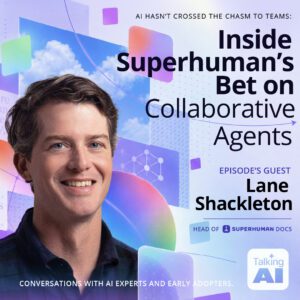
In this episode of Talking AI, Matt Paige sits down with Jay Hack, Head of AI at ClickUp and the founder of Codegen, one of the early autonomous coding-agent companies, which ClickUp acquired in late 2025. Jay spent years on the frontier of engineering automation and came away with a claim that sounds small and isn’t: a coding agent is just a general-purpose agent. The code was never the point. The loop was.
The conversation covers why the best coding model tends to be the best model at everything, why the era of token maxing is ending and what a hard compute cap actually does to a team, how ClickUp turns a company’s docs, chats, and meetings into a context engine, why verification rather than generation is now the bottleneck on shipping, and what happens to an org chart when the scarcest resource on the team is high agency.
In this episode, you’ll hear about:
- Why verifiability made software engineering the first domain AI genuinely transformed
- Positive transfer, and why getting better at code makes a model better at everything else
- What happened when Jay asked one model a question and it spawned 200 sub-agents to answer it
- The coming compute-budget reckoning, and why a cap wouldn’t dent day-to-day productivity
- A marketplace for ideas: allocating compute to people based on the quality of their pitch
- Ultra coding, and the class of project that went from impossible to routine
- The data silos problem, and why Jay sold Codegen to a company that already owned the context
- Roll-ups, and using cheap models to distill signal so the expensive model never reads the noise
- What ambient context does to onboarding, alignment, and the five-meetings-a-day habit
- Hiring for high agency in an agent-first org
- Why building ten features doesn’t mean shipping ten features
- The zero-person company, and Jay’s timeline for it
Key Moments
- 00:00:00 Matt’s intro: what happens when the work has no verifiable answer
- 00:01:30 Why coding went first: verifiability, low stakes, and Stack Overflow
- 00:04:37 “Build me Netflix”: level five self-driving for software engineering
- 00:07:02 Positive transfer: why the best coding model is the best model at everything
- 00:10:08 Fable spins up 200 sub-agents nobody asked for
- 00:11:00 A marketplace for ideas: how compute gets allocated inside a company
- 00:13:43 The a16z claim that humans are now cheaper than software
- 00:14:04 The $10K-a-month token cap, and why productivity wouldn’t drop
- 00:15:00 Ultra coding, and the projects that went from impossible to routine
- 00:17:17 Context is everything: the data silos problem and why he sold Codegen
- 00:19:00 Roll-ups: cheap models distilling signal so the expensive one skips the noise
- 00:22:00 Why ClickUp, and the realization that a coding agent is just a general-purpose agent
- 00:24:01 When context goes ambient: the org as a brain that finally sobers up
- 00:31:51 Agent pilled: hiring for an era of valid chess moves
- 00:33:00 High agency is the scarcest resource on your team
- 00:34:20 Why any roadmap past three months is performative
- 00:36:06 Ten features is not ten shipped features: verification is the bottleneck
- 00:37:56 Does human in the loop still matter? The zero-person company