OpenRouter's wallet-share data crossed back in early September 2026. For the first time since February 2024, users on the platform spent more on OpenAI models than Anthropic's. Astra alone accounted for 19% of spend in the week of September 7.
HatchWorks AI partners with both labs, which gives us a close view of how client questions move along with that spending.
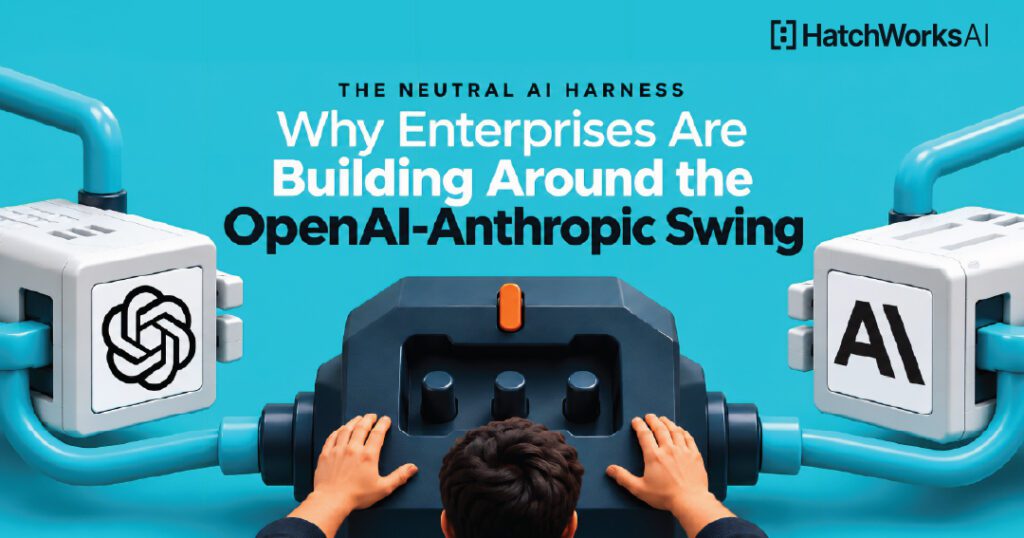
That swing is why more clients are asking us for a neutral AI harness: the skills, tool connections, memory, guardrails, routing, and evaluations around a model, built so the model underneath can change without the rest of the system changing with it.
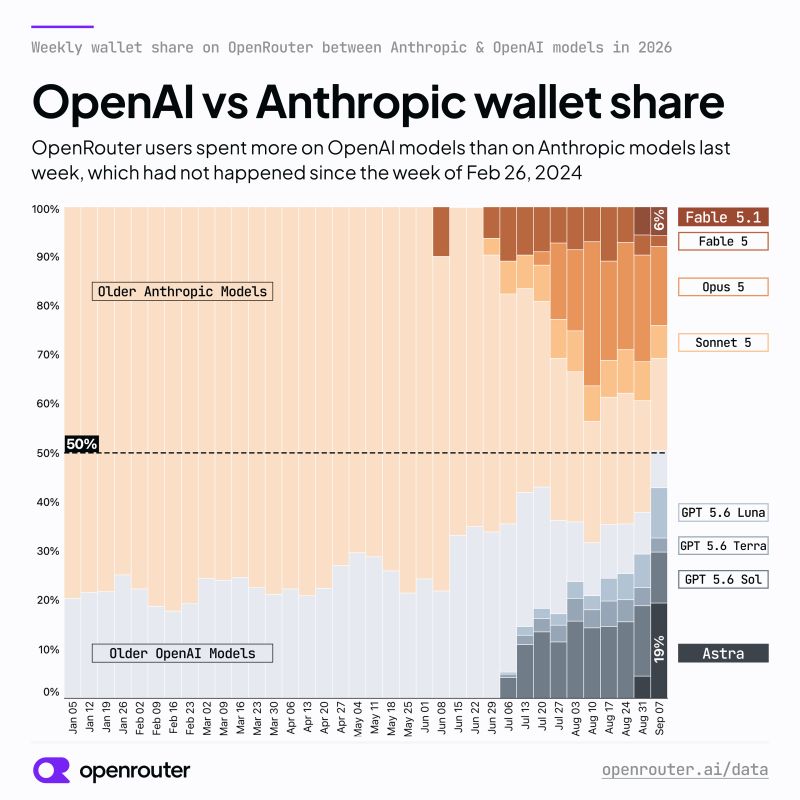
Source: openrouter.ai/data
The chart shows where developers are actually putting money across models. And that signal moved again.
The lead keeps changing
A year ago, our client conversations were split between ChatGPT and Claude. By early 2026, that had flipped toward Claude almost entirely, especially for coding and agentic work. It held through the summer.
Now OpenAI is back at the center of many of those conversations.
Whichever model a team has built around, the next release cycle can move the ground under it. One model gets better at coding, another gets cheaper, context windows expand, and tool use improves. A model that wasn't in the conversation six months ago suddenly becomes competitive for a production workload.
That exposure keeps showing up with clients regardless of which model they started with.
What it costs to keep switching
A team that has spent the past year building agent workflows around one lab's model has more sunk into that choice than the model itself.
The skills that tell the agent how to approach a task, the tool and data connections wired in, the context and memory handling, and the guardrails that decide what runs without a person watching are all tuned to how that specific model reasons and where it tends to fail.
Switching models means testing those assumptions again against a system that behaves differently. It also tends to expose just how many prompts, guardrails, fallbacks, and workarounds were built specifically around the previous model.
The API change may take an afternoon, but making sure the system still works the way the business expects can take a lot longer.
We're seeing that cost across client engagements this year, on whichever side of the latest swing a team sits.
Token costs are rising alongside it
Agentic workloads are also getting more expensive to run.
Longer tasks mean more turns. More turns carry more context. Agents call tools, inspect the result, reason about what happened, try something else, and keep going until the work is done.
At small volumes, it is easy to ignore the difference. At enterprise volume, the architecture starts showing up on the bill.
Costs can climb either way: staying on a model that has fallen behind on price or performance, or moving to a new one before the system around it is ready. A wrong model decision a year ago might have cost a few points of accuracy. At the usage volumes we're seeing now, it can mean a lot of engineering time and infrastructure spend.
Open models are widening the field
OpenAI and Anthropic aren't the only options clients are evaluating.
Open and open-weight models are increasingly part of the conversation, especially when the workload is predictable enough that running every request through a frontier model doesn't make economic sense.
A routine task may work just as well on a smaller model. A narrow domain task may be a better candidate for a model specialized around the company's terminology, data, and workflows. And some companies want more control over where a model runs and what happens to the data around it.
Open models are not automatically cheaper, since teams still pay for infrastructure, inference, monitoring, tuning, and deployment, but they give companies another lever.
Instead of picking one model for everything, the model portfolio can start to look more like the workload itself: smaller models for routine work, specialized models where domain performance matters, and frontier models for the hardest steps.
Routine work
Smaller models
Predictable, high-volume tasks that don't need a frontier model on every request.
Domain work
Specialized models
Open models tuned to the company's terminology, data, and workflows where domain performance matters.
Hardest steps
Frontier models
Brought in only when the task requires it, on whichever lab leads for that work.
Route each class of work by performance, economics, and control.
Our Model Fine-Tuning & Optimization work follows the same approach. We pair specialized open models with model portfolio optimization and route each class of work by performance, economics, and control, instead of sending every task to the largest available model.
Find the right model for every workload
HatchWorks AI benchmarks models against your own tasks, then fine-tunes and routes them for quality, latency, cost, and control.
Optimize Your Model Strategy →What clients are asking us to build: a neutral AI harness
Clients keep asking us for the same thing, in different words: build it so the model underneath can change without the rest of the system changing with it.
They want routing that can send work to different models based on the task, the cost, and the performance they're seeing now.
They want tool and data connections built once rather than rebuilt every time they change providers. Protocols like MCP are helping there by creating a more consistent way for models and agents to interact with the systems around them.
And they want evaluation suites that give them a consistent baseline. If a team wants to test a new model, they can run the same tasks against it, compare the results, catch regressions, and understand the cost and latency tradeoffs before putting it into production.
What happens to each part of the harness when the model changes
Select a component to compare a harness built around one model with a neutral AI harness.
Built around one model
Every task goes to the same model. When another model pulls ahead, moving to it is a replatforming project.
Neutral AI harness
Work goes to different models by task, cost, and current performance. The next swing is a routing change.
Built around one model
Integrations are wired to one provider and get rebuilt every time the team changes providers.
Neutral AI harness
Connections are built once through protocols like MCP, and models come and go behind them.
Built around one model
No consistent baseline, so every model swap turns into a full retest.
Neutral AI harness
The same tasks run against any new model to compare results, catch regressions, and see cost and latency before production.
Built around one model
Instructions are tuned to how one model reasons, so a swap means testing every assumption again.
Neutral AI harness
Skills stay with the system, and evaluations show where a new model needs adjustment.
Built around one model
Context handling is shaped around one model's behavior and has to be reworked when it changes.
Neutral AI harness
Context lives in the layer around the model, so it stays intact when the model underneath changes.
Built around one model
Many guardrails exist to patch the previous model's blind spots, and a swap exposes them.
Neutral AI harness
Guardrails reflect what the business allows to run without a person watching, whichever model is doing the work.
The value is moving into the layer around the model
We think of that architecture as the Intelligence Layer.
It is the connective layer across company knowledge, data, systems, models, and agents. It handles the context, permissions, orchestration, evaluation, and governance that allow AI to work inside the business without every use case becoming its own isolated stack. It treats frontier, open, and specialized models as interchangeable parts selected for the job rather than forcing the enterprise onto one model provider.
With that layer in place, a company can benchmark the work it needs done, see where different models perform well, route accordingly, and keep watching quality, latency, and cost as the market changes. In some places that may mean fine-tuning an open model around a specific domain. In others, it may mean using a smaller model for the first several steps of a workflow and bringing in a frontier model only when the task requires it.
We've built engagements on Anthropic, OpenAI, Google, and open models this year because clients increasingly want that flexibility. No one knows which lab will have the best model six months from now, so the system should hold up when that answer changes.
The OpenRouter chart will move again.
If the architecture is right, the next swing is a routing change instead of another replatforming project.
Make the next model swing a routing change
The HatchWorks AI Intelligence Layer connects your knowledge, data, systems, models, and agents, so you can change the model underneath without rebuilding what surrounds it.
Build Your Intelligence Layer →FAQ
What is an AI harness?
An AI harness is everything wrapped around a model that lets it do useful work: the skills that tell an agent how to approach a task, the tool and data connections, context and memory handling, and the guardrails that decide what runs without a person watching. Our guide to agent harnesses covers the architecture in depth.
Is OpenAI or Anthropic ahead right now?
On OpenRouter, users spent more on OpenAI models than Anthropic's in the week of September 7, the first time since February 2024. The lead has changed hands around major releases, so the next release cycle can move it again.
How do you switch LLM providers without rebuilding?
Use routing that can send work to different models by task, cost, and performance. Build tool and data connections once, through protocols like MCP. Keep evaluation suites that run the same tasks against any new model, so you can compare results and catch regressions before production.
Are open-weight models cheaper than frontier models?
Not automatically, because teams still pay for infrastructure, inference, monitoring, tuning, and deployment. Open models make the most sense for predictable, routine work or narrow domain tasks where a smaller or specialized model performs as well.