For Private Equity
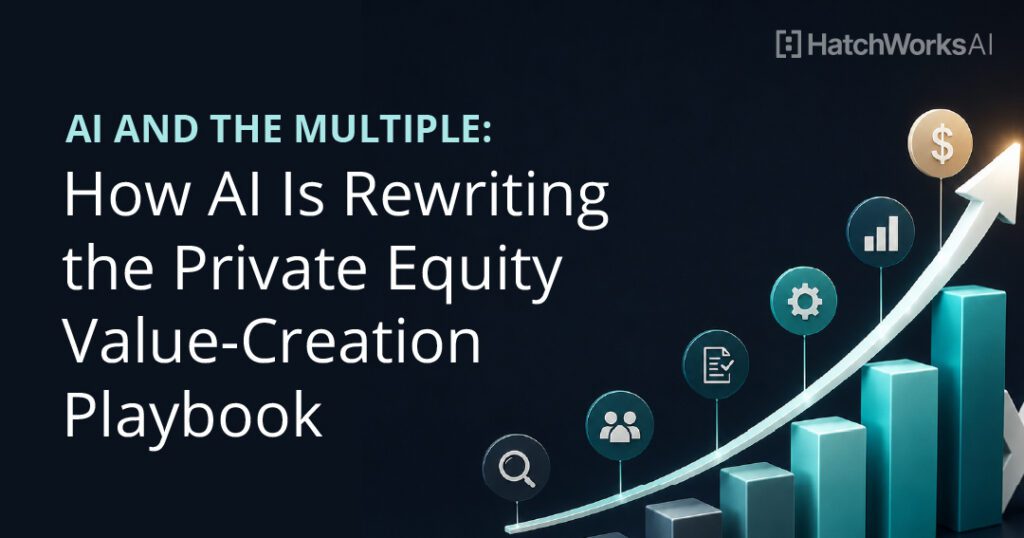
The traditional playbook of efficiency, margin, and growth still matters. It is no longer enough on its own. Here is how artificial intelligence now moves the number that decides an exit, and why the window to build it is open right now.
The short version
- Buyers are repricing in real time. Deal advisors are telling owners that multiples are softening for software and services businesses that are not generating AI intellectual property.
- AI moves enterprise value through three levers: it drives cost out, it shifts a business into the tech-enabled category, and it builds proprietary IP the company owns at exit.
- The third lever is the one most firms miss, and it is where the durable premium sits. Owned, embedded, documented AI is valued as an asset. Rented efficiency is not.
- Defensible AI takes time to build and document. A portfolio company that starts now can carry real, evidenced AI assets into its next process. The companies that wait will be diligenced against the ones that did not.
There is a conversation happening right now in live M&A processes, and it has very little to do with the technology itself. Investment bankers and deal advisors are telling founders and CEOs a version of the same thing: the multiple is softening for any software or services business that is not generating artificial intelligence as part of what it does. That message is not a forecast. It is what owners are hearing across the table today, and it is already shaping the price buyers are willing to pay.
For a private equity firm, that shift lands directly on the thing the whole model is built to produce, which is enterprise value at exit. The familiar value-creation levers of operational efficiency, margin expansion, and revenue growth still work. They are simply no longer sufficient on their own. A new lever has been added to the board, and it behaves differently from the others. Done well, AI does not just improve the financials a buyer underwrites. It can change what category the business sits in and what assets it owns, and both of those move the multiple rather than just the earnings.
What is actually being repriced is the nature of the work itself. The profit pool is shifting away from selling software licenses and toward selling outcomes that augment or replace expensive labor. Buyers have noticed that a company able to deliver those outcomes with proprietary systems is harder to displace and cheaper to scale than one renting the same capability from a vendor every competitor can call. That is why the repricing is showing up as a multiple effect and not only an earnings effect. It is a judgment about durability, and durability is precisely what a buyer pays a premium to acquire.
This article lays out the thesis behind the rest of this series. It explains why the market is repricing, the three distinct ways AI drives enterprise value, why ownership is the lever that compounds, and why the timing matters more than most operating partners assume. Each idea here opens into a deeper treatment elsewhere in the hub, from buy-side diligence through exit readiness.
The market is repricing in real time
It is tempting to file AI under experimentation, the place where pilots go to demonstrate promise and quietly stall. The data from inside the asset class says otherwise. In its 2026 Private Equity AI Radar, FTI Consulting reported that 95% of funds say their AI initiatives are meeting or exceeding the original business case. That is not a statement about potential. It is a statement about returns that have already shown up against a plan. FTI adds a useful caution alongside it, which is that only a much smaller share are significantly exceeding the case, so the spread between disciplined execution and box-checking is wide. The headline still holds: for the funds that have committed, AI is delivering.
The capital has followed the conviction. Accenture found that global private equity deal value in AI and machine learning more than tripled in a single year, climbing from 41.7 billion dollars in 2023 to 140.5 billion dollars in 2024. Measured as a share of total deal value, AI and ML moved from 3% to 8% over the same period. When a category of asset more than doubles its slice of where sponsors are putting money, that is not a thematic side bet. It is the center of strategy moving.
Priority has shifted to match. FTI's Private Equity Value Creation Index found that 65% of respondents now rank AI as a top priority for portfolio value creation, putting it alongside the levers operating partners have run for decades. The reason is structural. Intangible assets, the category that intellectual property and proprietary technology belong to, have come to dominate corporate value. Ocean Tomo has tracked this shift for years, noting that intangible assets grew to represent roughly 90% of the market value of the S&P 500. When most of what a company is worth is intangible, the assets a buyer can least easily replicate become the assets they pay the most to acquire.
$41.7B → $140.5B
Global private equity deal value in AI and machine learning more than tripled in a single year, rising from 3% to 8% of total deal value.
Source: Accenture, Agentic AI Is Redefining Private Equity in 2026The same repricing that rewards owners punishes the exposed. EisnerAmper points to the other side of the ledger, where businesses whose core service can be automated by widely available tools face downward pressure rather than a premium. A marketing agency built on copywriting and design, for example, has seen buyers push for a lower multiple, citing tools that can reproduce much of the work at scale. Investors discount where the risk of commoditization is high. The lesson is not that AI lifts every company. It is that AI sorts them, raising the value of those that own a defensible capability and lowering the value of those whose work it makes cheap to copy. A portfolio is rarely all on one side of that line, which is why the question is best answered company by company.
Put the three findings together and the picture is consistent. AI works when it is executed well, the smart money is concentrating around it, and firms are treating it as a core value driver rather than a science project. That is what a repricing looks like from the inside. The question for a sponsor is no longer whether AI affects value. It is whether the portfolio is being positioned on the right side of the shift before the next liquidity event, or being left to face buyers who are already pricing the gap.
Three ways AI moves the multiple
AI does not create enterprise value through a single mechanism, and treating it as one undersells it. There are three distinct levers, and they act on the valuation in different places. The first improves the earnings a buyer underwrites. The second changes the category the buyer is underwriting. The third creates an asset the buyer is acquiring. The most effective engagements pull more than one at the same time, but it helps to see them separately first.
| Lever | What it changes | How a buyer values it | Representative evidence |
|---|---|---|---|
| Drive cost out | Automates high-cost, high-volume work so revenue grows without headcount growing with it. | A structural lift to EBITDA margin that the buyer underwrites directly into the model. | AI-driven logistics associated with roughly 15% cost reductions and 35% inventory improvements (EisnerAmper). |
| Transform the operating model | Moves a traditional operator into the tech-enabled category by rebuilding the data, workflows, and products work runs on. | A different comparable set and a different conversation, which is to say a different multiple band. | AI-native private deals clearing 8x to 15x revenue versus 4x to 6x for traditional SaaS peers (FE International). |
| Build proprietary IP | Creates owned, embedded, documented AI that a competitor cannot simply buy tomorrow. | Valued as a transferable intellectual property asset rather than discounted as goodwill. | Exclusive access to proprietary models or architectures associated with 15% to 20% higher multiples (FE International). |
Lever one: drive cost out
The most immediate lever is the one buyers find easiest to underwrite. Custom automation and AI agents take high-cost, high-volume work off the payroll, in functions like underwriting, customer service, document processing, demand forecasting, and quality inspection. The effect is not a one-time cost saving that erodes the moment growth resumes. Done structurally, it changes the relationship between revenue and headcount, which is exactly the unit economics a buyer scrutinizes. EisnerAmper has reported that companies leaning on AI-driven logistics achieved roughly 15% cost reductions, around 35% inventory improvements, and significant service-level gains. Those numbers flow straight to EBITDA margin, and margin is the part of the story a buyer is most comfortable paying for, because it is the part they can model with confidence.
The reason this lever underwrites so cleanly is that it changes a ratio rather than producing a one-time gain. When high-volume work is genuinely automated, the company can absorb more volume without adding the people that volume used to require, and that decoupling of revenue from headcount is durable in a way a cost-cutting program is not. Buyers have learned to look past savings that reverse the moment growth resumes. A structural change to how the business scales is different, and it is the kind of efficiency that carries forward into the buyer's own model of the years ahead.
Lever two: transform how the business runs
The second lever is less obvious and more powerful. It moves a company from one category into another. A traditional services or distribution operator that rebuilds its core on AI, the data and pipelines underneath the business, the workflows that move the work, and the products customers actually touch, stops looking like its old peer set and starts looking like a tech-enabled platform. That is not a cosmetic relabeling. Buyers value tech-enabled businesses against a different group of comparables, and that group trades in a higher band. FE International's analysis of recent transactions puts AI-native private deals at roughly 8x to 15x revenue against 4x to 6x for otherwise comparable traditional SaaS, a premium of one to three turns of revenue that exists because AI is embedded in the core product rather than bolted on the side. When AI becomes the way the work gets done, the conversation with a buyer changes, and so does the multiple.
Rebuilding the core is the part that does the work, and it is more than adding features. It means instrumenting the data and pipelines underneath the business so they can feed models, re-engineering the workflows that move the work so AI carries the load rather than assisting at the margin, and reshaping the products customers touch so intelligence is part of what they are buying. When those layers change together, the company stops competing on the same axis as its old peers. It competes on learning speed and operational precision, which is the axis tech-enabled buyers reward. The reset in comparables is the visible mechanism, but the underlying cause is that the business has genuinely changed what it is.
Lever three: build proprietary IP the company owns
The third lever is the one most firms miss, and it is the one that compounds. Off-the-shelf AI delivers efficiency, but efficiency that any competitor can buy the next morning is not an asset. AI gets valued as intellectual property in a transaction when three things are true at once. It is owned outright by the portfolio company, it is embedded in core operations and products rather than rented through a generic interface, and it is documented and defensible as IP. When those conditions hold, the AI stops being an operating expense and becomes a transferable asset on the other side of the table. FE International has found that deals where buyers secured exclusive access to proprietary models or unique architectures routinely carried 15% to 20% higher multiples than peers. Ocean Tomo makes the same point from the IP side, arguing that AI assets should be formally recognized as intellectual property, because unlike goodwill, which buyers discount as subjective, documented AI can be audited, protected, and transferred. The single clearest illustration comes from EisnerAmper, where a regional distribution company that deployed AI demand forecasting improved inventory turnover by 15% and saw its valuation move from roughly 7x to 9x EBITDA. That is a 28% multiple expansion from one initiative, and it is the kind of outcome the rest of this hub is built to make repeatable.
The pattern holds at the level of whole sectors. Ocean Tomo's transaction work shows technology companies with defensible IP moats commanding multiples in the range of 8x to 12x EBITDA, against 5x to 9x for companies in weaker IP positions. The gap is not a rounding error. It is the difference between being acquired as a stream of cash flows and being acquired as the owner of something scarce. For a sponsor, that is the most important reframe in this article. The goal is not merely to make a portfolio company more efficient with AI, which competitors can match, but to ensure it owns AI that competitors cannot.
7x → 9x EBITDA
A single AI demand-forecasting initiative moved a distribution company's valuation by a full two turns. A 28% multiple expansion from one project.
Source: EisnerAmper, How AI Is Shaping the Valuation of Private CompaniesWhy owned beats rented at exit
It is worth dwelling on the difference between the three levers, because it explains where the durable value sits. Cost-out improvements are real, but a buyer knows they can be replicated. Category shifts are powerful, but they depend on what is underneath them holding up to scrutiny. Ownership is the lever that survives diligence intact, because it is the only one a competitor cannot acquire by writing a check to the same vendor you used.
A competitor cannot simply buy access to your customer interactions, your operational history, or your domain-specific patterns. That is what makes proprietary AI defensible.
This is also where the market is becoming most discriminating. FE International notes that buyers are increasingly cool on what they call AI wrappers, businesses that have layered a familiar chat interface on top of a commodity foundation model without building proprietary data, workflow, or distribution advantages underneath. Those companies are finding it hard to attract serious interest, precisely because the thing they are selling can be reproduced. The premium is reserved for AI that is hard to copy, and difficulty to copy comes from ownership, embedding, and documentation rather than from the model alone. We treat this distinction as the strategic core of the entire portfolio question, and it has its own dedicated analysis in how proprietary AI solutions are reshaping private company valuations.
Documentation is what converts a working system into a recognized asset, and its absence is expensive. Ocean Tomo notes that buyers apply meaningful risk discounts when IP ownership cannot be clearly demonstrated, or when a system carries unresolved ownership or litigation exposure. In practice that means a portfolio company can build genuinely valuable AI and still fail to be paid for it, simply because the data provenance, the model ownership, and the development history were never captured in a form diligence can verify. The remedy is unglamorous. It is disciplined record-keeping treated as part of building the system rather than a task left for the data room, so that what the company owns is legible to a buyer instead of something they have to take on faith and therefore discount.
AI now runs across the whole deal lifecycle
The repricing is not confined to value creation during the hold. AI is increasingly embedded across the full investment lifecycle, from deal selection and diligence through value-creation planning and exit readiness. FTI's research is direct on this point. The funds it identifies as consistently outperforming are not the ones spending the most on AI, since investment rates are broadly similar across tiers. They are the ones applying AI deliberately at every stage of the cycle rather than reactively, deal by deal. The differentiator is discipline, not budget.
The earliest stages are moving fastest. Accenture describes diligence shifting from a static snapshot to a living model, with intelligent systems scanning filings, sentiment, and sector signals to surface targets before the market reacts and to raise red flags in real time during a deal. The speed shows up in outcomes as well as in process. FTI's most recent Value Creation Index found that the share of leaders reporting AI benefits within twelve months roughly doubled year over year, reaching around two thirds of respondents. Faster time to value changes the arithmetic of a hold period, because a capability that pays back inside a year can be deployed, proven, and documented well before a process begins rather than rushed at the end of one.
That full-cycle orientation is the structure of this hub, and each stage gets its own treatment. On the buy side, the question is how to price AI risk and upside in a target before close, which is the subject of our framework on AI due diligence. During the hold, the question is how to build owned AI across a portfolio without burning the hold period, and how to measure it against a real business case. At exit, the question reverses: how to package and document AI assets so a buyer's own diligence rewards them with a premium rather than discounting them for uncertainty. The thesis in this article is the same one that runs through all of it. AI is now a line item in the value-creation plan, and it is best run as a coordinated capability rather than a series of one-off experiments.
The window is open now, and it has an expiry
The single most important fact about defensible AI is that it cannot be assembled at the last minute. Owned, embedded, documented AI is the product of time. The data has to accumulate, the systems have to be integrated into how the company actually operates, and the documentation that turns working software into a recognized asset has to be built deliberately. Ocean Tomo's guidance to companies preparing for a sale is to begin comprehensive IP work twelve to eighteen months ahead of a process, cataloging assets, resolving ownership questions, and documenting how AI models were developed and what data they were trained on. A portfolio company that starts that work today can carry real, evidenced AI assets into its next process. One that waits until the bankers are engaged will be diligenced against the companies that did not wait.
There is a constraint worth naming, because it is the one most likely to slow a firm down. FTI found that talent, not capital, is the primary limit on scaling AI adoption, cited by roughly a third of respondents. The firms that move fastest are the ones that solve the talent problem with a repeatable model rather than a hiring sprint, deploying the same methodology and the same senior engineers across portfolio companies so that what is learned in one becomes a pattern the rest inherit. That is how a fund-level capability compounds instead of being rebuilt from scratch in every portco. The window is open today. It favors the firms that treat AI as a discipline to operationalize now, not a decision to revisit before the next raise.
What this means for how you run the portfolio
If AI now moves the multiple, then it belongs in the value-creation plan with the same rigor as any other lever, and it is best run at two altitudes at once. At the fund level, the work is to look across the portfolio and rank AI opportunities company by company, weighing each by its likely impact, its feasibility, and its effect on enterprise value, so that value-creation capital flows to where it returns the most rather than to whichever portfolio company has the loudest internal champion. That ranking is the line between a coordinated program and a scattering of pilots that never add up to an asset.
At the portfolio company level, the work is to build, to measure, and to document. Build production systems on the company's own data, owned by the company and shipped into real operations rather than parked in a proof of concept. Measure them against the business case the way the outperforming funds do, because the firms that consistently win are the ones with the discipline to track impact and scale what works. Document them as they are built, so the AI assets are exit-ready by default instead of reconstructed under deadline pressure later. The connective tissue across both altitudes is a repeatable approach, one methodology and one accountable team deploying across companies, so the pattern learned in the first portfolio company compounds into an advantage in the rest.
None of this requires betting the portfolio on a single forecast about where AI is heading. It requires treating AI as a capability to operationalize deliberately, with ownership and documentation built in from the start, and sequencing it across the lifecycle from diligence through exit. The firms doing that are not waiting for certainty. They are accumulating evidenced, defensible assets while the window is open, which is exactly the position a buyer pays a premium to acquire.
Get Started
Find the AI value hiding in your portfolio.
Start with a Portfolio AI Assessment. We rank the highest-ROI AI opportunities across your portfolio by impact, feasibility, and effect on enterprise value, and you leave with a prioritized roadmap you can act on. Every engagement runs on Generative-Driven Development and is delivered by certified Forward Deployed Engineers.
Talk to our PE team