Forward Deployed Engineers
What Is a Forward Deployed Engineer? The Model Getting Enterprise AI Into Production
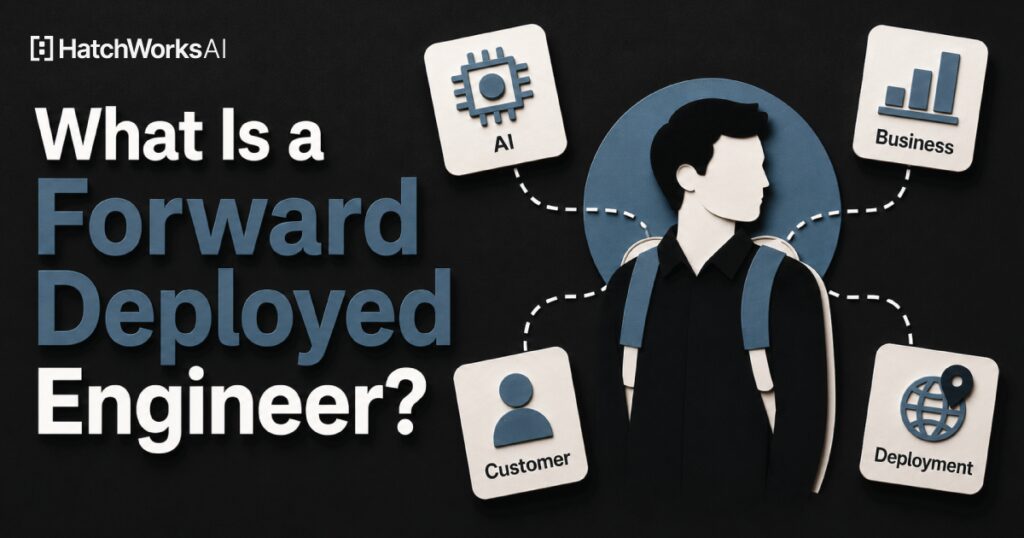
A forward deployed engineer (FDE) is a senior AI strategist and builder who embeds inside a company, identifies where AI can create measurable value, and then designs, builds, and ships production AI systems alongside the client's own team. Not slide decks. Not disconnected prototypes. Not staff augmentation. An FDE owns the loop from "what should we build" to "it's live and people use it."
That definition matters more in 2026 than it did a year ago, because the biggest names in AI just placed multi-billion-dollar bets on it. If you lead engineering, data, or AI strategy at an enterprise, the forward deployed engineer is the delivery model you are about to be pitched, benchmarked against, or asked about in a board meeting. This guide explains where the role came from, what FDEs actually do, what they build, and how to tell the real thing from a rebadged bodyshop.
The short version
- An FDE is an embedded senior builder who finds high-value AI opportunities, ships them to production, and transfers the patterns to your team.
- The model was pioneered by Palantir roughly two decades ago and has now been adopted at scale by OpenAI, Anthropic, Salesforce, and Google Cloud.
- Job postings for the role grew more than 800% between January and September 2025, and the labs have backed it with billions in dedicated ventures.
- The reason it works: most enterprise AI fails between the demo and the production system, and the FDE is the role built to close that gap.
- HatchWorks AI runs its FDE practice on Generative Driven Development, with 100+ certified engineers and official partnerships across Anthropic, Google Cloud, and Databricks.
The multi-billion-dollar job title
In May 2026, OpenAI launched The Deployment Company, a joint venture built specifically to embed forward deployed engineers inside enterprises. It raised more than $4 billion from 19 investors, led by TPG with Advent, Bain Capital, and Brookfield as co-leads, and counts Goldman Sachs, McKinsey, Bain and Company, and Capgemini among its founding partners. To staff it from day one, OpenAI acquired Tomoro, an applied AI consulting firm, bringing roughly 150 experienced FDEs and deployment specialists on board.
Days earlier, Anthropic had announced its own version. That venture launched under its official name in July 2026: Ode with Anthropic, an enterprise AI services firm founded with Blackstone and Hellman and Friedman, with Goldman Sachs, General Atlantic, Apollo, GIC, and Sequoia in the investor consortium. Ode is built on the acquisition of Fractional AI and exists to embed engineers who put Claude to work inside client organizations.
They are not alone. Salesforce has publicly committed to building a team of 1,000 forward deployed engineers to drive Agentforce adoption, complete with its own six-week FDE onboarding program. Google Cloud's CEO announced plans to hire hundreds more. And the analysis Salesforce cites from Indeed and the Financial Times found that job postings for the role grew more than 800% between January and September 2025.
The bets are not abstract. Anthropic embedded forward deployed engineers inside FIS to co-build an anti-money-laundering agent, the kind of regulated, high-stakes workflow where a demo means nothing and a production system means everything. Google Cloud stood up a dedicated AI organization inside its go-to-market team with plans to hire hundreds of FDEs. The pattern across every one of these moves is identical: put a senior builder inside the customer's environment and measure them on production adoption, not deliverables.
None of this is new to anyone who watched Palantir. The company built the FDE role roughly twenty years ago, sending engineers into client environments to build against real data and real workflows, and its alumni network of former FDEs now populates founder and executive roles across the industry. What changed in 2026 is scale: the FDE went from Palantir's peculiar institution to the delivery model the entire AI industry is converging on.
Here is the question that matters for buyers: why are the companies that build the models spending billions to put engineers inside customer businesses? Because they have learned what every enterprise AI team learns eventually. The model is not the product. The deployed, adopted, production system is the product. And getting there takes a specific kind of person doing a specific kind of work.
What is a forward deployed engineer?
A forward deployed engineer is part consultant, part product manager, part senior engineer, deployed as a single accountable owner. Salesforce describes its FDEs as a blend of personal tech guru, business consultant, and hands-on guide. Marty Cagan has written about FDEs as the latest expression of a longstanding argument for empowered builders working directly with customers rather than feature factories working from tickets. The FDE is that argument turned into a job description.
The name is literal. "Forward deployed" is borrowed from military logistics: positioned at the front, where conditions are real, rather than back at headquarters where plans are clean. Palantir operationalized it two decades ago by pairing engineers with government and industrial clients whose problems could not be solved from a product roadmap. Those engineers wrote code on-site, against live data, inside the client's constraints, and Palantir discovered something the rest of the industry is now rediscovering at billion-dollar scale: proximity is a feature. The engineer who has watched the workflow run builds a different system than the engineer who read a requirements document about it.
Where a traditional consultant analyzes and recommends, and a traditional engineer receives requirements and implements, an FDE does the full loop:
- Discovers the highest-value AI opportunities by working inside your business, not from a conference room.
- Scopes and designs the system against your real data, your real systems, and your real constraints.
- Builds and ships production software, writing code and making architecture decisions personally.
- Drives adoption, because a system nobody uses is a failed system regardless of its technical quality.
- Transfers the capability so your team can run and extend what was built.
At HatchWorks AI, we define our version of the role this way: a Forward Deployed Engineer is a senior AI strategist and builder embedded with your team, working across business, product, data, and engineering to turn AI opportunities into working software. The operative word is embedded. FDEs sit inside your standups, your codebase, your data, and your Slack. They experience your constraints firsthand, which is precisely why they can build systems that survive contact with them.
Our VP of Strategy, Matt Paige, puts the larger shift simply: AI did not replace builders, it multiplied who gets to be one. The FDE is what happens when that leverage meets a real customer problem, a senior builder who can now cover ground that used to take a whole delivery team, provided they are standing close enough to the problem to aim it correctly.
The problem the role exists to solve
AI is everywhere. Production outcomes are not. Most companies now have access to powerful AI tools, and far fewer have turned them into measurable business impact. The challenge was never just choosing the right model. It is knowing where AI creates value in your specific business, connecting it to your data and workflows, and shipping systems people actually use.
The gap between a working demo and a working system is where enterprise AI projects quietly die. It looks like this:
- The data that looked ready was not, and nobody owned fixing it. The pilot ran on a clean extract; production has to run on the real thing, with its duplicate records, silent schema drift, and the one critical field that has been free text since 2011.
- The integration was scoped as an afterthought. The AI worked in isolation. Getting it to read from and write to the fifteen-year-old system of record turned out to be most of the project, discovered after the budget was set.
- Security, compliance, and governance arrived in month four with a list of blockers that would have been design inputs in month one. In regulated industries this alone kills more AI projects than any model limitation.
- The workflow existed only in people's heads. The process the AI was meant to improve was never documented, so the system automated the org chart's version of the work instead of the real one, and the team quietly routed around it.
- Nobody owned the gap. After the demo got applause, the data team thought the platform team had it, the platform team thought the vendor had it, and the pilot entered the purgatory where enterprise AI goes to be "on the roadmap."
There is also a quieter failure mode, and it is the one we see most often: access is not adoption. Buying licenses and giving everyone a chatbot changes nothing by itself, the same way buying a treadmill does not make anyone fit. Using AI well is a skill built by doing, inside real work. Shopify's CEO made reflexive AI usage a baseline expectation for employees precisely because the habit, not the technology, is the bottleneck. An FDE's job includes building that habit alongside the software, so the usage sticks after they leave.
Every part of the FDE role is an answer to one of those failure modes. Embedded, so the real workflow gets seen. Senior, so the architecture and the integration get scoped honestly. Accountable end to end, so the pilot has an owner all the way to production. Focused on adoption and transfer, so the value compounds instead of evaporating.
What an FDE actually does: Find, Ship, Multiply
Every credible FDE practice has an operating model. Ours is called Find, Ship, Multiply, and it is how HatchWorks AI structures every engagement, whether the FDE is building an agent for a claims workflow or an intelligence layer across a data platform.
| Phase | What happens | What you get |
|---|---|---|
| 01. Find the value | The FDE embeds with your team to understand workflows, data, systems, and business priorities, then identifies where AI can create meaningful impact and which opportunities are worth pursuing first. | A scored opportunity map grounded in your actual business, not a generic use-case list. The first build chosen for both value and buildability. |
| 02. Ship the value | The FDE designs, builds, tests, and deploys AI systems grounded in your data and integrated into your workflows, with evaluation and governance built in rather than bolted on. | A production system tied to a real workflow, moving a metric you agreed on before the build started. |
| 03. Multiply the value | The FDE codifies what works, transfers context to your team, and creates reusable patterns that make the next AI initiative faster. | Documented patterns, a team that has leveled up by building alongside a senior AI engineer, and a shorter path to production for everything that follows. |
In practice, the first weeks look unglamorous by design. The FDE sits in the operations review, reads the runbooks, pulls the data and finds out what state it is actually in, and interviews the three people who really know how the workflow runs. The opportunity map that comes out of that is worth more than any generic use-case library, because every item on it has already survived contact with your reality. Then the building starts, and it starts small on purpose: the first system is chosen to be shippable in weeks, not quarters, because a production win changes an organization's relationship with AI in a way no roadmap can.
The third phase is the one most delivery models skip, and it is the difference between renting an outcome and buying a capability. If the only thing left behind after an engagement is the software, you got half the value. The patterns, the context, and the changed working habits of your team are the other half, and they are the half that compounds.
What FDEs build
Forward deployed engineers build production AI tied to real business workflows. Across our engagements, the most common outcomes fall into a recognizable set:
AI agents for multi-step workflows
Agents that execute real processes end to end, with deterministic guardrails and human checkpoints where they belong.
Workflow automation
Automation grounded in how the work actually happens, not how the org chart says it happens.
Internal AI tools
Purpose-built tools that put AI inside the daily work of specific teams.
RAG and enterprise knowledge systems
Retrieval systems that make institutional knowledge answerable, with evaluation to keep them honest.
Intelligence layers
Connective tissue across data, models, and systems so AI capability is reusable instead of rebuilt per project.
AI-native products and features
Customer-facing capability where AI is the product, built to production quality.
Data foundations for production AI
The unglamorous layer that determines whether everything above it works.
Evaluation, monitoring, and governance
The workflows that let you trust, measure, and defend what you shipped.
HatchWorks AI is an Official Anthropic Claude Partner. Our Anthropic-certified Forward Deployed Engineers deploy Claude into your business and make it stick.
Explore Our Claude FDE PracticeWhat a forward deployed engineer is not
The fastest way to sharpen a definition is to draw its edges. Three models get confused with the FDE, and the differences are not cosmetic.
Not staff augmentation
Staff augmentation adds capacity: more hands on a backlog you have already defined. A forward deployed engineer adds AI execution capability: someone who finds the opportunity, defines the build, ships it, and makes it stick. If nobody in the building can write down exactly what to build, adding capacity multiplies zero. This distinction matters enough that we wrote a full comparison of the four sourcing models, including when staff augmentation is still the right call.
Not a consultant who leaves a deck
Traditional consulting produces recommendations and departs before the hard part. The gap between the recommendation and the running system is exactly where enterprise AI dies, and it is the part the FDE owns. An FDE stays in the room until the thing is live.
Not the same bet as hiring in-house
Hiring your own senior AI builders is a good long-term play, and an FDE engagement makes it easier, not harder, since your team levels up by building alongside one. But as a way to get your first systems into production this year, the hiring market is brutal: postings for the role grew more than 800% in nine months, OpenAI lists the role at $220,000 to $280,000 plus equity, and every AI lab is competing with you for the same people. An embedded FDE arrives in weeks, brings a proven methodology, and has more than a hundred certified peers behind them.
Not a bodyshop developer with a new title
The market being hot guarantees the label will be abused. The test is simple: does the engineer find and define the opportunity, or wait to be told? Do they own production outcomes, or tickets? Do they transfer capability, or guard it? A rebadged contractor fails all three.
Questions that separate the real thing from the label
If you are evaluating providers, five questions cut through the branding quickly. What is your operating model, and can you show me the artifact from each phase of a past engagement? What does the engineer personally build, and what do they delegate? How is success measured, and is production adoption in the definition? What specifically gets transferred to my team, and in what form? And who stands behind the individual: what methodology, certification pipeline, and partner ecosystem do they draw on when the problem exceeds one person's knowledge? A genuine FDE practice answers all five without flinching, because the answers are the practice.
Where FDEs fit in an AI operating model
An FDE is a starting point, not a ceiling. The engagement path we run at HatchWorks AI scales with the value it creates:
Start here
Forward Deployed Engineers
A senior AI builder embedded inside your team. Best when you need to move quickly from AI strategy or experimentation into production.
Scale up
Agentic AI Pods
Compact AI delivery teams with product, engineering, and QA coverage that own larger systems and parallel workstreams.
Full journey
AI & Data Transformation
One accountable partner across strategy, roadmap, data readiness, delivery, governance, and adoption.
You know it is time to move up a rung when the signals stack: multiple validated use cases queued behind one builder, parallel workstreams that cannot share a single person, governance questions arriving from legal and security that deserve dedicated attention, business units outside the pilot asking when it is their turn. Scaling too early wastes money; scaling too late wastes momentum. The engagement path exists so the delivery model can match the value curve instead of guessing at it.
For organizations that need executive alignment alongside delivery, a Fractional Chief AI Officer can sit above any rung, prioritizing opportunities, shaping governance, and keeping AI investments tied to business value. The pattern that matters: start with one embedded builder, prove production value, and let the footprint grow only as fast as the value does.
Why HatchWorks AI built its FDE practice on GenDD
A single embedded engineer is only as good as the method behind them. Our FDEs work on Generative Driven Development, the methodology HatchWorks AI built for AI-native delivery: human direction, AI acceleration, and accumulated context. In practice, that means an FDE arrives with a repeatable way to scope, build, and evaluate AI systems rather than improvising one on your dime.
Behind each individual FDE is a structured certification pipeline: more than 100 certified engineers trained in GenDD, AI-assisted delivery, Claude, data and ML workflows, DevOps, architecture, and applied labs. And because production AI spans the model, cloud, and data layers, we maintain certified partnerships across Anthropic, Google Cloud, and Databricks, so the FDE in your building can pull on the whole stack.
GenDD matters here for a concrete reason: an FDE is a force multiplier only if their way of working transfers. Because the methodology is explicit about how human direction, AI acceleration, and accumulated context fit together, what the FDE does is legible to your team while they do it. The patterns they leave behind are not tribal knowledge in one person's head. They are documented, repeatable, and already proven inside your environment, which is what makes the third phase of Find, Ship, Multiply real rather than aspirational.
That is the practice enterprises like AT&T, Cox, DIRECTV, Anthem, Kimberly-Clark, and PwC have trusted. It is also why we treat the FDE not as a staffing SKU but as the front door to putting AI in production: AI is all we do, and the FDE is how it starts.
Frequently asked questions
What does FDE stand for in AI?
FDE stands for forward deployed engineer: a senior engineer embedded inside a client organization to identify, build, and ship production AI systems. The term originated at Palantir and has been adopted across the AI industry by OpenAI, Anthropic, Salesforce, Google Cloud, and services firms including HatchWorks AI.
How is an FDE different from staff augmentation?
Staff augmentation adds capacity to execute work you have already defined. A forward deployed engineer adds AI execution capability: identifying high-value use cases, shipping production AI systems, and helping your team build momentum. One fills seats, the other closes the gap between AI ambition and AI in production.
Do HatchWorks AI FDEs only work with one model or platform?
No. The offering is model-neutral. HatchWorks AI works across the enterprise AI stack and brings certified partner expertise across Anthropic, Google Cloud, and Databricks. For teams standardizing on Claude, our Anthropic-certified FDEs bring deep, hands-on Claude expertise.
When should we use an FDE instead of an Agentic AI Pod?
Use an FDE when you need a senior AI builder embedded with your team. Use an Agentic AI Pod when the scope requires a compact cross-functional team to own a larger product, platform, or workflow automation initiative.
Do FDEs replace our engineers?
No. FDEs work alongside your team and are explicitly measured on what they leave behind: shipped systems, reusable patterns, and a team that moves faster with AI than it did before the engagement.
Is an FDE right for us?
FDEs are a strong fit if you have AI pilots that have not reached production, valuable data spread across systems, or product and engineering teams that need more AI-native delivery expertise.
Sources
- OpenAI, "OpenAI launches the OpenAI Deployment Company to help businesses build around intelligence," May 2026
- Anthropic, Blackstone, and Hellman and Friedman, "Introducing Ode with Anthropic," July 2026 (Business Wire)
- Salesforce, "Today's Hottest Role: Forward Deployed Engineer," March 2026, citing Indeed and Financial Times job-posting analysis
- TechCrunch, "Anthropic and OpenAI are both launching joint ventures for enterprise AI services," May 2026
- The New Stack, "Why OpenAI and Anthropic are hiring forward deployed engineer teams," May 2026
- Matt Paige, "The Forward Deployed Engineer Is the Hottest Job in AI," Substack, May 2026
Put AI builders where the work happens.
HatchWorks AI is an Official Anthropic Claude Partner. Our Forward Deployed Engineers embed with your team, find the highest-value opportunities, and ship production AI tied to ROI.