For Private Equity
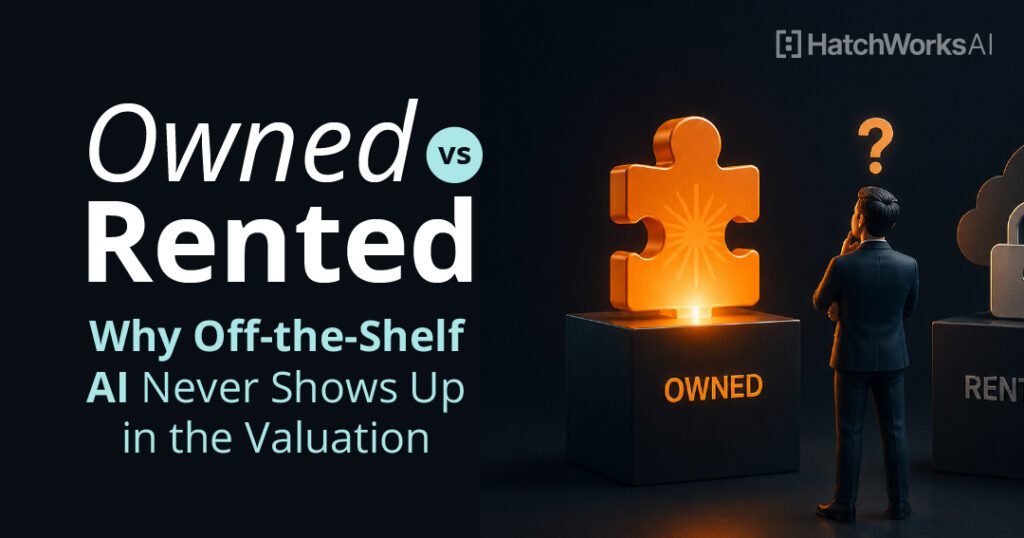
Efficiency a competitor can buy tomorrow is not an asset. Here is why off-the-shelf AI never reaches the valuation, what separates rented capability from owned intellectual property, and the scorecard a buyer uses to tell the difference.
The short version
- The model is not the moat. Foundation models are commoditizing, and AI that any competitor can buy or call through an API adds efficiency but no defensible value.
- The market is repricing on defensibility. Classic competitive moats have lost much of their predictive power, and AI-exposed companies have sharply underperformed AI-resilient ones.
- Owned AI passes three tests: it is owned outright, embedded in core operations, and documented and defensible. Only then is it valued as intellectual property rather than a subscription.
- Not everything should be owned. Rent the commodity, own the differentiating capability, and draw the line exactly where defensibility lives.
The distinction that decides the value
The pillar in this series laid out three ways AI moves the multiple: it drives cost out, it shifts a business into a new category, and it builds proprietary intellectual property the company owns. The first two matter, but they can be matched. The third is the one that compounds, and it rests on a single distinction that most AI conversations skip past entirely. The distinction is between AI a company owns and AI it merely rents. Ownership here does not mean building a foundation model, which almost no company should attempt and which is not where the value lives anyway. Nearly every strong AI product runs on an existing model from a provider like Anthropic or OpenAI, or on an open-source one, and that is the right call. What a company owns is the layer that makes that model its own: the proprietary data, the domain-specific tuning, and the workflows built around it.
That distinction decides whether AI shows up in the valuation at all. A capability any competitor can buy the next morning lifts a quarter's margin but creates nothing a buyer will pay a premium for, because the buyer can acquire the same capability without acquiring the company. Owned, defensible AI is different in kind, not degree. It is an asset that travels with the business and that a competitor cannot simply replicate, and that is the version that earns the premium. This article is about what actually makes AI defensible, the test a buyer applies to tell owned from rented, and how to build for the former without wasting capital trying to own things that should be rented.
This is the lever most firms underplay, and the reason is understandable. Cost-out projects produce a number this quarter, and category-shift narratives are exciting to tell in a board meeting. Ownership is slower and quieter, and its payoff lands at exit rather than in the next update. But it is also the only one of the three levers that a competitor cannot neutralize by writing the same check to the same vendor, which is exactly why it is the one that survives diligence and shows up in the price. Getting it right starts with being honest about where the moat actually is, and that is rarely where the attention goes.
The model is not the moat
Start with the layer everyone fixates on, which is the model itself, because that is the layer least likely to be a moat. Foundation models are commoditizing quickly. Gartner now classifies them as strategic commodities, available as utility services from every major cloud provider, which means differentiation based on model performance alone is unlikely to last. Analysts have a name for the broader effect, differentiation entropy, the tendency for visible, model-driven advantages to diffuse across the ecosystem as competitors fine-tune comparable models and bundle similar features. What looks like an edge at launch dissolves as the underlying technology improves and spreads, which it does faster every year.
If owning the newest model is a fragile advantage, renting one is no advantage at all. The thin layer over a third-party API, the so-called wrapper, is the clearest example. Its entire capability rests on an interface that anyone else can call, which makes it, in one memorable description, one provider update away from irrelevance. The prompts that feel proprietary can be reverse-engineered in a couple of days, the margins compress as the underlying tokens become a commodity, and the moment the model vendor ships a similar feature or a cheaper competitor appears, the differentiation evaporates. The market has watched this happen in public. Category leaders built on commodity AI have seen valuations cut and revenue fall when a model provider absorbed their function, and the cautionary cases are now part of every investor's mental model.
The economics underneath make the fragility concrete. A wrapper's costs scale with usage of a model it does not control, so its margins sit at the mercy of someone else's pricing, and founders have watched a single API price change erase their profitability overnight. The defensibility that analysts look for, proprietary data, real switching costs, network effects, is absent by construction, which is why the great majority of pure wrapper businesses are expected to fail and why the few that survive are the ones that quietly stopped being wrappers and started building something underneath. For a portfolio company the lesson is not that third-party models are bad. It is that a business whose only relationship to AI is a rented interface has built its product on rented land, where the landlord can raise the rent, change the terms, or build an identical structure next door whenever it chooses.
This is not a fringe worry. It is showing up in how companies are valued. Morningstar has found that four of the five classic sources of competitive advantage, switching costs, network effects, intangible assets, and efficient scale, now carry almost no predictive power in an AI environment, and that the companies most exposed to AI disruption underperformed the most AI-resilient companies by nearly 26 percentage points in early 2026, a stretch in which the broader software sector shed roughly two trillion dollars in market value. The market is actively repricing businesses on a single question: can an AI-native competitor erode this company's advantage, or is the advantage something AI cannot easily copy? For a private equity owner, that question is the whole game, because it is the same question a future buyer will ask about the AI inside a portfolio company.
What actually makes AI defensible
If the model is not the moat, the defensibility has to come from somewhere else, and as the lower layers of the stack commoditize, value moves up to the layers that are hard to copy. Three of them matter most, and they tend to reinforce one another.
The first is proprietary data. The technology a competitor can buy is nearly identical to everyone else's, but the one thing they cannot buy is a company's own accumulated operational history, its customer interactions, its domain-specific patterns. A model trained or tuned on that data produces results a rival cannot reproduce without first reproducing the data, which usually means reproducing years of operating in the same business. That is a genuine advantage. It comes with a caveat worth stating plainly, because overclaiming it is a common mistake. As the venture firm a16z has argued, data is not a magic moat: simply having more data does not create an inherent network effect, and what looks like a data advantage is often just a scale effect that competitors can narrow with widely available external datasets. The defensibility is real when the data is genuinely unique, tightly coupled to a feedback loop that keeps improving the product, and activated rather than merely stored. It is weak when data is treated as a trophy rather than a system.
The second is workflow embedding. AI that is woven into the core workflows a business runs on becomes part of how the work gets done, and replacing it stops being a software decision and becomes an organizational one. Systems that sit at the center of daily operations, the place orders move through, the place decisions get made, accrue switching costs that have nothing to do with model quality and everything to do with the friction of change. The deeper the integration, the stronger the hold, because ripping it out means retraining people and rewiring processes, not just swapping an API. The third is accumulated context, the memory of preferences, history, and business-specific knowledge that a system builds up in use and that a fresh competitor starts without. Each of these is something AI cannot replicate on its own, and each is strongest when the AI is owned and embedded rather than rented and bolted on.
The strongest version of workflow embedding is becoming the system of record. When a system holds the authoritative version of how a business operates, its orders, its decisions, its history, migrating away from it is a project few companies are willing to undertake, which is why incumbents that own the system of record are so hard to dislodge no matter how capable a challenger's model is. AI that earns its way into that position, by being the place the work actually happens rather than a tool consulted on the side, inherits the same durability. That is a fundamentally different asset from a feature users could switch off tomorrow without changing how they work, and it is the kind of position a buyer underwrites with confidence.
A fourth source ties the others together, and that is domain depth. A general-purpose model can generate a generic application in an afternoon, but it cannot reproduce the accumulated logic of how a specific industry actually works, the edge cases, the regulatory wrinkles, and the workflow exceptions that only surface after years in the business. Software built on that depth is hard to copy precisely because the difficulty of building it is the moat. The strongest positions stack these advantages rather than leaning on one: proprietary data feeding a specialized model, embedded in a workflow that generates still more of that data, in a domain deep enough that a generalist cannot casually enter. No single moat is decisive on its own, and the more porous moats can be narrowed by competitors over time. Layered together, they compound into something a rival cannot assemble quickly, which is a workable definition of defensible.
The owned-versus-rented test
Put those ideas into a form a deal team can actually use and you get a short scorecard. AI is valued as intellectual property in a transaction when three things are true at once, and a buyer tests all three. Scoring high on one is not enough, because the weakest of the three sets the ceiling on what the AI is worth.
| The test | The question | Owned and defensible | Rented and replicable |
|---|---|---|---|
| Ownership | Does the company own the layer that makes a model its own, the tuning, the proprietary data, and the workflows, with clean rights to use the underlying model? | A leveraged base model under clean, transferable terms, wrapped in proprietary data, tuning, and workflows the company owns outright. | A subscription to a third-party tool with nothing proprietary around it, where the vendor owns the intelligence and nothing transfers in a sale. |
| Embedded in core operations | How deeply is the AI woven into the workflows and products the business runs on? | Entangled with core operations and proprietary data, so replacing it requires real organizational change. | A bolt-on feature beside the existing process, removable without anyone really noticing. |
| Documented and defensible | Can ownership and provenance be evidenced, protected, and transferred? | Model ownership, data lineage, and development history are documented and protectable as IP. | Undocumented and unprovable, and therefore indistinguishable from what a competitor can simply buy. |
The three tests are cumulative. AI that is owned but bolted on shallowly is easy to leave behind. AI that is deeply embedded but rented disappears when the vendor changes terms. AI that is both owned and embedded but undocumented cannot be evidenced in diligence, and a buyer prices what cannot be proven as risk rather than value. Only when all three hold does the AI become a transferable asset that a buyer underwrites as intellectual property, which is precisely the distinction the buy-side diligence piece in this series tests dimension by dimension.
A concrete contrast makes the scorecard easy to apply. Consider two portfolio companies that both say they use AI for customer support. The first routes tickets through a public chatbot API and formats the replies. It is rented on all three tests: the vendor owns the intelligence, the integration is shallow, and there is nothing proprietary to document. The second has trained models on years of its own resolved tickets, wired them into the support workflow so that agents and downstream systems depend on them daily, and documented the data lineage and model ownership as it went. It is owned on all three. Both might report similar efficiency gains this year. Only the second carries anything a buyer will pay a premium for, because only the second owns something the buyer cannot obtain any other way than by buying the company.
What it is worth, and what it costs to skip
The gap between owned and rented is not abstract. It shows up as turns of multiple. FE International has found that deals where buyers secured exclusive access to proprietary models or unique architectures routinely carried 15% to 20% higher multiples than peers, and that AI-native private companies have cleared roughly 8 to 15 times revenue against 4 to 6 times for otherwise comparable traditional software. Ocean Tomo makes the same point from the intellectual-property side, with technology companies that hold defensible IP moats commanding multiples in the range of 8 to 12 times EBITDA against 5 to 9 times for weaker positions, and argues that documented AI should be recognized as a transferable asset rather than discounted as goodwill. The single clearest illustration remains the distribution company EisnerAmper describes, where AI demand forecasting built on the company's own data moved its valuation from roughly 7 to 9 times EBITDA, a 28% expansion from one owned capability. The premium in each of these cases attaches to the same thing, transferability: an asset the buyer actually receives and keeps, rather than a vendor contract the buyer could have signed without paying for the company at all.
The cost of getting it wrong runs in the other direction with the same force. EisnerAmper points to businesses whose core service can be reproduced by widely available tools facing a discount rather than a premium, the commoditization penalty. FE International notes that wrapper businesses, lacking proprietary data or workflow advantages, are struggling to attract serious buyer interest at all. And Ocean Tomo observes that buyers apply real risk discounts when ownership cannot be clearly demonstrated or transferred. Put the premium and the discount together and the conclusion is hard to avoid: owned, embedded, documented AI shows up in the valuation, rented efficiency does not, and AI whose ownership is murky can actively pull the number down. For the deeper treatment of how this is reshaping private company valuations specifically, our companion analysis on proprietary AI solutions goes further into the mechanics.
This is why the owned-versus-rented test has migrated from a strategy-deck abstraction into live diligence. Buyers have watched the public repricing, and they no longer take an AI story at face value. They ask where the data came from, who owns the models, how deeply the system is embedded, and what would happen to the business if the underlying model vendor changed its terms tomorrow. A portfolio company that can answer those questions with documentation walks into the room holding an asset. One that cannot answer them walks in with a liability it has not priced yet. It is the same test a sponsor should be applying throughout the hold, long before a banker is engaged, because the answer is far cheaper to fix in year one than in the final months before a sale.
Build for ownership without trying to own everything
None of this means a portfolio company should build everything from scratch. That would be its own kind of waste. For genuinely commodity tasks, the generic transcription, the boilerplate drafting, the routine classification, renting a foundation model through an API is the right call, because there is no advantage to be had there and no premium to protect. Owning the commodity layer costs money and earns nothing. The discipline is to draw the build-versus-buy line exactly where defensibility lives: rent the commodity, and own the capability that is built on the company's own data and woven into the work that makes it money.
That line maps directly onto the prioritization logic from earlier in this hub. The opportunities worth owning are the ones that score high on durability, the ones that produce proprietary, embedded, documented AI rather than rented efficiency, and they are usually found in the core functions where a company's own data and workflows already concentrate its advantage. Building there means building on the company's own data, embedding the result in core operations rather than alongside them, and documenting ownership and provenance as the work happens so the asset is defensible by the time anyone looks. Done that way, the build is also the documentation, and the capability is exit-ready by default.
Timing favors starting now. Because foundation models commoditize so quickly, the model a company licenses today is not where its lasting advantage will come from. The durable advantage is the proprietary layer built on top, and that layer takes time to accumulate, since the data has to build up, the integration has to deepen, and the documentation has to be produced along the way. A portfolio company that begins assembling that owned layer early in the hold has a defensible asset by the time it goes to market. One that waits, or that papers over the gap with a rented capability, arrives with efficiency any buyer can replicate and nothing that moves the multiple.
In practice the build-versus-buy decision is rarely all or nothing, and the best architecture is usually a hybrid. Rent the base model, because it is interchangeable and improves on someone else's budget, but own the layers that sit on top of it: the proprietary data and the pipelines that feed it, the tuning and orchestration that adapt it to the specific business, and the workflow integration that makes it sticky. Designed that way, a company can swap the underlying model as the market shifts without losing its advantage, because the advantage was never the model in the first place. It was the owned layer wrapped around it. That architecture also ages well in diligence, because it keeps the defensible assets clearly the company's own and the commodity components clearly replaceable, which is exactly the line a buyer is trying to draw.
Owned is what survives the exit
The simplest way to hold the distinction is to ask what survives the transaction. Rented AI does not survive it, because the buyer already has access to the same rented capability and pays nothing extra for the company to have rented it too. Owned, embedded, documented AI does survive it, because it is entangled with the business, evidenced in the data room, and impossible to acquire any other way than by acquiring the company. That is the entire difference between AI that lifts a quarter and AI that lifts the multiple. The companies that internalize it stop asking whether they are using AI, a question that no longer impresses anyone, and start asking whether they own it, which is the question a buyer is actually paying to have answered. Documenting and defending that ownership before a process begins is the subject of the exit-readiness piece that closes this hub.
For a sponsor, the practical takeaway is to treat ownership as something to engineer deliberately rather than hope for. The portfolio companies that command the premium are not the ones that adopted AI earliest or talked about it most. They are the ones that, somewhere in the hold, made a deliberate choice to build the differentiating capability on their own data, embed it where the work happens, and document it along the way. That choice is invisible in a product demo and decisive in a data room. It is, in the end, the difference between selling a story about AI and selling an asset, and it is the lever this hub keeps returning to because it is the one that lasts.
Get Started
Build AI your portfolio companies own.
Start with a Portfolio AI Assessment. We rank the highest-ROI AI opportunities across your portfolio, then build the differentiating ones on each company's own data and own them on the company's behalf, so the result is a defensible asset at exit rather than a subscription. You leave with a prioritized roadmap you can act on. Every engagement runs on Generative-Driven Development and is delivered by certified Forward Deployed Engineers.
Talk to our PE teamSources
- Gartner, research classifying foundation models as strategic commodities and forecasting AI-agent displacement of point-product software.
- Morningstar, analysis on the eroding predictive power of classic competitive moats and the underperformance of AI-exposed companies, early 2026.
- Andreessen Horowitz (a16z), The Empty Promise of Data Moats (data effects versus network effects).
- FE International, AI Business Valuation Model 2026 (15% to 20% proprietary-IP premium; AI-native revenue multiples; wrapper businesses).
- Ocean Tomo (J.S. Held), Increasing Exit Multiples: IP and AI Asset Management in M&A Transactions.
- EisnerAmper, How AI Is Shaping the Valuation of Private Companies (7x to 9x EBITDA case; commoditization discount).