Digital transformation has an interesting history. What started with businesses adopting computers and digitizing manual processes has grown into one of the biggest shifts in how companies operate, compete, and serve their customers.
You've likely heard your CEO mention digital transformation in strategic initiatives. For years, it was a buzzword that showed up in almost every corporate presentation.
Today, the stakes are much higher.
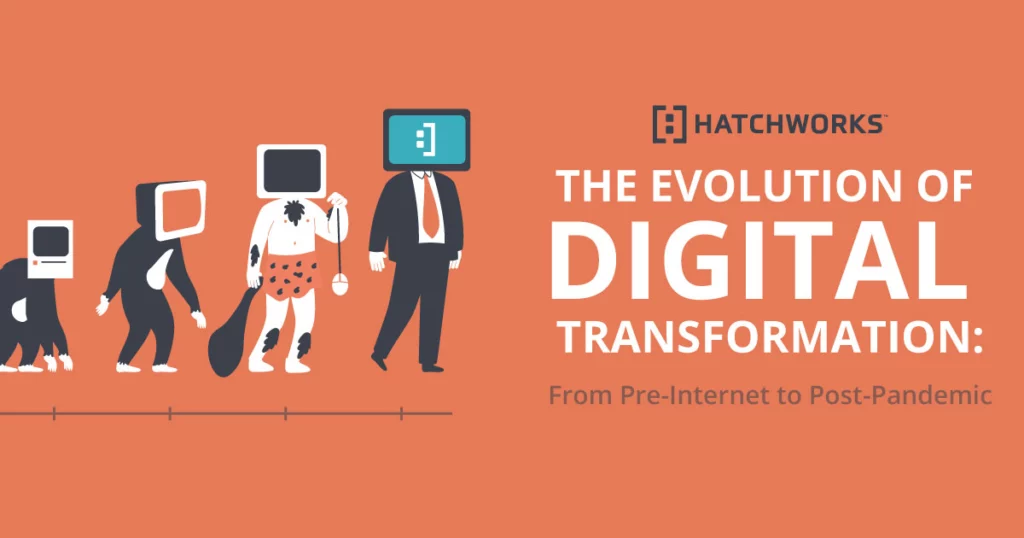
Every major technology shift, from the internet to mobile to cloud computing, has forced companies to rethink how they do business. Now artificial intelligence (AI) is accelerating that change faster than any wave before it.
According to Stanford's 2026 AI Index, organizational AI adoption worldwide rose from 55% in 2023 to 88% in 2025.
Organizational AI adoption worldwide
From just over half of organizations to nearly nine in ten in two years
But how did we get here? And what can the history of digital transformation tell us about where we're heading next?
Let's start with the basics.
What is digital transformation?
Digital transformation is the process of using digital technologies to improve or fundamentally change business processes, customer experiences, and business models.
It can be as simple as replacing a manual, paper-based process with software or as significant as creating an entirely new way of delivering products and services.
At its core, digital transformation is about helping organizations adapt to changes in technology, customer expectations, and the competitive landscape.
Technology is a major part of it, but people and processes matter just as much. Successfully implementing new technology often requires organizations to rethink how teams collaborate, how decisions are made and how work gets done.
In some cases, these changes reshape entire industries.
Now that we've defined digital transformation, let's look at how it has evolved.
The History of Digital Transformation
Integrating Digital Technology into Business Processes Through the Ages
There have been five major eras in the history of digital transformation, each introducing technologies that fundamentally changed how businesses operate and interact with customers.
Each era created new opportunities for businesses willing to adapt and serious challenges for those that didn't.
Pre-internet Era
1950 – 1989
The foundation of digital transformation was laid long before the internet became part of everyday life.
Advances in transistors, integrated circuits and computing made it possible to begin replacing manual processes with digital systems.
The first business computer didn't belong to a bank. It belonged to J. Lyons & Co., a British tea-shop and catering company, which began running business jobs on its LEO I computer in 1951 and went on to put payroll and inventory on it.
Others followed. American Airlines and IBM built SABRE, a reservation system that became fully operational in 1964 and cut the time to book a seat from roughly 45 minutes to seconds.
Businesses began using computers for accounting, inventory management, data processing and other work that previously required significant manual effort. Instead of relying only on paper records and human calculations, companies could process and store growing amounts of information digitally.
These systems were expensive and far less accessible than today's technology. But they established the foundation for everything that followed.
Key milestones:
- 1947Bell Labs demonstrates the transistor, the building block of modern electronics.
- 1951J. Lyons & Co. runs the first business application on its LEO I computer.
- 1958Jack Kilby demonstrates the first working integrated circuit at Texas Instruments.
- 1964IBM announces System/360, and SABRE becomes fully operational.
- 1965Gordon Moore publishes the observation that becomes known as Moore's Law, predicting rapid growth in computing capability as more components fit onto integrated circuits.
- 1969The first ARPANET message travels from UCLA to the Stanford Research Institute, a forerunner of the internet.
- 1971Intel introduces the 4004, the first commercially available microprocessor.
- 1981IBM introduces the IBM PC, bringing computing to desks across corporate America.
Post-internet Era
1990 – 2006
The next major era changed just about everything.
The rise of the internet turned a world of largely disconnected systems into one where people, businesses, and information could connect globally.
Personal computers became common in homes and offices, and the World Wide Web gave people access to information that was previously much harder to find.
Businesses suddenly had new ways to reach customers, market their products and complete transactions.
E-commerce began changing retail. Online banking changed financial services. Search engines changed how people discovered information and businesses.
Companies also gained access to more customer data, making it possible to better understand buying behavior and personalize experiences.
Toward the end of this era, software as a service and cloud computing created entirely new ways to access and deliver technology.
Key milestones:
- 1993CERN makes the World Wide Web software freely available, helping accelerate the growth of the web.
- 1998Google is founded, transforming how people search for and access information.
- 1999Salesforce is founded, pioneering software as a service for business applications.
- 2000Personal computers become commonplace in U.S. households.
- 2004Facebook launches, helping usher in the social media era.
- 2005The number of internet users worldwide approaches one billion.
- 2006Amazon Web Services launches S3 and EC2, popularizing modern cloud computing.
Mobile Era
2007 – 2019
Just when businesses were getting comfortable with the internet, another major technology shift arrived.
The iPhone's launch in 2007 kicked off the modern smartphone revolution. Suddenly, people had the internet, applications, and digital services wherever they went.
That created entirely new customer expectations. People could shop, communicate, manage their finances, order food and stream entertainment from a device in their pocket.
Businesses had to rethink their digital experiences around mobile devices, creating new products, services, and ways to engage customers. Entirely new business models emerged, including mobile-first companies like Uber and Instagram.
In 2011, Marc Andreessen published his influential essay, Why Software Is Eating the World. His argument: software was becoming central to nearly every industry, and companies built around technology would have a significant competitive advantage. That prediction played out across industries over the following decade.
The same year, Capgemini and MIT published research defining digital transformation as "the use of technology to radically improve performance or reach of enterprises." The term soon became a standard part of business vocabulary.
Under the surface, the foundations of modern AI were also falling into place. Cheap computing power, cloud infrastructure, and massive amounts of internet data made new breakthroughs in machine learning possible.
Key milestones:
- 2007Apple launches the iPhone, accelerating the mobile revolution.
- 2008Apple's App Store launches, creating a new distribution channel for software and digital services.
- 2011Marc Andreessen publishes Why Software Is Eating the World, and Capgemini and MIT publish research defining digital transformation.
- 2012A neural network called AlexNet wins a major image-recognition competition, kicking off the deep learning boom.
- 2017Google researchers publish "Attention Is All You Need," introducing the Transformer architecture behind today's large language models.
- 2010sCloud computing, mobile applications and data analytics become central to business operations.
Post-Pandemic Era
2020 – 2022
The COVID-19 pandemic accelerated digital transformation in ways few business leaders could have anticipated.
Practically overnight, organizations had to reconsider how they operated in a world where employees worked remotely, and customers relied on digital channels. Zoom went from about 10 million daily meeting participants in December 2019 to more than 300 million in April 2020.
Zoom daily meeting participants
About 30x growth in four months
Companies that had spent years discussing digital transformation initiatives suddenly had to implement them. Remote collaboration tools, cloud platforms, e-commerce, telehealth, and digital customer service saw rapid adoption.
Businesses with strong digital capabilities were generally better positioned to adapt, while others struggled.
The pandemic showed how important digital technology had become to business resilience. It also changed customer expectations permanently. Convenience, accessibility, and seamless digital experiences were no longer differentiators in many industries. They had become expectations.
Key milestones:
- 2020The COVID-19 pandemic accelerates digital adoption as businesses rapidly shift to remote operations and digital customer experiences.
- 2021Hybrid work, digital collaboration, and cloud-based business systems become established. GitHub Copilot launches as a technical preview, an early sign of AI-assisted software development.
- 2022Businesses keep investing in digital infrastructure, automation and data capabilities to support changing customer and operational needs.
Generative AI Era
2022 – Present
We're now in what may become the most significant era of digital transformation yet.
Artificial intelligence isn't new. Businesses have used machine learning, predictive analytics and other forms of AI for decades.
But the arrival of widely accessible generative AI in late 2022 fundamentally changed what people and organizations could do with the technology.
When OpenAI launched ChatGPT in November 2022, it reached an estimated 100 million users in about two months. For the first time, millions of people could work with sophisticated AI using plain language. It could write, summarize, analyze, and generate content in ways that previously required specialized software or technical expertise.
ChatGPT's estimated reach after its November 2022 launch, as millions of people began working with sophisticated AI using plain language.
Since then, AI has advanced at a remarkable pace.
Models now work across text, images, audio, and video. Reasoning models can tackle complex problems. AI coding agents help build software, and AI systems can connect to business applications to carry out multi-step workflows.
The implications for digital transformation are enormous.
Key milestones:
- November 2022 ModelsOpenAI launches ChatGPT, bringing generative AI into the mainstream.
- February 2023 ModelsMeta releases its LLaMA models, helping start the open-weight AI ecosystem.
- March 2023 ModelsOpenAI releases GPT-4 and Anthropic launches Claude on the same day.
- April 2023 Agents & platformsAmazon announces Bedrock, a managed service for building generative AI applications with foundation models.
- December 2023 ModelsGoogle introduces Gemini, its family of multimodal AI models.
- February 2024 ModelsOpenAI unveils Sora, its text-to-video model.
- April 2024 ModelsMeta releases Llama 3, advancing openly available AI models.
- May 2024 ModelsOpenAI introduces GPT-4o, enabling more natural interactions across text, vision, and audio.
- August 2024 PolicyThe EU AI Act enters into force, the first comprehensive AI law from a major regulator.
- September 2024 ModelsOpenAI introduces its o1 reasoning models, improving AI's ability to work through complex problems.
- October 2024 Agents & platformsAnthropic introduces computer use for Claude, letting AI operate software interfaces by clicking and typing.
- November 2024 Agents & platformsAnthropic introduces the Model Context Protocol (MCP), an open standard for connecting AI applications to external tools and data.
- January 2025 ModelsDeepSeek releases R1, an open-weight reasoning model that rivals leading closed models.
- February 2025 Agents & platformsAnthropic previews Claude Code, an agentic coding tool that works directly in a developer's terminal.
- March to April 2025 Agents & platformsOpenAI adopts MCP, and Google launches its Agent2Agent protocol for communication between AI agents.
- May 2025 ModelsAgents & platformsAnthropic launches Claude 4, and Claude Code becomes generally available.
- August 2025 ModelsOpenAI releases GPT-5.
- December 2025 Agents & platformsAnthropic donates MCP to the Agentic AI Foundation, a new fund under the Linux Foundation co-founded with OpenAI and Block.
- April 2026 Adoption & spendGoogle says 75% of its new code is AI-generated and approved by engineers, up from 50% the previous fall.
- June 2026 PolicyThe European Parliament approves delaying the EU AI Act's high-risk obligations to December 2027.
- August 2026 Adoption & spendMcKinsey reports that 40% of respondents at companies with more than $1 billion in revenue are scaling AI agents, up from 27% a year earlier.
- September 2026 Adoption & spendGartner forecasts worldwide AI spending will reach about $2.7 trillion in 2026, up nearly 50% from 2025.
From chatbots to AI agents (2024–2026)
One of the biggest developments in recent years has been the rise of agentic AI.
Early generative AI applications focused on generating information. You asked a question, and the AI produced an answer.
AI agents take this a step further. An AI agent is a system that uses AI models, tools and external information to work toward a goal and take actions within defined boundaries.
For example, a traditional AI chatbot might summarize customer feedback. An AI agent could collect feedback from multiple approved sources, categorize recurring issues, create support tickets, and prepare a report for the team.
Same request, two very different results: "Help me with this week's customer feedback."
- YouPaste in a batch of customer feedback
- ChatbotSummarizes the feedback
- YouDo everything else by hand
One step. The chatbot generates information, and the work stays with you.
- Step 1Collects feedback from multiple approved sources
- Step 2Categorizes recurring issues
- Step 3Creates support tickets
- Step 4Prepares a report for the team
Multiple steps across tools, within defined boundaries. The agent does the work, and your team reviews it.
In software development, AI coding agents can write code, run tests, find bugs and propose changes across an application.
This creates an opportunity to rethink entire workflows instead of simply making individual tasks faster.
These systems still have limits. They can make mistakes, misread information or take incorrect actions. That's why access controls, testing, evaluations, monitoring and human oversight remain essential, especially when agents touch sensitive information or important business processes.
Still, AI is moving beyond answering questions and into doing work.
What AI means for digital transformation today
The implications go well beyond productivity improvements.
Companies can now automate increasingly complex business processes, build AI-native products and fundamentally change how software is made.
The role people play is shifting too. Rather than completing every step of a workflow by hand, employees increasingly direct, review, and improve work done with AI.
Adoption, though, has raced ahead of results. McKinsey's August 2026 State of AI survey found nearly nine in ten organizations regularly use AI, but only 37% report any impact on earnings (EBIT). Large companies are moving fastest on agents: 40% of respondents at organizations with more than $1 billion in revenue report scaling AI agents, up from 27% a year earlier. At smaller organizations, that share stayed flat at 22%.
The AI adoption gap
Most organizations use AI. Far fewer see it on the bottom line.
Share of respondents reporting they are scaling AI agents.
Share reporting they fundamentally redesigned workflows around AI.
History has seen this gap before. In 1987, economist Robert Solow observed, "You can see the computer age everywhere but in the productivity statistics." The payoff from computers eventually came, but mostly to companies that redesigned how work got done around the new technology. McKinsey sees the same pattern with AI: nearly three-quarters of AI high performers report fundamentally redesigning workflows, compared with about a quarter of other companies.
That's where digital transformation becomes especially important.
Successful AI adoption takes more than choosing the latest model. Organizations need reliable data, access to relevant business knowledge, integrations with their existing systems, security and governance, and employees who know how to work effectively with AI.
An AI model may be capable of performing a task, but it still needs the right context and tools to perform it reliably inside a business.
This is why capabilities like data modernization, agentic automation, and an enterprise Intelligence Layer are becoming core parts of modern digital transformation.
Companies that connect these capabilities to meaningful business outcomes will be better positioned for the next wave of AI innovation.
How to approach digital technologies
Looking back at the history of digital transformation, one thing becomes clear.
Every major technological era has created opportunities for businesses to improve their operations, serve customers differently, and develop entirely new business models. And every era has challenged companies that were slow to adapt.
One of the biggest mistakes organizations make is treating digital transformation as a project with a defined beginning and end. Technology keeps evolving, customer expectations keep changing, and businesses need to adapt along with them.
AI makes this even more important. Capabilities that seemed out of reach a year ago are becoming practical for businesses today.
But moving quickly doesn't mean chasing every new model or AI tool.
The most effective digital transformation strategies start with a clear understanding of the business problems worth solving.
From there, organizations can evaluate which opportunities offer the most value and what it will take to implement them. Data readiness, system integrations, governance, employee adoption, and the ability to measure results all play a role.
At HatchWorks AI, we've built our approach around helping organizations work through this process.
Our GenROI AI Strategy & Roadmap helps businesses identify and prioritize AI opportunities based on business value, feasibility, and organizational readiness.
Once those opportunities are identified, our Generative-Driven Development (GenDD) methodology uses AI throughout the software development lifecycle to accelerate delivery while maintaining quality and human oversight.
We also help organizations build AI-native products, implement intelligent automation, connect AI to enterprise data, and support adoption as these solutions move into production.
For example, we worked with a national commercial real estate firm to move from an AI strategy roadmap to a production multi-agent platform that connects enterprise knowledge and supports critical real estate workflows. The solution brought together business data, AI agents, secure integrations, and governance into a reusable foundation for additional AI use cases.
Read the commercial real estate AI transformation case study.
The goal is to turn emerging technology into measurable business outcomes, whether that means reducing operational costs, improving productivity, creating better customer experiences, or unlocking new revenue.
If the history of digital transformation has taught us anything, it's that there will always be another wave of technological change. The question is how prepared your business will be to take advantage of it.
Frequently Asked Questions about Digital Transformation
When did digital transformation start?
Business computing began in 1951, when J. Lyons & Co. ran the first business application on its LEO I computer. The phrase "digital transformation" was in use by 2000 and became mainstream in the early 2010s, after Capgemini and MIT published research defining it in 2011.
When was digital technology invented?
The foundations arrived in the 1940s and 1950s. ENIAC, an early general-purpose electronic digital computer, was completed in 1945. Bell Labs demonstrated the transistor in 1947, and Jack Kilby built the first integrated circuit in 1958.
What are some key events in the history of digital transformation?
Major milestones include the invention of the transistor and integrated circuit, the rise of personal computing, the growth of the internet, the smartphone revolution, the adoption of cloud computing, and the acceleration of digital services during the COVID-19 pandemic.
More recently, the launch of ChatGPT in 2022 and later developments in reasoning models and AI agents have introduced new possibilities for how businesses operate.
How did the digital revolution lead to AI?
The digital revolution supplied the three ingredients modern AI needs. Moore's Law made computing cheap, the internet created data at enormous scale, and cloud platforms made massive computing power available to rent. Together, those made possible the 2012 deep learning breakthrough, the 2017 Transformer architecture, and the 2022 launch of ChatGPT.
What industries have been most impacted by digital transformation?
Digital transformation has affected virtually every industry.
Retail, financial services, healthcare, manufacturing, media, and technology have seen especially significant changes as businesses adopt digital platforms, automation, cloud computing, and data-driven processes.
AI is expanding these opportunities across industries by making it possible to automate more complex work, improve decision-making and build new digital products.
How has digital transformation impacted society?
Digital transformation has changed how people communicate, work, shop, learn, and access services.
The internet made information widely accessible, smartphones made digital services available almost anywhere, and cloud computing let businesses deliver software and services at scale.
AI is creating another shift by making advanced digital capabilities accessible through plain language and increasingly letting people delegate tasks to AI systems.
What is the future of digital transformation?
Artificial intelligence is expected to play a major role in the future of digital transformation.
As AI systems become more capable, businesses will have more opportunities to automate workflows, develop AI-native products and create personalized customer experiences. AI agents, robotics, connected devices, and advanced data systems are also likely to shape how organizations operate.
Long-term success will depend on how effectively companies integrate these technologies into their people, processes, and business strategies.
How can organizations benefit from digital transformation efforts?
Digital transformation can help organizations improve operational efficiency, reduce costs, create better customer experiences, and introduce new products or revenue streams. It can also make businesses more adaptable to changes in technology and customer demand.
With AI, organizations have new opportunities to automate knowledge-intensive work, improve access to business information, and accelerate software development.
What challenges do organizations face when undergoing digital transformation?
Common challenges include outdated technology systems, disconnected data, resistance to organizational change, limited technical expertise, and difficulty measuring the return on technology investments.
AI adds considerations around security, governance, accuracy, reliability, and employee adoption.
Organizations can address these challenges by prioritizing high-value opportunities, strengthening their data foundations and introducing appropriate controls and human oversight.
How has digital transformation changed the way we work?
Digital transformation has enabled remote work, improved collaboration, and automated many repetitive business processes. Cloud-based tools let employees work across locations, while data platforms help teams make better-informed decisions.
AI is changing work again by letting employees use intelligent assistants and agents to research information, analyze data, create content, write software, and complete multi-step tasks.
How has artificial intelligence changed digital transformation?
AI has expanded digital transformation beyond digitizing existing processes.
Businesses can now use AI to understand unstructured information, generate new content, support decisions, and automate complex workflows. This creates opportunities to redesign how work happens, develop new customer experiences and build products with AI at their core.
What is the difference between generative AI and agentic AI?
Generative AI refers to AI systems that create content such as text, images, audio, video, and code in response to user inputs.
Agentic AI refers to systems that use AI models and other tools to pursue goals and perform tasks, often across multiple steps.
For example, generative AI might draft an email, while an AI agent could gather the information needed for the email, prepare a response, and submit it for approval.
How are AI agents changing business processes?
AI agents help organizations automate workflows that involve gathering information, working across software applications, making decisions within defined rules, and completing multiple steps.
Examples include processing customer requests, preparing reports, analyzing documents, supporting sales operations, and assisting software development.
The biggest opportunities often come from redesigning workflows around what AI can do rather than adding AI to existing processes.
What should businesses prioritize in an AI-driven digital transformation?
Start by identifying business problems where AI could create measurable value. Then evaluate the data, systems, processes, and organizational readiness needed to support those opportunities.
A strong AI transformation strategy also includes governance, human oversight, employee adoption, and clear performance metrics. The goal is to move promising AI initiatives into reliable production use and keep improving the results they deliver.
Ready for the next era of digital transformation?
AI is creating new opportunities across every business function. The challenge is knowing where to start and which opportunities are worth pursuing.
At HatchWorks AI, we help organizations identify their highest-value AI opportunities and turn them into a clear, prioritized roadmap tied to measurable business outcomes.
Build your AI Strategy & Roadmap →