AI agent security matters now because AI agents do not just answer questions.
They plan, call tools, and take actions across real systems.
That can shrink cycle time across support, engineering, and operations.
It can also create a new class of risk: language becomes a pathway to authorized action.
In our Talking AI conversation with Microsoft EVP Charlie Bell, the theme was practical.
You do not get security by hoping an agent behaves.
You get security by treating agents like identities, constraining what they can do, and watching what they actually do.
This article gives you a copy-paste checklist you can apply this week, then backs it up with a production path from pilot to rollout.
What is AI agent security and why it’s different from app security
AI agent security is the discipline of protecting both the agent and everything it can touch: prompts, memory, tool connectors, credentials, data sources, and downstream systems.
The goal is not “perfect behavior.”
The goal is controlled behavior: agents operate within approved intent, and you can prove what happened if something goes wrong.
This is different from traditional application security because agents create a direct path from language to action.
A typical application has fixed interfaces and predictable inputs.
An agent ingests messy context from tickets, documents, inboxes, web pages, and tool outputs.
It can then decide a plan and chain tool calls across systems. That combination changes the threat model in a very practical way.
How AI agents create a bigger attack surface
The attack surface expands any time an agent can authenticate and operate tools.
When you add autonomy, you add speed and complexity.
That complexity is where security breaks first.
Here’s the simplest way to think about it:
- Identity makes the agent “someone” in your environment
- Tools give that someone the ability to act
- Chaining lets one action unlock another action
Executive Translation
More autonomy plus more integrations equals more places for things to go wrong.
Autonomous AI agents vs chatbots
A chatbot responds. Autonomous agents decide and act across multi-step workflows.
That jump in capability is the jump in risk.
With autonomous AI agents, model safety alone is not enough.
You need identity, authorization, and runtime oversight that follows actions across the systems the agent touches.
The “double agents” problem in plain English
Charlie’s “double agents” framing’ is useful because it avoids hype.
It describes a real enterprise issue: the same agent that helps your team can be manipulated to help someone else.
Agents are built to comply, and they often operate on untrusted content streams.
If you combine that with broad tool access, you get a new kind of incident: authorized actions with the wrong intent.
The episode also highlighted the dual-use reality.
AI can strengthen defense by accelerating analysis, correlating signals, and helping teams ship more secure code.
Charlie described how agentic development can reduce certain classes of human mistakes because an agent can generate code without common insecure patterns.
At the same time, autonomy plus access can be turned against you.
If an agent can authenticate and call tools, an attacker does not have to “steal data first.” They can steer the agent into taking an action that looks normal on the surface.
Confused deputy: when an agent uses your privileges against you
A confused deputy is a trusted system that can be tricked into misusing its authority.
With agents, that looks like this: The agent has privileges because you want it to work. It then reads instructions embedded in context. If it treats those instructions as legitimate, it acts using the authority you gave it.
You do not fix this with a single guardrail.
You fix it with a pattern: least privilege, policy checks on sensitive actions, and step-up approvals.
Indirect prompt injection: instructions hidden in the content stream
Indirect prompt injection is when malicious instructions ride along in content the agent reads: tickets, documents, emails, or web pages.
The agent is not “broken.” It is doing what it was designed to do.
That’s why agent security has to cover both the context stream and the resulting actions. It’s not enough to only harden prompts.
AI agent security checklist: the 15-point quick scan
If you only read one section, read this one.
It’s designed to be practical: you should be able to run this checklist against any agent and know whether it belongs in production.
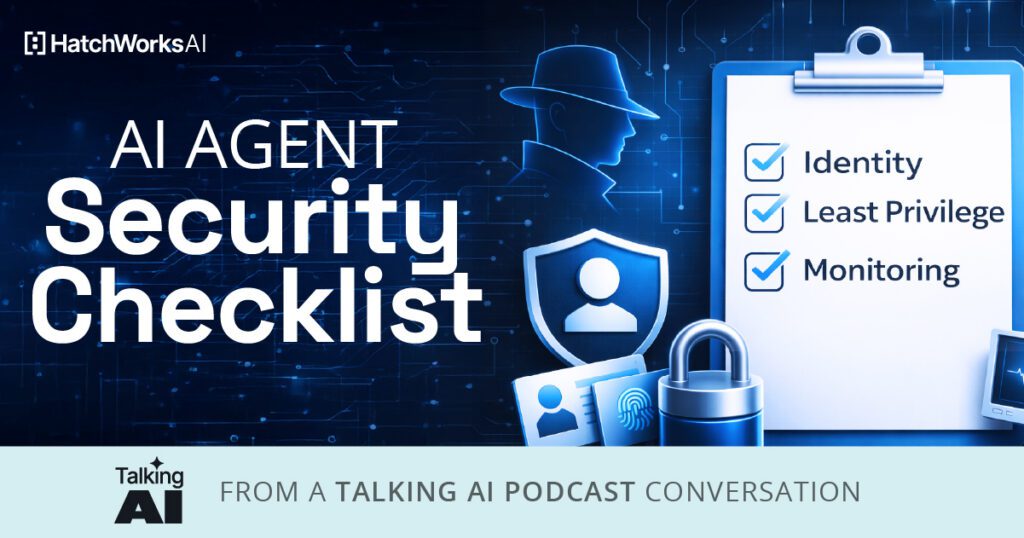
The checklist is organized into three pillars.
That structure matters because it mirrors how security works in real environments: you need a trusted identity, constrained authority, and visibility into actions.
This aligns with an “Agentic Zero Trust” posture: authenticate, authorize, and monitor every action.
Checklist pillar 1: identity and ownership (agent security starts here)
Before you worry about prompt tricks or advanced attacks, confirm you can answer a simple question: Which agents exist, and who owns them? If you cannot, you cannot manage risk.
- Every agent has a unique ID and an accountable human owner
- Agents use non-human identity with short-lived credentials (no hardcoded tokens)
- You can inventory all AI agents, including shadow deployments
- The agent’s intent and scope are documented, including what it must never do
- You can revoke credentials and disable the agent quickly
Charlie put the principle plainly: “It starts with identity.”
Checklist pillar 2: access controls and least privilege
Once identity exists, you can contain outcomes.
Least privilege is how you reduce blast radius when something goes wrong.
Think of it as making sure the agent can complete the job, but cannot quietly expand the job.
- Least privilege is enforced per tool, per dataset, per action (not one broad service account)
- High-risk actions require step-up approvals or a policy gate
- Environments are segmented so lateral movement is limited
- Inputs and outputs are treated as untrusted by default
- Retrieval paths have boundaries, and sensitive data is minimized or redacted
Checklist pillar 3: monitoring, anomaly detection, and response
Monitoring is not a “nice to have” for agents. It is your containment system after deployment.
You want to be able to reconstruct what happened, and you want early warning when behavior changes.
- You can see what the agent saw and what it did, including tool calls and side effects
- Behavioral baselines exist and anomaly detection flags deviations
- Logs flow to SIEM and playbooks can isolate an agent fast
- Alerts map to “agent moves,” like tool escalation or data access spikes
- Incident response includes agent-specific steps: revoke tokens, audit actions, contain spread
If you only implement three controls, implement these: unique identity, minimal permissions, full tool-call logging.
Agentic Zero Trust for AI Systems
Agentic Zero Trust is a clean mental model for deployments that need to scale.
The posture is familiar: never trust by default, always verify, assume breach, and shrink blast radius.
What changes is the object you’re securing. You’re securing an identity that can act.
The Microsoft “double agents” framing ties directly to this: least privilege plus monitoring becomes the operational core.
“Assume breach” for autonomous AI
Assume breach matters even more with autonomy because “compromised” does not always look like “broken.”
An agent can be legitimately credentialed and still harmful if it is steered into the wrong action chain.
Practical outcome: continuous verification and rapid containment beat perfect prevention.
Context-aware auth and dynamic policy decisions
Static roles are a blunt instrument for agents.
A better approach is dynamic authorization decisions that consider context.
That typically includes: who invoked the agent, where it is running, what data class is involved, the risk of the requested action, and whether behavior matches baseline.
This is where RBAC can be supplemented with ABAC or policy-based controls.
Identity-first controls for AI agents
Identity is the root of accountability, revocation, and auditability.
It’s also the foundation for governance.
Once you can reliably identify agents, you can enforce consistent rules, measure coverage, and respond fast.
In the real world, two things break identity first: shared credentials and shadow deployments.
That’s why the “inventory and owner” step sits near the top of the checklist.
Non-human identity: treat agents like privileged workloads
Treat agents like you treat privileged workloads:
- use managed identities where possible
- issue short-lived credentials
- rotate secrets and revoke quickly
- avoid tokens embedded in code or config
This is standard discipline, applied to a new identity type.
Inventory: find shadow AI agents and “unknown tool callers”
Inventory is not busywork. Inventory is your control plane.
Start with a discovery approach you can operationalize:
- enumerate agents by platform, environment, and connector
- enumerate token issuances and service identities
- scan logs for unknown tool callers
- quarantine unknown agents until ownership and intent are documented
If it helps, keep an inventory schema simple: agent name, owner, purpose, environments, tools, data sources, and risk tier.
Access controls and least privilege for autonomous agents
Least privilege in agent terms is minimum permissions for the current task, not maximum permissions “just in case.”
Broad tool access turns prompt injection into real-world action.
That’s why the best place to start is not “Which tools does the agent have?”
It’s “Which actions do we allow the agent to perform inside those tools?”
Tool-level permissions: constrain actions, not just data
Define permissions at the action level.
For example, “email access” is not a permission.
Permissions look like:
- search inbox (read-only)
- draft only (human sends)
- send only to allowed domains
- attach only from approved locations
Then apply the same pattern across CRM, ticketing, storage, and internal tools.
Data boundaries for RAG and tool-calling
If an agent retrieves internal knowledge or queries enterprise systems, define boundaries up front:
- partition by sensitivity (public, internal, regulated)
- minimize and redact where possible
- use encryption and segmentation for high-risk classes
This isn’t just compliance.
It’s how you keep “helpful” retrieval from becoming silent exposure.
For more design patterns, check out AI Agent Design Best Practices.
Sandboxes and segmentation to reduce lateral movement
If an agent is steered, the blast radius must be small.
Segmentation makes that true.
In practice:
- isolate code-executing agents
- separate dev, test, and prod
- restrict network egress
- isolate privileged agents from broad internal systems
Orchestration patterns can help you enforce these boundaries consistently.
Monitoring and anomaly detection for AI security
Monitoring is containment.
You cannot secure what you cannot observe, especially when agents are acting across tools.
This is also where many teams under-invest.
They log the final output, but not the tool-call chain that created the output.
That makes investigation slow and containment uncertain.
Monitor the prompt stream, tool calls, and outputs
A good baseline is the ability to reconstruct an action chain end-to-end.
That means capturing:
- inputs and context sources
- tool invocations and parameters
- tool outputs
- policy decisions and approvals
- resulting side effects (what changed)
Store logs with access controls and retain enough for forensics. Redact sensitive fields when needed, but keep traceability.
Anomaly detection: baselines for autonomous behavior
Anomaly detection gets practical when you baseline what normal looks like.
Start with signals tied to real outcomes: tool mix, API frequency, data volume, destinations, auth sources, and schedules.
Then define tripwires:
- first-time tools used
- privilege changes
- spikes in volume
- unusual destinations
- new cross-system chains (email → storage → external)
Incident response runbook for agent security
Your runbook should match agent reality: fast containment, fast attribution, and a clean path to re-enable safely.
A strong sequence looks like:
- isolate the agent and disable workflows
- revoke tokens and rotate secrets
- audit tool-call chains and side effects
- identify the vector (ticket, doc, email, connector)
- patch controls and re-test before re-enabling
Charlie’s containment mindset is the right anchor here: “You have to contain it.”
Threat map: what attackers will try first
This section exists to connect threats to controls.
You should be able to look at a threat and know which checklist items reduce it.
Prompt injection and indirect prompt injection
Direct injection targets prompts.
Indirect injection targets content streams.
Tool access raises stakes because the agent can take actions.
Mitigation Direction:
Treat inputs as untrusted, constrain actions, require approvals for sensitive steps, and log the tool-call chain.
Token compromise and identity spoofing
Stolen tokens turn “agent identity” into attacker identity.
That’s why identity work is not optional.
Mitigation Direction:
Short-lived credentials, rotation, workload identities, behavioral monitoring, and a tested kill switch.
Data exfiltration through legitimate access
Exfiltration can look like normal productivity unless you baseline behavior.
DLP alone can fail when the agent is allowed to access the data.
Mitigation Direction:
Outbound limits, export approvals, partitioned retrieval, and alerts on abnormal data movement.
AI governance that keeps agent deployments shippable
Governance is how you scale safely without slowing down.
The best governance models are lightweight and repeatable: clear tiers, clear approvals, clear logs.
What works in practice:
- risk tiers for agents
- required inventory fields at creation
- approval rules for tool access changes
- audit trails for prompt, policy, and connector changes
AI governance meets security operations
Keep the process simple: a short threat model template, this checklist, a go/no-go gate, and a small set of metrics. Examples: coverage, policy violations, MTTD, MTTR.
Compliance and audit readiness for AI systems
Audit readiness is mostly documentation plus evidence.
Retain inventories, access policies, approvals, change logs, incident reports, and postmortems.
Implementation playbook: from pilot to production
If you want speed without regret, start with one workflow, lock scope, and instrument early.
Expand permissions only after telemetry proves you’re in control.
A pragmatic rollout path:
- Pilot: read-only tools, tight scope, full logging from day one
- Expand: add action-level permissions and approvals for sensitive steps
- Production: route logs to SIEM, baseline behavior, validate kill switch, re-attest access
For deeper framework considerations, check out our AI Agent Frameworks Guide.
Reference architecture for agent security
A clean way to structure this is two planes:
- control plane: identity, policy engine, logging, approvals, kill switch
- execution plane: agent runtime, tools, data connectors
Test “break glass” procedures, especially token revocation and workflow shutdown.
How HatchWorks AI helps teams ship secure AI agents
At HatchWorks AI, we treat agent security as a delivery constraint, not a cleanup task.
We focus on scoped tool access, orchestration boundaries, and observability from day one.
If you’re building with orchestration tools like n8n, these references may help:
Secure AI agents with a production path
If you’re building with AI agents today, the goal is not to eliminate risk. The goal is to control it.
Identity gives you accountability. Least privilege shrinks blast radius.
Monitoring gives you the ability to contain outcomes fast, even when something unexpected shows up in the context stream.
If your team wants help turning these controls into a real deployment pattern, HatchWorks AI supports secure, production-grade agentic workflows end-to-end, from orchestration and tool scoping to governance and observability.
Agentic AI Automation
Use this when you already have a target workflow and need to build and harden it for production, with scoped tool access, policy gates, and monitoring baked in.
AI Agent Opportunity Lab
Use this when you’re choosing the right use case and want a structured sprint to define scope, threat model the workflow, set access boundaries, and validate controls before scaling.
If you want the fastest next step: pick one workflow where an agent would save real time, then run the 15-point checklist against it.
The gaps you find will tell you exactly what needs to be built before you let the agent act in production.