The CEO of a large general contractor has a spreadsheet with forty AI ideas in it. Field operations wants automated daily reports. Estimating wants something that can read drawings. Finance wants better cash flow forecasting. HR wants resume screening and has already bought a tool for it.
The CIO keeps a separate list, mostly infrastructure. A VP came back from a conference in March convinced the company should be running agents everywhere, and two of his teams now are.
The board asked for an AI strategy at the last meeting. What the CEO has is an inventory.
This is where most companies stall, and it does not feel like stalling. It feels like momentum. There are pilots running. There is a list.
What nobody can answer are the three questions that decide where the money goes: where AI creates value in this business, which of those opportunities the company is ready to pursue, and which one to fund first.
So the work starts at prioritization. A team ranks a list it did not build, using feasibility estimates nobody stress-tested, for an organization whose readiness was never assessed. The output looks like a plan. Garbage in, beautifully sequenced garbage out.
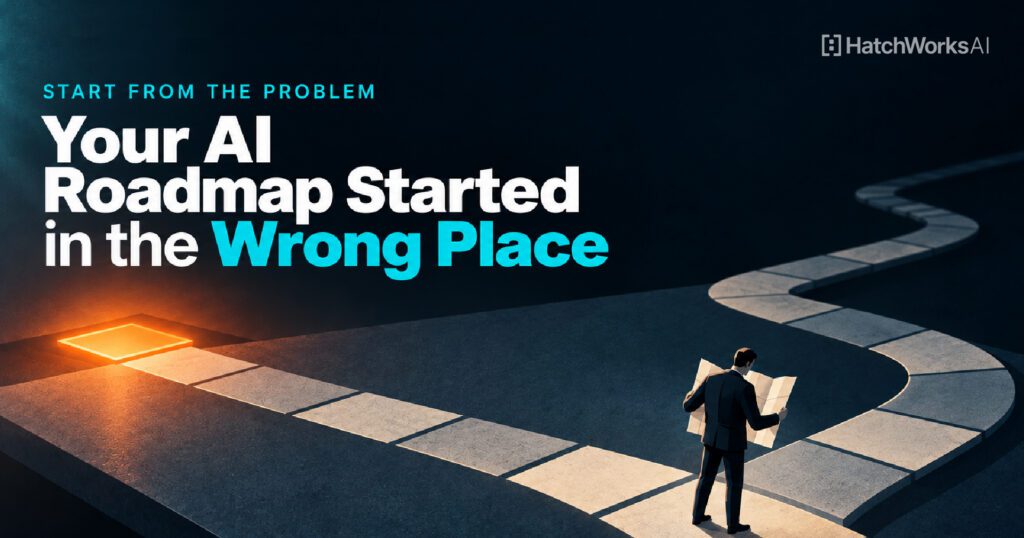
An AI roadmap is the output of four steps, not the first one. Discover opportunities across the business, assess each on value, feasibility, strategic fit and organizational readiness, prioritize with dependencies visible, then sequence.
Start at step three and you are ranking a list that discovery never built and readiness never tested.
Choosing whether a single use case is worth building is a different question, and one we cover in how to identify AI use cases that are worth building. This piece is about the order the whole set gets built in.
What makes an AI roadmap different from any other technology roadmap?
Dependencies are not an AI problem. Every serious technology portfolio has them, and sequencing them is ordinary program management.
Four things about AI in 2026 are not ordinary.
Feasibility has a shelf life. A use case that was infeasible in January can be routine by September, and a promising pilot can become infeasible the week it meets real data.
A feasibility score is a reading taken on a date. Record the date beside the score, or next year's roadmap inherits a judgment nobody remembers making.
Readiness belongs to the use case, not the company. "Are we AI ready" has no useful answer. One company can hold clean, governed financial data and a document estate held together by email attachments and tribal knowledge.
One of those is ready now and the other is not. A company-level maturity score averages them and hides the thing you needed to know.
Governance can veto a good opportunity. A high-value, feasible initiative can be unbuildable this year because of how customer data is contracted, where it is allowed to be processed, or who may see the output. Score that alongside value, or meet it at the security review after the build.
Volume decides the architecture. A classifier that fires on every inbound email and a market analysis that runs four times a year can carry identical accuracy requirements and unrelated cost structures.
The first lives or dies on cost per call and wants the smallest model that clears the bar. The second can run on the most expensive model available and still round to nothing. The architecture follows the volume, and the business case follows the architecture.
Then there is the work itself. In McKinsey's August 2026 global survey of 1,719 executives, nearly three-quarters of high performers reported fundamentally redesigning workflows because of AI, against one-quarter of everyone else: a three-to-one gap between the companies seeing returns and the companies not.
The same survey found eight in ten respondents saying AI had improved their own productivity, while 37 percent reported any positive contribution to EBIT.
Individual productivity is not hard to get. Enterprise value requires changing how the work is done, which makes workflow redesign a roadmap item with a cost and a position in the sequence, not a change management deck at the end.
How do you build an AI roadmap in the right order?
Two of the four are usually skipped, and they are the first two.
Discovery gets skipped because the forty ideas feel like discovery. They are not. They are the opportunities visible to people who had a channel to submit them, which skews toward the loudest functions and the most visible pain.
Structured discovery goes wider: interviews across business units, time with the people doing the work rather than the people describing it, and a pass through operational data to find where hours and dollars actually go. The opportunities nobody submitted tend to have the cleanest economics.
Assessment gets skipped because a value-versus-effort grid feels like assessment. Readiness is the dimension that grid has no axis for, and it has to be scored per opportunity: is the data there, is it clean, is it governed, does anyone own the process, and will the team whose work changes actually change it.
Why isn't the highest-ROI initiative the one you fund first?
Take three candidates from that contractor's list.
Automated proposal and RFQ response. Estimating spends weeks assembling responses from past proposals, pricing sheets and spec documents. Modeled annual savings are the largest of the three.
Readiness is the worst of the three: the source material lives in email threads, personal drives and a document system nobody trusts.
Predictive project risk. Flagging jobs likely to slip schedule or budget while there is still time to act. Value is high and strategic fit is excellent. It needs unified cost, schedule and change-order history, which currently sits in three systems that do not reconcile.
A governed project data platform. Cost, schedule and document history in one place, with access controls and lineage. Standalone return is unremarkable: faster reporting, fewer arguments about whose number is right.
Ranked on value, the platform finishes third and never gets funded. Ranked with dependencies visible, it goes first, because neither of the other two can work without it.
Fund proposal automation first and you spend two quarters learning that the output is only as good as a document estate nobody has curated.
The version that works builds the foundation and ships one narrow, visible win in the same phase, so the organization sees output while the platform goes in.
K9 Resorts is the same pattern with the order already run. K9 Chat, the assistant that answers plain-language questions about performance across the franchise network, was the seventh of eight things built.
Ahead of it: a lakehouse, pipelines unifying two systems that had never spoken to each other, and revenue validated to penny-level accuracy. As Kevin Tennant put it, "The numbers in K9 Chat match the dashboard to the penny because they come from the same validated logic."
The assistant inherited its accuracy from the six things funded ahead of it.
We sequence this way because the alternative keeps failing in the same place. On a recent engagement with a leading general contractor, more than fifty use cases were qualified and prioritized with data readiness scored as a first-class dimension, and phase one is a data foundation rather than any of the fifty.
On a national commercial real estate platform, readiness was assessed before delivery rather than after a demo, and secure integrations were built before the knowledge assistant that depends on them.
What does this look like as an engagement?
Discover, assess, prioritize, roadmap is GenROI, our AI strategy engagement.
The step that changes the output is the first one. GenROI runs AI-guided interviews across more roles, teams and functions than a workshop reaches, and strategists then validate and synthesize what comes back.
The breadth is what stops the opportunity set from being a transcript of the loudest room. The strategists are what stop it from being a list of everything anyone said.
Opportunities are assessed on value, feasibility, strategic fit and organizational readiness, and only then prioritized and sequenced. You finish with an AI Opportunity Assessment, an AI Readiness Report, a prioritized AI roadmap, and an effort and value summary.
Every recommendation carries its reasoning, because why an initiative is third matters to a board as much as the fact that it is.
Which one are you holding?
The forty ideas are not the problem. Ranking them before you know what else is out there, and what you are ready to build, is.
Frequently asked questions
What is the difference between an AI roadmap and an AI strategy?
The strategy says which business outcomes matter and why. The roadmap says what gets built in what order to reach them, and what each phase unlocks. A strategy with no roadmap has no delivery path. A roadmap with no strategy is a sequence with no argument behind it.
What should an AI roadmap include?
The full opportunity set from discovery, not only submitted ideas. A per-opportunity assessment covering value, feasibility, strategic fit and readiness. The dependency map showing which initiatives unlock which.
A phased sequence with what each phase makes possible. And the reasoning for the order, so it survives a sponsor asking why their initiative is third.
How do you prioritize AI use cases?
Score value and feasibility, score readiness separately for each use case, then map dependencies before you rank. Dependencies are what most scoring models leave out. A foundational initiative with a modest standalone return often belongs first because it makes two or three higher-value ones possible.
How does AI readiness affect the roadmap?
It changes the order more often than it changes the list. Low readiness rarely kills a good opportunity. It moves that opportunity later and tells you what has to happen first, usually data unification, governance, or someone owning the process.
Who should be involved in building an AI roadmap?
Executive sponsorship for the tradeoffs, business unit leaders for the opportunities, data and engineering owners for feasibility, and legal and security early enough that governance shapes the plan instead of blocking it. The people whose work is being automated belong in discovery, not only in rollout.
How do you keep an AI roadmap current?
Revisit feasibility and readiness quarterly, and the opportunity set twice a year. Capability moves fast enough that an initiative parked in Q1 can be viable by Q3. The assessment is the living document; the sequence is what you re-derive from it.