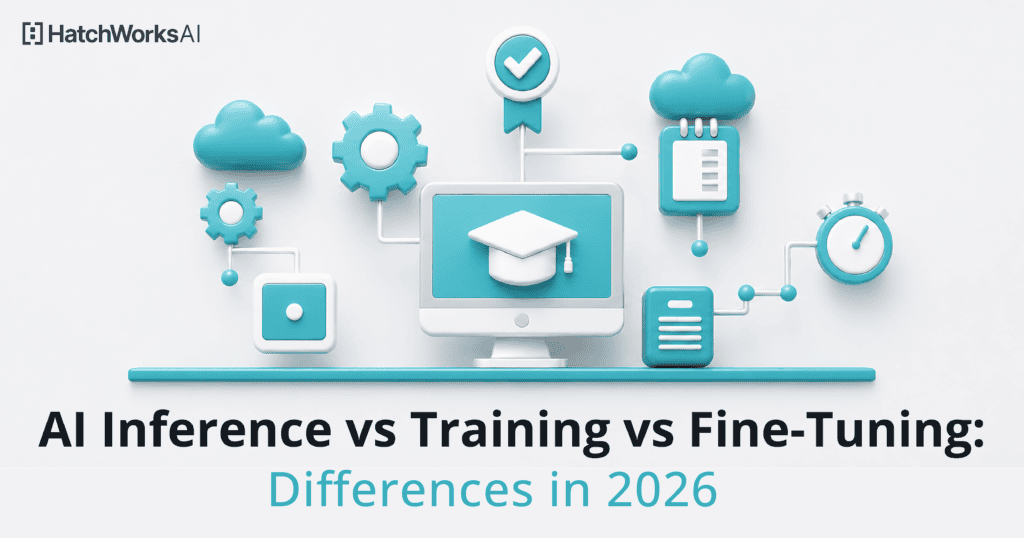
Inference is what happens every time a finished model answers a request — the production step your users actually experience, and the one you pay for over and over. Training is how that model was built in the first place: a neural network fed enormous amounts of general data until it learns language patterns, at a cost that reaches into the hundreds of millions of dollars. Fine-tuning is how an already-trained model is adapted to a narrow job using a small, targeted dataset, and it can cost as little as a few dollars.
| Training | Fine-tuning | Inference | |
|---|---|---|---|
| What it does | Builds a model's general capability from scratch | Adapts an existing model to a specific task or domain | Runs the finished model to produce an answer |
| Typical cost | Up to roughly $500M for the largest known runs (Epoch AI, Nov 2025) | $4 to a few thousand dollars | Fractions of a cent per request, but continuous |
| Data needed | Trillions of tokens of general text | Hundreds to tens of thousands of curated examples | None — just the user's prompt |
| Who does it | A handful of frontier labs | Almost any engineering team | Everyone shipping an AI product |
| When you do it | Almost never; you buy this | When prompting and retrieval have genuinely failed | Every single request, forever |
Those three words get used interchangeably in vendor decks, and the confusion is expensive. This guide separates them properly, gives you the 2026 numbers for speed and cost with sources attached, walks through a real fine-tuning job that cost about $10, and adds the fourth option that barely existed when we first published this piece: distillation and reinforcement fine-tuning. If you are a technical leader deciding where to spend your AI budget, this is the decision framework.
The short version
- Inference is now the majority of AI infrastructure spend. Gartner forecast in August 2026 that inference will take $23.3 billion of the $42 billion AI-optimized IaaS market this year — 55% — against $19 billion for training.
- What counts as fast now depends on the size of the model. On a 120B-parameter model, Cerebras reported in November 2025 that its WSE-3 runs GPT-OSS-120B at over 3,000 tokens per second, roughly 5x an NVIDIA Blackwell GB200 result of 650 tokens per second on the same model. At trillion-parameter scale the leading edge is closer to 1,000: Artificial Analysis measured Cerebras at 981 tokens per second on Kimi K2.6 in May 2026, 6.7x the next-fastest GPU cloud.
- Fine-tuning a small open-weight model is genuinely cheap: Together AI charges $0.48 per million training tokens for LoRA on models up to 16B parameters, with a $4 minimum per job, as listed on its pricing page in August 2026.
- Reinforcement fine-tuning costs 100x to 700x more than supervised fine-tuning and does not reliably win. TensorZero's September 2025 head-to-head found RFT cost $65.07 against SFT's $0.09 on a data extraction task, and actually degraded performance on a customer service task.
- On-policy distillation is the best price-performance story in the category. Thinking Machines Lab reported in October 2025 that on-policy distillation beat a reinforcement learning baseline on AIME'24 — the Qwen3 technical report's 74.4% against RL's 67.6% — using roughly 1,800 GPU hours instead of 17,920, which the post describes as one-tenth the cost of RL. Against off-policy distillation the saving is 9x to 30x, depending on whether you already have the SFT dataset.
- OpenAI is retiring its self-serve fine-tuning platform, announced May 7, 2026: organizations without recent fine-tuning activity lost the ability to create new jobs on July 2, 2026, and all remaining customers lose it on January 6, 2027.
Training vs fine-tuning vs inference: the full comparison
Six dimensions, three concepts. Choose a concept to view it on its own, or open any cell for the detail and the dated source behind the number.
Training
Building the model. You almost certainly buy this rather than do it.
Training exposes a randomly initialised network to a vast general corpus until its parameters encode the statistical structure of language. Before training, ask the model to complete "the students opened their…" and it returns noise; after training it returns "laptops."
Source: HatchWorks AI engineering practice, August 2026.Epoch AI tracks spending on the largest training runs growing 2.4x a year, from AlphaGo Zero at about $600,000 in 2017 to Grok 4 at an estimated $500 million. The non-financial cost scales with it: Grok 4's training emissions were put above 72,000 tons of CO₂ equivalent.
Sources: Epoch AI, November 2025; IEEE Spectrum on Stanford's 2026 AI Index, April 2026.The corpus has to be broad enough to cover language itself, not your domain, which is why acquisition, cleaning and licensing dominate the effort. Nothing about that dataset is specific to your product, which is exactly why buying the result is rational.
Source: HatchWorks AI engineering practice, August 2026.A frontier run is on the order of 8,100 GPUs for ten days, which is a capital programme rather than a project. For scale, that is thousands of times the cost of the $10 fine-tuning walkthrough later in this article.
Sources: HatchWorks, original September 2024 version of this article (8,100 GPUs for ten days); HatchWorks fine-tuning walkthrough, this article.Training sits upstream of every lifecycle stage you control; by the time you are choosing a model, it has already happened. Treat the $500M figure as a benchmark for what an API call gives you essentially for free.
Source: Epoch AI, November 2025, for the $500M figure. The benchmark framing is HatchWorks' own.Teams that decide to train from scratch typically burn a year and their budget reproducing capability they could have rented on day one. Frontier spending is still growing about 2.4x a year, so the gap between your run and the state of the art widens while you build.
Source: Epoch AI, November 2025.Fine-tuning
Moving a finished model's behaviour onto your specific job.
Fine-tuning nudges an existing model toward narrower behaviour using a small curated dataset — fine-tune on fantasy novels and "the students opened their…" becomes "spellbook." You have not taught the model English, you have taught it your context.
Source: HatchWorks Flan-T5 and LoRA walkthrough, this article.Together AI lists LoRA supervised fine-tuning at $0.48 per million training tokens up to 16B parameters, $1.50 for 17–69B and $2.90 for 70–100B, with a $4 minimum per job on those bands and full fine-tuning only slightly higher. Specialised models break the pattern on both price and minimum — $10.00 per million tokens for DeepSeek LoRA SFT with a $20 job minimum, and $40.00 for GLM-5 with a $60 job minimum — and reinforcement fine-tuning is a different category again at $100 per hour of active training.
Sources: Together AI pricing, accessed August 2026; OpenAI RFT billing guide, accessed August 2026.The paired structure is what does the work: SAMSum, used in the walkthrough below, gives each dialogue a human-written summary so the model learns the mapping rather than the vocabulary. On a real project, assembling and labelling that set is the expensive line item, not the GPU time.
Source: HatchWorks fine-tuning walkthrough (SAMSum dataset), this article.LoRA freezes the original weights and trains a small set of new parameters alongside them — about 16% of the model in the walkthrough — which brings the job inside a Colab Pro subscription at roughly $10 a month. The skill barrier is now dataset design and evaluation, not infrastructure.
Source: HatchWorks LoRA walkthrough, this article; Together AI pricing, August 2026.It belongs mid-project, once you have a held-out test set and evidence that better prompts and a retrieval pipeline cannot close the gap. Starting here instead of ending here is the most common sequencing error we see.
Source: TensorZero, RFT versus SFT head-to-head, September 2025.Fine-tuning cannot install knowledge the model needs to keep current, so a tuned model still will not know your Q3 pricing, and TensorZero's customer service test showed tuning can actively degrade quality without evaluation. There is platform risk too: OpenAI announced on May 7, 2026 that self-serve fine-tuning ends — no new jobs for inactive organizations from July 2, 2026, and none for anyone from January 6, 2027.
Sources: TensorZero, September 2025; OpenAI deprecations notice, May 2026.Inference
Running the model. The bill your users generate every day.
Nothing is learning during inference: a prompt goes in and tokens come out against fixed weights. It is the least glamorous of the three steps and the only one your users ever experience directly.
Source: HatchWorks AI engineering practice, August 2026.OpenAI's list prices show gpt-5.6-sol at $2.50 per million input and $15.00 output, dropping to $0.10/$0.60 for gpt-5.6-luna, while Vertex AI lists Gemini 3.1 Pro Preview at $2/$12 and Gemini 3.1 Flash-Lite at $0.25/$1.50 with cached input discounted 90%. The spread inside one vendor's lineup is wider than the spread between vendors, so model choice moves your bill more than provider choice does.
Sources: OpenAI pricing and Google Cloud Vertex AI pricing, both accessed August 2026.You supply no training data at all — only the prompt, plus whatever context a retrieval pipeline attaches to it. That retrieved context is also what makes a base model current without any training run.
Source: HatchWorks RAG practice, August 2026.Inference is the one step no team escapes, and the market reflects that: Gartner put inference at $23.3 billion of a $42 billion AI-optimized IaaS market in 2026 against $19 billion for training. Deloitte estimated inference at half of all AI compute in 2025 and two-thirds in 2026.
Sources: Gartner forecast, August 10, 2026; Computerworld reporting from CES, January 2026.Training is a capital expense; inference is an operating expense that starts the day you launch and never stops. That makes latency and cost per request architectural decisions, not tuning details you defer to launch week.
Source: Gartner forecast, August 2026.Per-token prices for a fixed capability level fall roughly 5x to 10x a year, which lulls teams into assuming their bill falls too. The same MIT analysis found the cost of running at the frontier rose 3x to 18x a year, because reasoning models emit far more tokens.
Source: Gundlach, Lynch, Mertens and Thompson (MIT), "The Price of Progress: Price Performance and the Future of AI", arXiv, November 2025, revised March 2026.All figures carry the date they were captured. Re-check anything older than six months before it goes into a strategy document.
Training: how a model gets built in the first place
Training is the process of taking a neural network with essentially random parameters and exposing it to a vast general dataset until those parameters encode the statistical structure of language. Before training, ask the model to complete "the students opened their…" and it produces noise. After training, it produces "laptops."
The scale is the point. Epoch AI's training cost dataset, last updated in November 2025, tracks spending on the largest runs growing at 2.4x per year, from AlphaGo Zero at about $600,000 in 2017 to Grok 4 at an estimated $500 million. Stanford's 2026 AI Index, as reported by IEEE Spectrum in April 2026, put Grok 4's training emissions above 72,000 tons of CO₂ equivalent.
This is why almost nobody reading this should train a foundation model. Treat the number as a benchmark for what you get essentially for free when you call an API. If you are weighing build-versus-buy at the model layer, our guide to large language models covers the architecture decisions that follow.
Training is a capital expense a few dozen companies in the world can afford. Inference is an operating expense you will pay every day for the life of your product. Budget accordingly.
Fine-tuning: teaching a trained model your specific job
Fine-tuning starts with a model that already understands language and nudges it toward a narrower behavior using a much smaller, curated dataset. Take the same "the students opened their…" prompt and fine-tune on fantasy novels, and the completion becomes "spellbook." You have not taught the model English. You have taught it your context.
The technique that made this affordable is LoRA — Low-Rank Adaptation — which freezes the original weights and trains a small set of new parameters alongside them. In the walkthrough below, that means retraining about 16% of the model rather than all of it.
Fine-tuning is the right tool when you need a consistent output format, a specific tone, or a behavior the base model keeps getting wrong. It is the wrong tool when what you need is current information — retrieval beats fine-tuning there almost every time, which is why our RAG practice is a separate service line. A model that does not know your Q3 pricing needs a retrieval pipeline, not a training run.
Inference: the part your users actually touch
Inference is the model doing its job. Parameters are fixed, nothing is learning, and a prompt goes in and tokens come out. It is the least glamorous of the three and by far the most consequential to your unit economics, because you pay for it on every request forever.
The market has caught up to that reality. At CES in January 2026, Computerworld reported Lenovo CEO Yuanqing Yang describing a flip from roughly 80% of AI spend going to training today to 80% going to inference in future, with Deloitte estimating inference accounted for half of all AI compute in 2025 and two-thirds in 2026. Gartner's August 10, 2026 forecast put hard numbers on it: $23.3 billion for inference against $19 billion for training within a $42 billion AI-optimized IaaS market growing 96.4% year over year.
How fast is inference in 2026?
When we first published this article in September 2024, the honest state of the art was roughly 100 tokens per second from a mainstream hosted chat model and roughly 1,000 tokens per second from Groq's custom silicon — a 10x gap that felt enormous. Both halves of that comparison have since been overtaken, and the shape of the question changed with them.
Here is where the numbers stand, with dates attached, because figures like these go stale within months:
| Measurement | Figure | Hardware / provider | Source and date |
|---|---|---|---|
| GPT-OSS-120B, single stream | over 3,000 tokens/sec | Cerebras WSE-3 | Cerebras, November 2025 |
| GPT-OSS-120B, single stream | 650 tokens/sec | NVIDIA Blackwell GB200 via Baseten | Cerebras, November 2025 |
| Kimi K2.6 (trillion-parameter), single stream | 981 tokens/sec | Cerebras | Artificial Analysis via Cerebras, May 2026 |
| GPT-5.3-Codex-Spark, single stream | ~1,000 tokens/sec | Cerebras | Forbes, February 2026 |
| Claude Opus 4.6, single stream | ~65 tokens/sec | Anthropic API | Forbes, February 2026 |
| DeepSeek-R1, server scenario | 8,064 tokens/sec per GPU | NVIDIA GB300 NVL72 | MLPerf Inference v6.0, April 2026 |
| DeepSeek-R1, offline scenario | 2,494,310 tokens/sec total (9,821 tokens/sec per GPU) | 4x NVIDIA GB300 NVL72 (288 GPUs) | MLPerf Inference v6.0, April 2026 |
Two things in that table deserve unpacking.
Single-stream speed and system throughput are different numbers
The most common mistake in inference benchmarking — one the original version of this article made — is comparing a single-user speed figure to an aggregate throughput figure as if they measure the same thing.
When Cerebras reports 981 tokens per second on Kimi K2.6, that is how fast one response streams back to one user. When MLPerf Inference v6.0 reports 2,494,310 tokens per second for four GB300 NVL72 racks — 288 GPUs, or 9,821 tokens per second per GPU — in April 2026, that is total tokens across thousands of concurrent requests. The first number tells you whether your product feels instant. The second tells you your cost per million tokens at scale. Optimize for the wrong one and you either ship something sluggish or overspend badly on hardware.
Custom silicon leads on speed, and that lead is real but narrow
Cerebras has the strongest claim to raw speed right now, with commercial validation to match: Forbes reported in February 2026 that it raised a $1 billion Series H at a $23 billion valuation and signed a $10 billion deal with OpenAI in January 2026 for 750 megawatts of wafer-scale systems, with OpenAI's GPT-5.3-Codex-Spark running on Cerebras at about 1,000 tokens per second.
But the counter-case matters. Cerebras's own November 2025 comparison priced its 3,000 tokens per second at $0.75 per million tokens against Baseten's Blackwell result of 650 tokens per second at $0.50 per million — faster, but not cheaper. It is worth noting where these numbers come from: the 3,000 and 650 figures are Cerebras' own published benchmarks, and of the speed figures above only the 981 tokens per second on Kimi K2.6 was measured by an independent third party, Artificial Analysis. On the NVIDIA side, StorageReview reported that Blackwell Ultra systems delivered the highest throughput across all the models and scenarios NVIDIA submitted to MLPerf Inference v6.0 in April 2026 — a claim about NVIDIA's own submission set, in a round with 14 other submitting partners — improving per-GPU DeepSeek-R1 server throughput 2.77x over the prior round. And the fastest silicon in the world does not help if the model you need is not hosted on it. For most teams, model availability and price per token decide the provider long before tokens per second does.
What inference and fine-tuning actually cost in 2026
Two cost curves are moving in opposite directions, and conflating them is how AI budgets blow up.
Per-token prices are collapsing. An MIT team — Gundlach, Lynch, Mertens and Thompson — posted "The Price of Progress: Price Performance and the Future of AI" to arXiv in November 2025 and revised it in March 2026, finding that the price for any given level of benchmark performance fell roughly 5x to 10x per year, with about 3x of that attributable to algorithmic efficiency alone. Epoch AI's March 2025 analysis found declines from 9x to 900x per year depending on the capability threshold.
And yet frontier-level workloads got more expensive. The same MIT paper found the cost of running at the frontier rose 3x to 18x per year, because reasoning models emit vastly more tokens and models keep getting larger. Cheap tokens plus enormous token counts is not a cheap bill.
Current list prices give you the floor. OpenAI's pricing page in August 2026 shows gpt-5.6-sol at $2.50 per million input tokens and $15.00 output, dropping to $0.10/$0.60 for gpt-5.6-luna. Google Cloud's Vertex AI pricing shows Gemini 3.1 Pro Preview at $2/$12 and Gemini 3.1 Flash-Lite at $0.25/$1.50, with cached input discounted 90%. The spread across a single vendor's lineup is wider than the spread between vendors, so model choice moves your bill more than provider choice does.
Fine-tuning is cheaper than most people assume. Together AI's pricing page, as of August 2026, lists LoRA supervised fine-tuning at $0.48 per million training tokens for models up to 16B parameters, $1.50 for 17–69B, and $2.90 for 70–100B, with a $4 minimum per job. Full fine-tuning runs only slightly higher — $0.54, $1.65 and $3.20 respectively. Dedicated compute, if you would rather rent the machine, was listed at $5.49 per hour for an HGX H100 and $8.99 per hour for an HGX B200.
Two caveats worth stating plainly. Larger and specialized models cost much more per million tokens, and carry higher job minimums — Together AI lists $10.00 for DeepSeek LoRA SFT with a $20 minimum, and $40.00 for GLM-5 with a $60 minimum, against the $4 minimum on the standard bands. And serving a fine-tuned model can carry a premium: Google prices tuned Gemini 3 endpoints at 1.5x the base model rate, though tuned Gemini 2.5 endpoints match base pricing.
Not sure whether your use case needs fine-tuning, retrieval, or just better prompting? Our AI Strategy & Roadmap engagement pressure-tests that decision before you commit budget to the wrong one.
How to fine-tune an LLM: a real example
This walkthrough is unchanged from the original version of this article, because the economics of small-scale fine-tuning have not moved much and the approach still holds up. The whole job cost about $10.
Step 1: Define the objective
The goal is a model that summarizes conversations accurately. Out of the box, given a dialogue where Mark promises to send George a tracking number, the base model produces something technically true but useless: "Mark will send George the tracking number." It drops the context that makes a summary worth reading.
Step 2: Choose a pre-trained model
Flan-T5 — specifically google/flan-t5-base from the Transformers library. It is already trained to handle conversational input, which means the fine-tuning job only has to teach the summarization behavior, not language itself.
Step 3: Set up the environment
Google Colab, with a Colab Pro subscription at about $10 a month for GPU access. You are renting GPU capability rather than buying it. The contrast with foundation model training is stark: that scale of work uses something like 8,100 GPUs for ten days and costs thousands of times more than the $10 being spent here.
Step 4: Collect and prepare the dataset
SAMSum — thousands of dialogue examples, each paired with a human-written summary. Loaded as JSON with conversation IDs, dialogues and reference summaries. The paired structure is what lets the model learn the mapping from conversation to good summary. On a real project this step is the expensive one, and it is why data engineering work usually precedes any fine-tuning work.
Step 5: Fine-tune with LoRA
LoRA generates a small set of new parameters to train while the original weights stay frozen, which works out to retraining about 16% of the model. Kick off trainer.train() and watch the loss values fall. On the consumer-grade GPU in Colab, the run takes about 17 hours.
The output afterwards captures what actually happened in the conversation. Same model, same prompt, small targeted dataset — different behavior. If you want this running in production rather than in a notebook, our walkthrough on how to deploy an LLM covers the serving side.
The fourth option: reinforcement fine-tuning and distillation
When we first wrote this piece, the choice was training, fine-tuning, or inference. In 2026 there is a fourth category that sits between fine-tuning and full training, and it is where the most interesting work is happening.
Reinforcement fine-tuning (RFT)
RFT optimizes a model against a grader that scores outputs, rather than against labeled examples. It is genuinely useful when you can define "good" but cannot write down the correct answer. It also inherits every failure mode of optimizing against a proxy — reward hacking chief among them, which we cover in our piece on AI model misbehavior.
It is also very expensive and does not reliably beat plain supervised fine-tuning. TensorZero's September 2025 head-to-head is the most useful public evidence: on a data extraction task, RFT cost $65.07 against SFT's $0.09 — a 723x difference — and SFT on a larger dataset produced better results anyway. On agentic coding, RFT cost $168.57 against $0.70 and was the one clear win, improving performance where SFT failed. On customer service, RFT cost $201.85 against $1.80 and actively degraded performance.
OpenAI prices RFT on o4-mini-2025-04-16 at $100 per hour of active training time, billed prorated to the second, with grader model tokens charged separately. Worth knowing before you plan around it: OpenAI announced on May 7, 2026 that it is winding down its self-serve fine-tuning platform entirely. Organizations without recent fine-tuning inference lost the ability to create new jobs on July 2, 2026, and all remaining customers lose it on January 6, 2027. Inference on already-fine-tuned models continues until the base models are deprecated. If your roadmap assumed OpenAI fine-tuning would be there, it will not be.
Distillation
Distillation trains a small "student" model to imitate a large "teacher." You get most of the capability at a fraction of the serving cost — which, given that inference is the recurring expense, is where the money actually is.
The strongest recent result is on-policy distillation, where the student generates its own outputs and the teacher grades them token by token. Thinking Machines Lab reported in October 2025 that distilling Qwen3-32B into Qwen3-8B-Base reached 74.4% on AIME'24 — the score the Qwen3 technical report gives for that run, against 67.6% for a reinforcement learning baseline — using roughly 1,800 GPU hours against RL's 17,920, which the post describes as one-tenth the cost of RL. Thinking Machines' own replication, starting from a 400k-example SFT checkpoint, reached 70% in about 150 steps. The 9x to 30x figure often quoted alongside this is a different comparison: on-policy against off-policy distillation, and the multiple depends on whether you already have the SFT dataset and whether you have to pay for the teacher's outputs. In a separate run starting from Qwen3-8B-Base with no additional SFT, on-policy distillation recovered the teacher's AIME score in under 10 gradient steps where RL took 70 — roughly 7–10x faster — which, combined with shorter training context and smaller batch sizes, the authors put at a cumulative 50–100x reduction in compute.
There is theory behind it. An arXiv survey by Song and Zheng of Tencent, first posted in April 2026 and revised through June 2026, explains that off-policy training accumulates error at O(εT²) over sequence length while on-policy methods reduce that to O(εT) — a widening advantage as reasoning chains get longer. It also cites the canonical production example: DeepSeek-R1 distilled a 671B mixture-of-experts teacher into dense students from 1.5B to 70B parameters with long chain-of-thought reasoning largely intact.
The honest caveat: distillation needs a teacher you are permitted to distill from. Check your provider's terms before building a roadmap on it, and expect open-weight teachers to be the safer foundation.
Which one do you actually need?
Most teams asking "should we fine-tune?" have a prompting problem or a retrieval problem. Work the list in order and stop at the first thing that works.
- Better prompting and structured outputs. Free, instant, solves more than people expect.
- Retrieval (RAG). Correct whenever the gap is knowledge rather than behavior, and the only option that stays current without retraining.
- Fine-tuning with LoRA. For consistent formats, tone, or a behavior the base model keeps missing. From $4 per job on Together AI's standard bands; specialized models carry higher minimums.
- Distillation. When a big model already does the job and you need it cheaper or faster in production.
- RFT. When success is scoreable but not writable, and you can absorb 100x+ the cost of SFT with no guarantee.
- Training from scratch. Effectively never. Buy this.
Which do I actually need?
Four questions. Answer them honestly about the gap you are seeing in production, not the technique you already want to use.
Question 1. Is the gap knowledge or behaviour?
If the model lacks information — your documents, prices, policies — go to retrieval (RAG). If it has the knowledge but behaves wrongly, continue.
Question 2. Do labelled correct outputs exist?
If yes, continue. If you cannot write the correct answer but can score one automatically, consider reinforcement fine-tuning. If you can do neither, improve the prompt first.
Question 3. Is the binding constraint quality, or cost and latency?
If quality and consistency, fine-tune with LoRA. If a big model already does the job well and you only need it cheaper or faster, continue.
Question 4. Do you have a teacher model you are permitted to distil from?
If yes, distil it. If not, fine-tune with LoRA on your labelled data instead.
The five outcomes
- Better prompting — free. See AI training for teams.
- Retrieval (RAG) — the only option that stays current without retraining. See our RAG practice.
- LoRA fine-tuning — from $4 per job on the standard bands, with higher minimums on specialised models, Together AI pricing, August 2026. See data engineering.
- Distillation — one-tenth the cost of RL, and 9x to 30x cheaper than off-policy distillation, Thinking Machines Lab, October 2025. See AI-powered software development.
- Reinforcement fine-tuning — $100 per hour on OpenAI, and 100x+ the cost of SFT per TensorZero, September 2025. See AI Strategy & Roadmap.
Warning on any provider-hosted fine-tuning route: OpenAI is winding down self-serve fine-tuning. Inactive organizations lost the ability to create new jobs on July 2, 2026, and everyone else loses it on January 6, 2027.
Where teams go wrong
- Fine-tuning to fix a knowledge gap. Retrieval solves this; training does not, and a fine-tuned model still will not know yesterday's data.
- Benchmarking single-stream speed and budgeting for aggregate throughput. Cerebras' 981 tokens per second streaming to one user on Kimi K2.6 and MLPerf's 2.49 million tokens per second across four NVIDIA GB300 NVL72 racks answer completely different questions.
- Hardcoding a vendor speed claim into a strategy document. The figures in this piece are dated for exactly this reason. Re-check anything older than six months.
- Assuming per-token price cuts mean lower bills. The MIT price-performance study's finding that frontier-level running costs rose 3x to 18x per year while per-token prices fell is the trap.
- Building on a provider's fine-tuning API without an exit. OpenAI's May 2026 wind-down notice is the cautionary example.
- Ignoring evaluation. Without a held-out test set you cannot tell whether fine-tuning helped, and in TensorZero's customer service test it made things worse.
Six ways this goes wrong in production
Open a row for the symptom you would actually observe, the underlying cause, the fix, and the dated 2026 figure behind it.
-
Symptom in productionThe tuned model answers in exactly the house style and still quotes last quarter's pricing. Confidence went up, accuracy did not.
CauseFine-tuning moves behaviour, not facts. Anything that changes after the training run is invisible to the weights, and retraining on every content change is neither affordable nor auditable.
FixPut the source of truth outside the model with retrieval, and reserve fine-tuning for format, tone and task behaviour. If you need both, do retrieval first and re-measure before tuning anything.
A model that does not know your Q3 pricing needs a retrieval pipeline, not a training run — and retrieval is priced as inference, with cached input discounted 90% on Vertex AI.Source: Google Cloud Vertex AI generative AI pricing, accessed August 2026.
-
Symptom in productionThe demo felt instant on one laptop and the product crawls at 200 concurrent users — or the reverse: capacity planning built on a headline throughput number, and every individual response feels sluggish.
CauseTwo different measurements read as one. Single-stream tokens per second describes one response to one user; aggregate throughput describes total tokens across thousands of concurrent requests.
FixKeep two separate targets: a latency target measured single-stream at your real prompt length, and a cost-per-million-tokens target measured under concurrency. Never quote one in a conversation about the other.
981 tokens/sec (Cerebras on the trillion-parameter Kimi K2.6, single stream) and 2,494,310 tokens/sec (four NVIDIA GB300 NVL72 racks, offline scenario) answer completely different questions.Sources: Artificial Analysis via Cerebras, May 2026; MLPerf Inference v6.0, April 2026.
-
Symptom in productionA board deck still asserts that 1,000 tokens per second is the ceiling, and an architecture decision made on that basis is now eighteen months old and quietly wrong.
CauseVendor benchmarks are point-in-time marketing artefacts tied to one model, one batch size and one scenario. This category moves faster than the documents describing it.
FixDate every figure at the point of use, cite the source inline, and set a standing six-month review on any number load-bearing enough to shape a decision. Re-benchmark on your own prompts rather than inheriting a vendor's.
In September 2024 the state of the art was roughly 100 tokens/sec hosted and roughly 1,000 tokens/sec on custom silicon. By November 2025 Cerebras reported over 3,000 tokens/sec on GPT-OSS-120B against 650 for an NVIDIA Blackwell GB200 result.Sources: HatchWorks, original September 2024 version of this article, for the 2024 figures; Cerebras, "OpenAI GPT-OSS 120B Benchmarked – NVIDIA Blackwell vs. Cerebras", November 2025, for the 3,000 and 650 figures.
-
Symptom in productionList prices fell, you switched on a reasoning model, and the monthly invoice went up several multiples. Nobody can point to the line item that caused it.
CausePrice per token and cost per task are different curves. Reasoning models emit far more tokens per answer, and models keep getting larger, so falling unit prices are outrun by rising token counts.
FixBudget in cost per completed task, not cost per million tokens. Cap reasoning effort, measure output token counts per request in production, and re-test whether a cheaper model in the same family clears your quality bar.
Prices for a fixed capability level fell roughly 5x to 10x per year, while the cost of running at the frontier rose 3x to 18x per year over the same period.Source: Gundlach, Lynch, Mertens and Thompson (MIT), "The Price of Progress: Price Performance and the Future of AI", arXiv, November 2025, revised March 2026.
-
Symptom in productionA deprecation notice lands, and the roadmap item that depended on creating new tuning jobs has no path forward. Nobody kept the training data in a portable shape.
CauseA managed tuning API is a product decision the provider can reverse. Tuned weights are usually not exportable, so the asset you thought you owned lives entirely inside someone else's roadmap.
FixKeep the dataset, the evaluation harness and the training recipe under your own version control so the job can be re-run elsewhere. Prefer open-weight bases with portable LoRA adapters when tuning is core to the product, and check announced end dates before committing.
OpenAI announced on May 7, 2026 that it is winding down self-serve fine-tuning: no new jobs for organizations without recent activity from July 2, 2026, and none for anyone from January 6, 2027. Inference on already-tuned models continues only until the base models are deprecated.Source: OpenAI deprecations notice, May 2026, accessed August 2026.
-
Symptom in productionThe team ships a tuned model because the spot-checked outputs read better, and a month later support escalations are up with no way to attribute the change.
CauseWithout a held-out test set there is no counterfactual. Tuning changes behaviour across the whole distribution, and vibes-based review reliably samples the cases that improved.
FixBuild the evaluation set before the training run, freeze it, and score base against tuned on the same inputs. Treat any technique that cannot beat the baseline on that set as a failed experiment, however expensive it was.
In TensorZero's head-to-head, reinforcement fine-tuning cost $201.85 against supervised fine-tuning's $1.80 on a customer service task — and actively degraded performance.Source: TensorZero, "Is OpenAI's Reinforcement Fine-Tuning (RFT) Worth It?", September 2025.
Frequently asked questions
What is the difference between training and fine-tuning?
Training builds a model's general capability from scratch on trillions of tokens, at frontier costs Epoch AI tracks up to around $500 million. Fine-tuning takes that finished model and adapts it to a narrow task with a small curated dataset, often for less than the price of a dinner. Training teaches language; fine-tuning teaches your job.
Is inference more expensive than training?
For almost every company, yes — in total. Any single training run costs far more than any single inference call, but you pay for inference on every request forever, which is why Gartner forecast in August 2026 that inference would take 55% of the $42 billion AI-optimized IaaS market against training's 45%.
How many tokens per second is fast in 2026?
For a frontier-scale model, anything near 1,000 tokens per second to a single user is at the leading edge — Artificial Analysis measured Cerebras at 981 tokens per second on the trillion-parameter Kimi K2.6 in May 2026. Mainstream hosted reasoning models are much slower; Forbes reported Claude Opus 4.6 at roughly 65 tokens per second in February 2026.
How much does it cost to fine-tune a model?
Less than most people expect for open-weight models. Together AI listed LoRA supervised fine-tuning at $0.48 per million training tokens for models up to 16B parameters in August 2026, with a $4 job minimum, and the walkthrough in this article cost about $10 of Colab Pro. Reinforcement fine-tuning is a different category: OpenAI charges $100 per hour of active training.
Should I fine-tune or use RAG?
Use RAG when the model lacks information and fine-tuning when it lacks behavior. If your problem is that the model does not know your current pricing, documents or policies, retrieval is cheaper, faster to update, and easier to audit. Fine-tune when you need a consistent format or tone that prompting cannot hold.
Deciding between fine-tuning, retrieval and distillation is an architecture question with a large bill attached. HatchWorks' AI-powered software development teams and forward deployed engineers build and ship the version that fits your constraints — and our AI training for teams gets your engineers fluent in the tradeoffs.
Sources
- Cerebras, "OpenAI GPT-OSS 120B Benchmarked – NVIDIA Blackwell vs. Cerebras", November 2025, https://www.cerebras.ai/blog/blackwell-vs-cerebras
- Cerebras, "Cerebras Brings Trillion Parameter Inference to Enterprises with Kimi K2.6", May 2026, https://www.cerebras.ai/blog/cerebras-kimi-k2-Enterprise
- Forbes, "Cerebras Pockets $1 Billion To Challenge Nvidia In AI With 20x Faster Chip", February 2026, https://www.forbes.com/sites/johnkoetsier/2026/02/05/cerebras-pockets-1-billion-to-challenge-nvidia-in-ai-with-20x-faster-chip/
- StorageReview, "NVIDIA Sets MLPerf Inference v6.0 Records with Blackwell Ultra Platform", April 2026, https://www.storagereview.com/news/nvidia-sets-mlperf-inference-v6-0-records-with-blackwell-ultra-platform
- Gartner, "Gartner Forecasts Worldwide AI-Optimized IaaS Spending to Grow 96% in 2026", August 2026, https://www.gartner.com/en/newsroom/press-releases/2026-08-10-gartner-forecasts-worldwide-artificial-intelligence-optimized-iaas-spending-to-grow-96-percent-in-2026
- Computerworld, "CES 2026: AI compute sees a shift from training to inference", January 2026, https://www.computerworld.com/article/4114579/ces-2026-ai-compute-sees-a-shift-from-training-to-inference.html
- Gundlach, Lynch, Mertens and Thompson (MIT), "The Price of Progress: Price Performance and the Future of AI", arXiv preprint, November 2025, revised March 2026, https://arxiv.org/abs/2511.23455
- Epoch AI, "LLM inference prices have fallen rapidly but unequally across tasks", March 2025, https://epoch.ai/data-insights/llm-inference-price-trends
- Epoch AI, "Training compute costs are doubling every eight months for the largest AI models", updated November 2025, https://epoch.ai/data-insights/cost-trend-large-scale
- IEEE Spectrum, "Stanford's AI Index for 2026 Shows the State of AI", April 2026, https://spectrum.ieee.org/state-of-ai-index-2026
- Together AI, "Pricing", accessed August 2026, https://www.together.ai/pricing
- OpenAI, "Pricing", accessed August 2026, https://developers.openai.com/api/docs/pricing
- OpenAI, "Deprecations", announcement dated May 2026, accessed August 2026, https://developers.openai.com/api/docs/deprecations
- OpenAI, "Billing guide for the Reinforcement Fine Tuning API", accessed August 2026, https://help.openai.com/en/articles/11323177-billing-guide-for-the-reinforcement-fine-tuning-api
- Google Cloud, "Vertex AI generative AI pricing", accessed August 2026, https://cloud.google.com/vertex-ai/generative-ai/pricing
- TensorZero, "Is OpenAI's Reinforcement Fine-Tuning (RFT) Worth It?", September 2025, https://www.tensorzero.com/blog/is-openai-reinforcement-fine-tuning-rft-worth-it/
- Thinking Machines Lab, "On-Policy Distillation", October 2025, https://thinkingmachines.ai/blog/on-policy-distillation/
- Song and Zheng (Tencent), "A Survey of On-Policy Distillation for Large Language Models", arXiv preprint, April 2026, revised June 2026, https://arxiv.org/abs/2604.00626
Talk to Our AI Experts
AI is transforming every business.
Make sure it transforms yours for the better.