The data is in: software engineering job postings are surging, iOS app releases are up 60%, and new websites are exploding. But the real story isn’t about engineers. It’s about what happens when you make code dramatically cheaper to produce.
There’s a chart circulating right now that should stop every executive, hiring manager, and career strategist in their tracks.
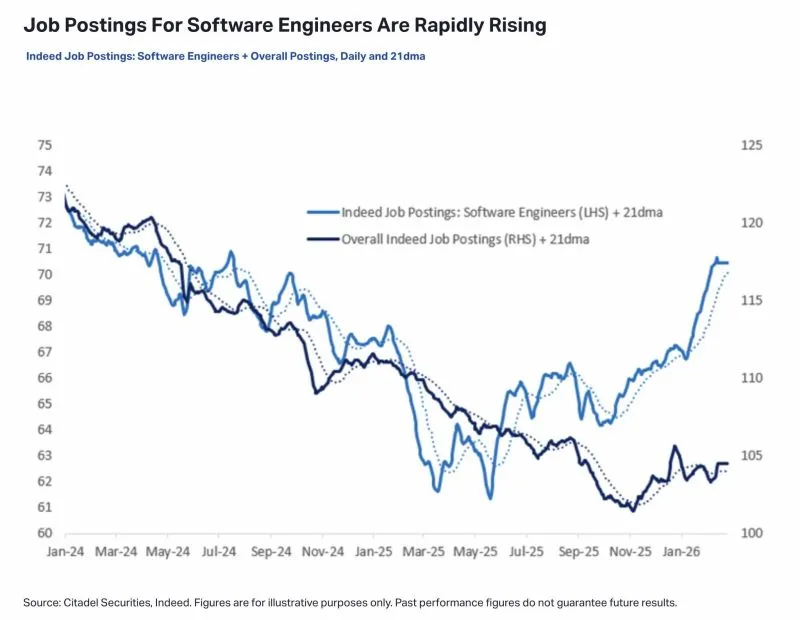
Data from Citadel Securities and Indeed shows that software engineering job postings have inflected sharply upward, rising 11% year-over-year in early 2026, even as agentic coding tools like Claude Code, Cursor, and Codex have moved well beyond autocomplete into full autonomous development. These aren’t coding assistants anymore. They’re coding agents, capable of architecting features, writing pull requests, debugging across codebases, and shipping production code with minimal human intervention. Overall job postings remain relatively flat. But software engineering? It’s pulling away from the pack and accelerating.
This is counterintuitive if you’ve been absorbing the prevailing narrative, especially in a week where Jack Dorsey just cut nearly half of Block’s workforce, roughly 4,000 people, explicitly citing AI as the reason. Weren’t AI coding agents supposed to replace software engineers? If Claude Code is now writing Claude Code, and its creator Boris Cherny says he hasn’t manually written a single line of code since November, why would anyone be hiring more engineers?
The answer is more nuanced than either the optimists or the doomers want to admit. And the best framework for understanding why, one you’ve probably already heard buzzing around LinkedIn, boardrooms, and tech podcasts, is Jevons’ Paradox.
The Most Important Economic Concept in AI Right Now
By now, you’ve likely encountered Jevons’ Paradox in some form. Satya Nadella invoked it after DeepSeek launched. Garry Tan at Y Combinator has been making the case. Aaron Levy at Box spelled it out plainly. It’s become one of the most referenced frameworks in the AI discourse, and for good reason. It’s the single best lens we have for understanding why AI isn’t destroying jobs in the way that panic-driven headlines suggest.
The quick version, for anyone who needs a refresher: In 1865, economist William Stanley Jevons observed that as steam engines became more efficient at burning coal, coal consumption didn’t fall. It skyrocketed. Better efficiency made steam power economically viable for entirely new applications that nobody had previously considered worth the cost. The resource got cheaper to use per unit, so total demand exploded.
This pattern has repeated with striking consistency across every major technological shift since. Containerization cut shipping costs by roughly 90% in the 1960s, and global trade volume increased by orders of magnitude, spawning entirely new industries in logistics and distribution. Cloud computing made IT infrastructure dramatically cheaper, and rather than eliminating IT roles, it created the entire DevOps and cloud architecture profession.
Now swap coal for code. AI tools are dramatically reducing the cost and friction of producing software. And just as the paradox predicts, the result isn’t less software. It’s vastly more. But what makes this moment different from a theoretical economics discussion is that we can now see it in the data, across multiple dimensions, in real time.
The Creation Explosion: We’re Not Just Hiring More Engineers, We’re Building More Everything
The job postings data from Citadel Securities tells one side of the story. But there’s a second dataset that makes the case even more powerfully, and it’s the one that should reshape how executives think about what’s actually happening on the ground.
According to data from a16z, Sensor Tower, and Wells Fargo Securities, new iOS app releases surged 60% year-over-year by December 2025. This came after three years of essentially flat growth. The trailing twelve-month figure hit 24% growth, a dramatic reversal from the stagnation that had characterized the App Store since 2022.
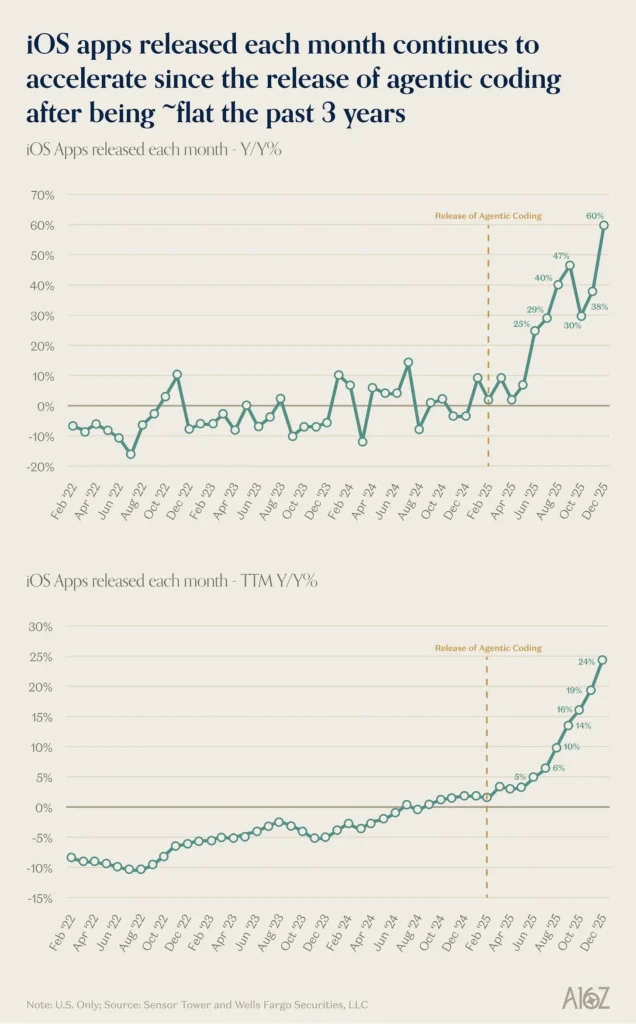
And it’s not just apps. Financial Times analysis shows a synchronized explosion across every measurable indicator of software creation. New website registrations have accelerated to roughly 40% year-over-year growth. GitHub code pushes in the U.S. jumped to approximately 35% growth, while the UK saw around 30%. All of these metrics had been flat or slightly negative throughout 2022 and 2023 before the sharp uptick.
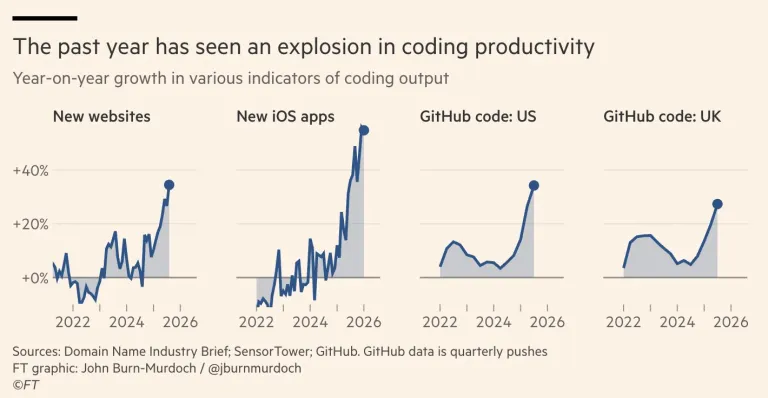
The timing is not coincidental. The inflection aligns directly with the release and widespread adoption of agentic coding tools, not the earlier generation of autocomplete assistants, but true AI agents capable of autonomously executing multi-step development tasks from natural language descriptions. a16z draws a parallel to 2008, when Apple released the iPhone SDK and the App Store launched with 500 apps but hit one million downloads within a weekend. We may be witnessing an equivalent inflection point for software creation itself.
This is the part that matters most for strategic planning. The story isn’t just “companies are hiring more engineers.” It’s that the total surface area of software being created is expanding in every direction: by professional engineers shipping faster, by small businesses building tools they never could have justified before, by solo founders turning ideas into products in a weekend, by non-technical operators automating workflows that previously required a development team. The Apple App Store reached 2.28 million total apps by the end of 2025, an increase of 160,000 year-over-year.
This is Jevons’ Paradox made visible. The cost of creating software dropped, and the world responded by creating dramatically more of it.
Beneath the Numbers: What’s Actually Driving the Demand
Let’s ground this in the mechanics that matter for organizational strategy.
According to Citadel Securities’ February 2026 macro strategy report, authored by Frank Flight in direct response to viral AI doomsday narratives, the broader labor market data tells a story that contradicts the displacement panic:
Software engineering job postings are up 11% year-over-year. This isn’t a marginal tick. It’s a clear trend reversal from the post-pandemic tech correction.
U.S. unemployment sits at 4.28%. Not the profile of an economy in the early stages of mass displacement.
AI capital expenditure has reached approximately $650 billion, roughly 2% of U.S. GDP. This spending is creating entirely new categories of demand, from the approximately 2,800 data centers planned for U.S. construction to the engineering talent needed to build, deploy, and maintain AI systems.
New business formation remains elevated. U.S. Census Bureau data shows over 5.1 million new business applications per year on average since the pandemic surge began, with January 2026 seeing 532,319 seasonally adjusted applications, a 7.2% monthly increase.
Meanwhile, the St. Louis Fed’s Real-Time Population Survey data on AI adoption shows something that should temper the most extreme predictions on both sides: the intensity of daily AI use for work remains remarkably stable. There is no exponential inflection in adoption frequency, which means the displacement timeline many analysts have projected is, at minimum, premature.
As Flight’s report notes, AI adoption is following the same historical S-curve we’ve seen with personal computers, the internet, and smartphones: slow start, gradual acceleration, then plateauing, not overnight disruption.
The Five-Stage Cycle: How This Actually Plays Out Inside Organizations
Aaron Levy, CEO of Box, articulated the mechanism as clearly as anyone: when you lower the cost of something that was previously supply constrained, demand for that thing goes up. Software engineering has been supply constrained for decades. The bottleneck was never a shortage of problems to solve. It was the cost and complexity of solving them.
Here’s how the cycle actually plays out inside organizations:
Stage 1: Capability awareness. Every small business, IT team, and enterprise sees that engineering can now drive vastly more output per person. An engineer with AI tools can prototype in hours what used to take weeks. A team of five can ship what used to require fifteen.
Stage 2: Ambition expansion. Leadership starts considering all the things they could build or automate, projects that were previously deprioritized because they couldn’t justify the engineering headcount. Internal tools. Customer-facing features. Workflow automations. Data pipelines. Integrations. Things that never made it past the “we don’t have the resources” conversation.
Stage 3: Prototype validation. Teams, sometimes non-technical stakeholders, start testing ideas themselves using agentic tools. They vibe code prototypes with Claude Code or Cursor. They use platforms like Lovable, Bolt, or Replit to spin up functional apps from natural language descriptions. They get surprisingly far. This is exactly what’s driving the iOS app surge and the explosion in new websites: people who previously couldn’t build software are now shipping it.
Stage 4: The complexity wall. They hit the reality that getting from prototype to production-grade software involves far more than generating code. Security. Testing. Deployment. Monitoring. Compliance. Performance optimization. Data architecture. Integration with existing systems. Maintaining the thing once it’s live. Atlassian’s internal data shows engineers spend only about 16% of their time actually writing code. The remaining 84% goes to coordination, debugging, testing, deployment, documentation, and the operational burden of keeping software running.
Stage 5: Hiring acceleration. Organizations hire more engineers, not to write code in the traditional sense, but to architect systems, manage complexity, oversee AI-generated output, and maintain an expanding surface area of software that their organization is now ambitious enough to build.
The creation explosion data confirms this cycle is playing out at scale. Sixty percent more iOS apps, 40% more websites, 35% more GitHub pushes: all of that new software needs to be maintained, secured, scaled, and integrated. The paradox feeds itself. More creation leads to more complexity, which leads to more demand for expertise.
The Democratization Dimension: More Builders Means More Demand for Professionals
There’s a secondary dynamic embedded in the a16z and FT data that deserves its own attention, because it has massive implications for how companies think about talent and go-to-market strategy.
The explosion in iOS apps and new websites isn’t being driven primarily by professional engineering teams shipping faster. It’s being driven by a massive expansion of who is building software in the first place. Solo founders. Small business owners. Marketing teams. Operations managers. People who had an idea for an app three years ago but couldn’t code and couldn’t afford a developer.
Agentic coding tools have democratized creation in the same way that YouTube democratized video production and Shopify democratized e-commerce. The barrier to entry has collapsed, and latent demand that was always there (the restaurant owner who wanted a custom ordering app, the consultant who wanted to automate client onboarding, the teacher who wanted to build an interactive learning tool) is now being unlocked at scale.
But here’s what every wave of democratization teaches us: more amateur creators don’t replace professional creators. They expand the market and increase demand for professionals.
When YouTube made it easy for anyone to upload a video, it didn’t kill the professional video production industry. It created an entirely new economy of content creators who eventually needed professional editors, thumbnail designers, producers, and strategists. When Shopify made it easy to launch an online store, it didn’t eliminate the need for e-commerce engineers. It created millions of stores that eventually needed custom development, integrations, and performance optimization.
The same pattern is unfolding with vibe-coded software. Every solo founder who ships an MVP that gains traction will eventually need professional engineering help to scale it. Every small business that automates a workflow with AI-generated code will eventually need someone to maintain and extend it. Every non-technical operator who builds an internal tool will eventually need it to integrate with the rest of the company’s systems.
The creation explosion isn’t replacing the engineering profession. It’s massively expanding the funnel of software that eventually requires professional engineering.
The Role Is Shifting, Not Disappearing: What “Software Engineer” Means in 2026
Consider what’s happening at the bleeding edge. Boris Cherny, the creator and head of Claude Code at Anthropic, hasn’t manually written a single line of code since November 2025. He shipped 22 pull requests in one day, 27 the next, every one of them 100% written by Claude. Across Anthropic, between 70% and 90% of all code is now AI-generated. Claude Code itself is roughly 90% written by Claude Code. The tool is building itself.
And yet Cherny is, by his own account, one of the most productive engineers at Anthropic. Not despite not writing code, but because of it. As he put it on Lenny Rachitsky’s podcast: “The fun part is figuring out what to build. It’s talking to users. It’s thinking about these big systems. It’s thinking about the future. It’s collaborating with other people on the team, and that’s what I get to do more of now.”
This is the clearest preview we have of what the engineering role becomes. Not eliminated. Transformed. And the transformation is creating more demand, not less, because it shifts engineers from the bottleneck of production into the higher-leverage work of deciding what to build and why.
Cherny predicts the title “software engineer” will start to be replaced by “builder,” and that’s already happening in practice. Everyone on the Claude Code team codes, from the product manager to the finance lead. The lines between engineering, product, and design are blurring. The question is no longer “can you write code?” It’s “can you think clearly about systems, users, and outcomes, and orchestrate agents to execute on that thinking?”
Several capability shifts are defining this new role:
From code authorship to system orchestration. The center of gravity has moved away from writing syntax and toward designing systems, defining constraints, reviewing AI-generated output for correctness and security, and making architectural decisions that agents are not yet reliable at making autonomously.
From individual output to multi-agent management. Engineers are increasingly orchestrating multiple AI agents and sub-agents in parallel, standing up workflows where autonomous systems coordinate to accomplish complex tasks. This is closer to engineering management than traditional coding, and it requires deep technical understanding of both the domain and the agents’ capabilities and limitations.
From building features to maintaining expanding systems. As the total number of active codebases, microservices, internal tools, and integrations multiplies (a trend the a16z and GitHub data makes vividly clear) the operational burden grows with it. Someone has to own the reliability, performance, and security of all that software. Agents can write it, but humans still have to architect, govern, and maintain it.
From specialist to generalist builder. AI agents compress the specialist advantage in narrow domains (writing CSS, generating boilerplate, translating between languages) while amplifying the advantage of people who can think across the entire stack and across disciplines. As Cherny advises: “Try to be a generalist more than you have in the past. The people who will be rewarded most won’t just be AI-native. They’ll be curious generalists who can think about the broader problem they’re solving.”
LinkedIn’s 2025 Emerging Jobs Report found demand for AI-fluent software engineers surging nearly 60% year-over-year, with compensation premiums of 15–25% for developers proficient in AI frameworks and orchestration tools. The market is pricing this shift in real time.
Software Engineering Is the Tip of the Spear: Every Domain Is Next
Here’s the part that most analysis misses, and it’s the most strategically important takeaway: software engineering is simply the first domain where we’re seeing the paradox play out with AI because it’s had the highest adoption curve. Engineers were the earliest and most intensive adopters of AI tools. They were the canary in the coal mine, and the canary is singing.
The same dynamic is coming for every knowledge domain.
Once people in any function realize they can just do things (spin up agents to automate workflows, create content, analyze data, build internal tools, prototype new products) the constraints shift from “we don’t have the resources” to “how fast can we move?” The scope of what individuals and teams attempt will expand dramatically. Humans have an innate drive to think ambitiously, fill their time, and always strive for more. When AI agents and sub-agents remove constraints on what a single person can accomplish, people don’t sit idle. They expand their scope. They identify new problems. They pursue projects that were previously impossible.
Consider the parallels already emerging:
Marketing and content. AI is making content production dramatically faster and cheaper. The result isn’t less content. It’s an explosion of demand for more personalized, more targeted, more channel-specific content. And organizations need people who understand audience, brand, and strategy to orchestrate that expanded output.
Legal. AI can draft contracts, review documents, and summarize case law at a fraction of the previous cost. The likely result isn’t fewer lawyers. It’s legal services becoming accessible to businesses that previously couldn’t afford them, expanding the total addressable market for legal expertise.
Finance and analysis. AI can generate reports, model scenarios, and process data far faster than any human. The result is more analysis, more scenarios, more decision-support, and a greater need for people who can interpret the output, validate assumptions, and make judgment calls.
Operations and process automation. AI agents can automate workflows that previously required dedicated headcount. But every automation creates new decision points, exception handling requirements, and oversight needs, expanding the operational surface area that humans manage.
The iOS app explosion is the proof-of-concept. It’s what happens when you take one domain, mobile software, and dramatically lower the cost of creation. You get 60% more apps in a single month. Now extrapolate that pattern across every knowledge domain, every industry, every function. That’s where we’re headed.
What the Paradox Doesn’t Guarantee: Block, the Counterpoint, and the Risks Executives Must Manage
Intellectual honesty requires confronting the elephant in the room. The same week that Citadel Securities published data showing software engineering jobs rising 11%, Jack Dorsey announced that Block, the parent company of Square and Cash App, was cutting over 4,000 employees, nearly half its global workforce, reducing from over 10,000 to just under 6,000.
Dorsey was unusually direct about the reasoning. “We’re already seeing that the intelligence tools we’re creating and using, paired with smaller and flatter teams, are enabling a new way of working which fundamentally changes what it means to build and run a company,” he wrote. “And that’s accelerating rapidly.” He predicted that within the next year, “the majority of companies will reach the same conclusion and make similar structural changes.”
Block’s stock surged over 20% on the announcement. Investors loved it. Four thousand people lost their jobs. Both things are true at the same time, and both matter.
So how do you reconcile Block cutting 40% of its workforce with Indeed data showing software engineering demand rising 11%? The answer is that Jevons’ Paradox operates at the market level, not necessarily at the individual company level. The total demand for software and engineering talent is growing. But within any single organization, AI can absolutely enable the same or greater output with fewer people, especially if that company overhired during the pandemic (Block nearly tripled its headcount between 2019 and 2022) and is now using AI as both the catalyst and the justification for a structural correction.
Several analysts have noted that Block’s cuts look as much like a cleanup of pandemic-era bloat as a pure AI play, what some are calling “AI-washing” of traditional cost-cutting. A Babson College survey of over 1,000 executives in late 2025 found that while many organizations were making cuts citing AI’s promise, only about 2% were making cuts tied to actual AI implementation. The distinction matters.
But here’s the harder truth that Dorsey’s letter surfaces: even if some of Block’s cuts were overdue regardless of AI, the pattern he’s describing (smaller teams, AI at the core, flatter structures) is real and it is coming for individual companies across industries. The question is whether the new demand created by the paradox absorbs the displaced workers fast enough and broadly enough.
That tension is exactly what makes this moment so consequential. And it points to several caveats that should inform any serious workforce strategy:
The paradox has limits. When demand for a resource isn’t elastic enough to absorb efficiency gains, displacement does occur. Farming employment dropped from roughly a third of U.S. workers in the early 1900s to about 1.3% today because human demand for food, while it grew, couldn’t grow fast enough to offset the dramatic productivity gains in agriculture. Some categories of work may follow this pattern rather than the Jevons pattern.
Timing and distribution are uneven. This is the crux of the Block situation. Job losses from automation tend to be sharp, concentrated, and visible: 4,000 people at one company on one day. The new jobs created by expanded demand tend to emerge slowly, unevenly, and often in different geographies, different companies, and different organizational structures. As one tech recruitment consultant put it, the hiring isn’t happening at the big names doing layoffs. It’s happening at medium-sized companies in other industries that need people to build and manage the technology those big names are deploying. That gap between destruction and creation is where real human pain lives, and it demands proactive planning.
Full substitution is different from augmentation. Where AI fully substitutes for a task, not just augments it, the demand for that specific human role can remain permanently depressed. The question for each role isn’t “can AI do any part of this job?” It’s “is AI a complement that amplifies human output, or a substitute that replaces it?” Dorsey is betting on substitution at the company level. The macro data suggests complementarity at the market level. Individual workers experience the former long before they benefit from the latter.
The natural ceiling on automation. Citadel Securities makes a critical point often overlooked in displacement narratives: if automation scales at the pace doomers predict, compute demand would skyrocket, driving up the marginal cost of AI-powered work. If that cost rises above the cost of human labor for certain tasks, substitution simply won’t occur. Physical capital, energy, and regulation create a natural economic brake on runaway displacement.
Practical Implications: What Leaders Should Do Now
If the paradox holds, and the current data strongly suggests it does for knowledge work, the strategic implications are significant:
Invest in AI fluency across your workforce, not just in your engineering team. The organizations that will capture the most value from AI are the ones that expand the population of people who can leverage it. The iOS app and website data proves the point: when more people can build, more things get built. Every team that becomes proficient with agentic tools will generate new demand for more ambitious projects, and Boris Cherny’s observation that everyone on the Claude Code team codes, from PMs to finance, shows where this is heading.
Redefine roles around judgment, architecture, and orchestration. The tasks that AI automates are becoming table stakes. The roles that grow in value are the ones focused on the work AI can’t do reliably: making ambiguous decisions, designing systems, managing complexity across organizational boundaries, and maintaining quality as output scales.
Plan for expanded scope, not just cost reduction. The companies that use AI primarily for headcount reduction are leaving the largest opportunity on the table. The strategic winners will be the ones that use AI-driven efficiency to attempt things they never would have considered before: entering new markets, building new products, automating processes that were previously too expensive to touch.
Prepare for the transition, not just the destination. Even if the long-run outcome is more jobs and more demand, the short-run can be disruptive. Workforce planning should include reskilling programs, internal mobility frameworks, and honest assessment of which roles are being augmented versus substituted.
Watch the data, not the narratives. The Indeed job postings data, Census Bureau business formation statistics, a16z app release metrics, and Fed adoption surveys are more reliable signals than viral Substack posts or social media hot takes. Build your strategy on real-time labor market data, not fear-driven projections.
The Bottom Line
The chart from Citadel Securities and Indeed tells one part of the story: as AI makes software engineering more productive, demand for software engineers is rising, not falling. The a16z and Financial Times data tells the other part: the total volume of software being created (apps, websites, code) is exploding across the board.
Together, they paint a picture that is the most powerful real-time illustration of Jevons’ Paradox any of us have seen. The cost of creating software collapsed, and the world responded by creating dramatically more of it. That creation requires more human expertise to architect, maintain, scale, and secure, not less.
Software engineering is the leading indicator. As AI adoption deepens across every knowledge domain, the same cycle of efficiency, expanded ambition, democratized creation, and increased demand for human expertise will follow. The organizations and individuals who understand this dynamic, and plan accordingly, will be the ones who thrive.
The future isn’t fewer humans. It’s humans with dramatically expanded capabilities, attempting dramatically more ambitious things, and needing dramatically more expertise to pull it off. The demand for human ingenuity isn’t contracting. It’s compounding.