Your AI pilot worked. The model did what it was supposed to do, the demo landed, and the early users liked it. Leadership saw enough to believe there was something there.
Four months later, eleven people in one department are still the only ones using it, and finance wants to know what the budget bought.
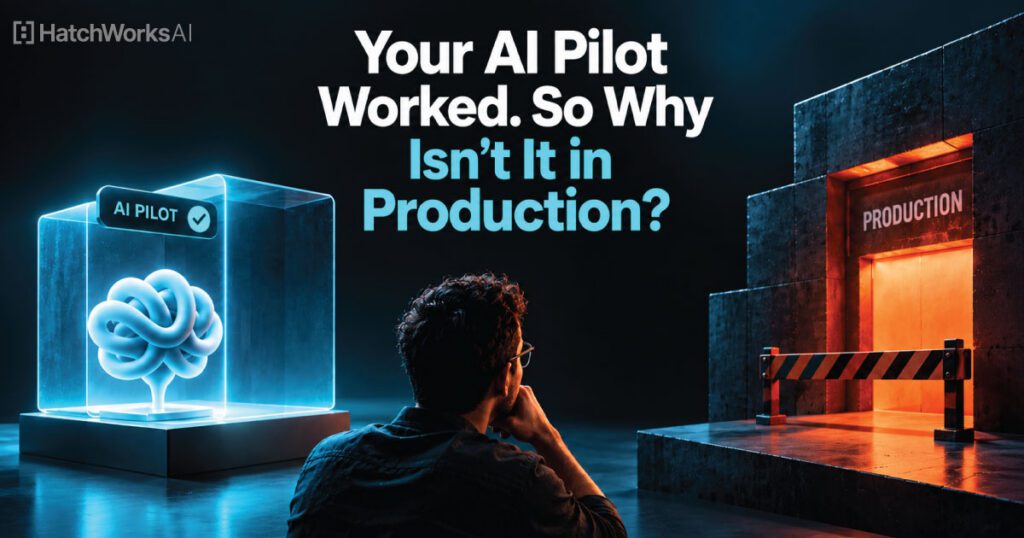
This is where a lot of AI initiatives stall, and the stall is easy to misdiagnose because nothing obviously failed. The model worked. The team may have hit every milestone it set. The problem is that the pilot ran under conditions production was never going to repeat.
Your AI pilot was subsidized
Pilots get advantages production systems do not.
Someone hand-picked the data, so it was cleaner than what normally arrives. The scope was deliberately narrow, so the model saw few inputs outside its design. The first users were volunteers who were interested in the project and willing to tolerate rough edges.
Integrations were limited because the pilot could sit beside the existing workflow rather than inside it. Governance was lighter because the system was not yet touching customers, transactions, or regulated processes. And when something went wrong, the person who built it was usually nearby.
Every one of those conditions is a subsidy. Production withdraws them.
Real data is messy. Users are busy. Existing systems have permissions, dependencies, and technical debt.
Edge cases stop being edge cases at thousands of transactions a day. Errors need escalation paths. Costs that looked trivial during the pilot start showing up on a P&L.
That is why a successful demonstration tells you less about production readiness than it feels like it should, and why the gap between companies that scale AI and companies that stall so rarely comes down to the model. A pilot proves the capability can work. Production shows whether the organization around it can support it.
Production withdraws the subsidies
Each subsidy the pilot enjoyed becomes a question production will ask. Eight of them matter more than whether the demo worked.
Can it operate on production data?
A pilot built on a curated set of documents or transactions can perform extremely well. Production means the full range of data: missing fields, conflicting records, unexpected formats, stale records, duplicates, and inputs nobody designed the demo around.
The system also has to reach that data where it actually lives, often across several systems, while respecting the access rules already in place. You need to know how it performs once the clean pilot slice disappears.
Does it fit into the actual workflow?
The production system has to live where the work happens. If employees have to leave the tools they already use, paste information into another interface, and carry the answer back, adoption gets harder immediately.
The question is not only whether AI can do the task. It is how the surrounding workflow changes when AI becomes part of it.
Do you know what failure looks like?
Production requires evaluation against the inputs that actually arrive, including malformed, ambiguous, and unusual ones. You need a baseline for acceptable performance, a way to detect regression, and a clear view of which errors matter most.
Without that, you know the system worked in the pilot. You do not know whether it keeps working.
What is it allowed to do?
The governance bar rises quickly when an AI system moves from answering questions to taking actions.
What data can it access? What can it write back? What transactions can it start? What needs human approval? The more agency the system has, the more explicit those boundaries need to be.
Do the economics still work at scale?
Token pricing is easy to calculate. Cost per business transaction is harder. Production adds larger context windows, multiple model calls, retrieval, monitoring, retries, human review, and the infrastructure around the model.
Finance will eventually stop asking what the model costs and start asking what it costs to complete the work.
What happens when the AI gets stuck?
During a pilot, escalation often means walking over to the person who built it. That does not scale. Production needs a defined path for exceptions, a named owner, and an agreed response.
Will people actually use it?
Pilot users volunteered. They wanted the project to work, forgave rough edges, and made time to learn a new tool. Production users signed up for none of that.
Adoption looks different depending on who the system serves. An internal tool needs employees to trust it enough to change how they work. That usually takes training, a manager who expects it to be used, and proof that it saves time instead of adding a step. A customer-facing product needs end users to find it, understand it, and choose it over the way they already get things done. Either way, a weak experience does not produce complaints. People just quietly go back to the old way.
Eleven users in one department four months after launch is an adoption problem, not a model problem. Before rollout, you need to know who has to use the system, what will get them to start, and how you will measure whether they are still using it a quarter later.
Did the workflow actually change?
An AI system can reach production and still produce very little value if people keep working exactly as they did before. The business case depends on something changing: time saved, throughput increased, revenue improved, cost reduced or risk removed.
Eight questions sound like a lot if you ask them at the end. It is a much shorter list when you ask them before approving the pilot.
Do 95% of AI pilots really fail?
The most quoted number in this conversation comes from MIT's Project NANDA report, The GenAI Divide: State of AI in Business 2025. It is usually repeated as "95% of AI projects fail."
That is not what it measured. The report found that "95% of organizations are getting zero return" on their generative AI investment. One organization might run one initiative or a dozen, so an organization reporting no return and an individual pilot failing are two different measurements.
There are plenty of reasons to worry about AI initiatives getting stuck between experiment and value. A headline number that measures something else does not help you fix yours. The more useful question is why an initiative that visibly worked never became something the organization could run.
Most pilot failures start months before the pilot stalls
By the time an AI pilot gets stuck, the decision that caused the problem is often months old.
The opportunity was chosen because it made a compelling demo, not because it was attached to a valuable business problem. Success was never defined in a unit finance would recognize. The data a production version needed was scattered across systems nobody had evaluated. Nobody owned the workflow the AI was supposed to change.
The infrastructure decision was pushed off because the team wanted to move quickly, and governance became something to solve after the technology proved itself.
These problems eventually show up as technical blockers, but most of them started as planning decisions. All of them are far cheaper to find before a team spends a quarter building something.
Readiness changed what got built first
A general contractor we worked with had no shortage of ideas. Interviews with its leadership team and subject-matter experts surfaced more than 50 AI use cases across estimating, project management, field operations, procurement, safety, and finance. Once each one was qualified and prioritized, four rose to the top.
The data told a harder story. Critical data was fragmented across disconnected systems, and without a solid foundation, even the most promising use cases would have stalled at implementation. So instead of pushing the most attractive ideas straight into pilots, the first phase of the roadmap paired data and infrastructure investment with a few early generative AI wins that could prove value quickly.
That can feel slower. A working demo could have been standing much sooner. But deferring the data problem would not have removed it. It would have moved it to the point in the project where solving it costs the most.
Production readiness should not be a gate you hit after the pilot. It should shape whether an opportunity becomes a pilot in the first place.
Make readiness an input to AI strategy
That is the decision HatchWorks AI built GenROI to support. AI-guided interviews gather perspectives across more roles, teams and functions than a handful of workshops can reach. Our strategists then validate, challenge and synthesize what comes back, and assess each opportunity on four dimensions: value, feasibility, strategic fit and organizational readiness.
That last dimension changes the sequence.
A high-value opportunity may need to wait until its data foundation is in place. Another may depend on an integration that should be built first. A promising use case may need a workflow owner before anybody writes code. And sometimes a less exciting initiative turns out to reach production faster and create value sooner.
That is still progress. Learning an idea is not ready before the pilot costs far less than learning the same thing two quarters later.
What to establish before approving your next AI pilot
Before anyone builds, you should be able to put every row on the left in place. Each row on the right is a question you have chosen to answer later, when changing direction costs more.
None of this makes AI pilots unnecessary. Pilots are valuable when they test what the organization does not know yet. The problem is letting a pilot's subsidies hide answers you could have had before anyone started building.
Settle those first. Then use the pilot to learn what only a pilot can teach you.
Frequently asked questions
What percentage of AI pilots actually fail?
Nobody has a reliable universal percentage. The most frequently quoted statistics measure different things, including organizations reporting no return, proofs of concept that were abandoned, and projects that never reached production. Before a failure statistic goes into a board presentation, check exactly what population and outcome the research measured.
Why do AI pilots succeed and then fail in production?
Pilots run under favorable conditions that production removes: cleaner data, narrower scope, motivated early users, fewer integrations, lighter governance, and easy access to the people who built the system. Production brings real data, full workflows, permissions, scale, economics, adoption requirements, and edge cases. A pilot can prove the technology works without proving the organization can operate it.
What should an AI pilot prove before it moves to production?
At minimum, that the system works on realistic inputs, can operate inside the intended workflow, has viable economics at scale, and has a clear plan for data access, integrations, permissions, governance, and escalation. It should also be tied to a business outcome that can be measured after deployment. A pilot that only proves the model can complete the task has proved technical capability, not production readiness.
Related from elsewhere on the blog: From Pilot to P&L: Building Owned AI Across a Portfolio covers the same stall from the private equity sponsor's side. How to Identify AI Use Cases That Are Worth Building covers how to choose what to pilot in the first place.