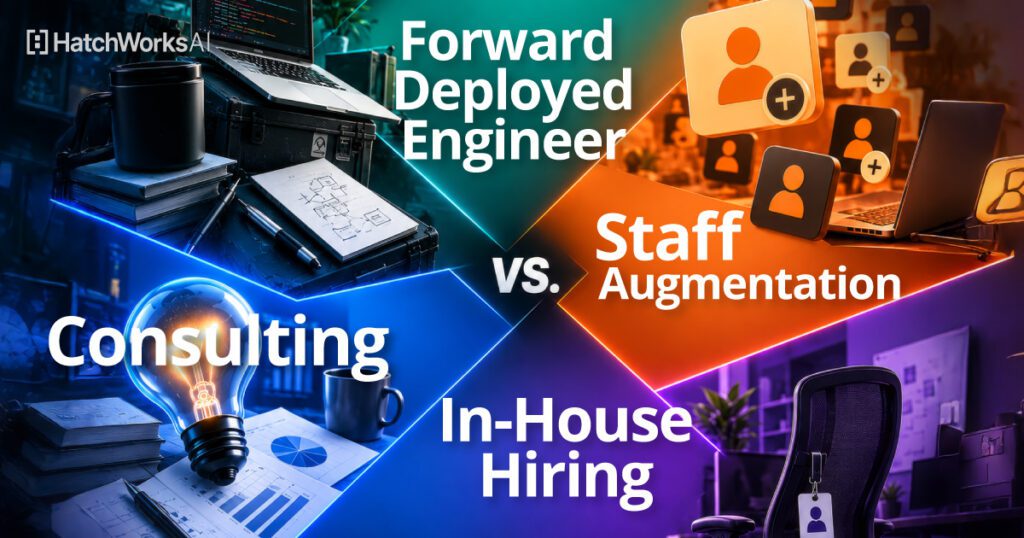
Staff augmentation adds capacity: more hands on a backlog you have already defined. A forward deployed engineer adds AI execution capability: someone who finds the opportunity, builds the system, and makes it stick. Consulting hands you a recommendation and leaves; in-house hiring is a strong long-term bet but a slow one in the current market. For getting AI into production this year, the difference between these four models decides whether anything ships at all.
If you lead engineering or data and you are trying to get real AI systems into production, you have four ways to get help: augment your staff with contractors, hire a consultancy, hire full-time in-house, or embed a forward deployed engineer. They are not interchangeable, and the AI shift has changed which one fits when. This guide compares all four honestly, including where staff augmentation is still the right answer, so you can match the model to the problem instead of the sales pitch.
The short version
Key takeaways
- Staff augmentation is capacity for a defined backlog. It works when you already know exactly what to build.
- Consulting gives you a strategy and a deck, then leaves before the production work that AI projects live or die on.
- In-house hiring builds durable capability but competes in a market where FDE postings grew more than 800% in nine months.
- A forward deployed engineer finds the opportunity, ships the system, and transfers the capability, closing the gap where most enterprise AI stalls.
- The honest rule: match the model to whether the bottleneck is capacity, strategy, headcount, or getting AI into production.
The decision every engineering leader is re-running in 2026
The build-versus-buy-versus-borrow question is old. What changed is where the bottleneck sits.
For traditional software, the scarce thing was engineering capacity: you knew what to build, you needed more hands to build it, and staff augmentation or an outsourced team solved that cleanly. AI moved the bottleneck upstream. The hard part is no longer writing the code. It is knowing which AI use case is worth building, connecting it to messy real data, and getting people to actually adopt what ships.
That is why the sourcing decision feels different now, and why the old comparison pages do not quite fit. If you arrived here comparing staff augmentation vendors, weighing nearshore against offshore, or pricing an outsourced development team, you are asking a capacity question about what has become a capability problem.
The four models below still all exist. But for AI work specifically, they sort very differently than they did for your last CRM migration.
The four models compared
Here is the honest side-by-side. Read it as a fit guide, not a ranking: each model wins in a different situation.
Forward deployed engineer, staff augmentation, consulting, and in-house hiring compared across what you get, who defines the work, time to production value, knowledge left behind, cost profile, and best-fit situation.
| Forward Deployed Engineer | Staff Augmentation | Consulting | In-House Hire | |
|---|---|---|---|---|
| What you get | An embedded senior AI builder who finds, ships, and transfers | Extra engineering hands on your existing backlog | Strategy, assessment, and recommendations | A permanent team member |
| Who defines the work | The FDE, working inside your business | You do, in advance | The consultancy, then hands it back | You do, and manage it |
| Time to production value | Weeks | Depends entirely on your spec quality | Rarely reaches production directly | Months to hire, then ramp |
| Knowledge left behind | Codified patterns and an upskilled team | Whatever your team absorbs informally | A document | Stays in-house by definition |
| Cost profile | Premium rate, short duration, outcome-focused | Lower rate, scales with headcount and time | High fixed fee for the engagement | Salary, equity, benefits, recruiting cost |
| Best when | You have AI ambition but nothing in production | You have a defined backlog and a stable stack | You need an outside strategic view | AI is a permanent core competency you must own |
The table makes the pattern visible: the models differ most on who defines the work and what survives after the engagement. Those two rows are where AI projects are won and lost.
Staff augmentation: what it solves and where it stops
Staff augmentation deserves a fair hearing, not a strawman, because for the right problem it is the most efficient option on this list. When you have a clearly defined roadmap, a stable architecture, and a genuine shortage of hands, adding vetted engineers to your team is fast, flexible, and cost-effective. Plenty of good software gets built this way, and there is nothing second-rate about it.
It stops at one specific place: when nobody has written down what to build.
Augmentation assumes the thinking is done and the work is specified. AI initiatives usually fail that assumption. The use case is fuzzy, the data reality is unknown until someone digs in, and the definition of done keeps moving as the team learns what the model can and cannot do. Drop augmented engineers into that and you get motion without direction: they build exactly what the ticket says, and the ticket was the problem. Capacity multiplied by an undefined objective is still an undefined objective.
There is a second, quieter limit. Augmentation is designed to leave nothing behind on purpose; the arrangement is capacity for a period of time. For AI work, the thing you most need to keep is the capability, the patterns, and the adoption. That is not a knock on the model. It is just outside what the model is for.
What about nearshore, offshore, and outsourced teams?
These are variations on the capacity model, and the same logic applies with one extra wrinkle. Nearshore and offshore outsourcing optimize the cost of hands, which is a real lever when the work is well specified and largely independent. The trade you are making is coordination distance: time zones, communication overhead, and context loss. For a defined build, that trade can be worth it, and many teams run it successfully.
For AI work, coordination distance is expensive in a specific way, because the whole value depends on tight feedback loops with the people who own the workflow and the data. The more the success of a project hinges on discovering what to build rather than executing a fixed spec, the less an arms-length outsourced arrangement fits, and the more you want the builder embedded where the problem actually lives.
If you are weighing nearshore against offshore for an AI initiative, the more useful question is not which geography is cheaper, but whether the work is defined enough for a capacity model at all.
Consulting: the strategy-to-execution gap
Management and technology consultancies are very good at what they do: bringing an outside perspective, benchmarking you against peers, and producing a considered strategy. For a board that needs an independent read on where AI could matter, that has real value.
The pattern is familiar to anyone who has commissioned a strategy engagement: a strong opening, a lot of interviews, a polished readout, and then a quiet realization months later that the deck is still a deck. The recommendations were probably sound. The organization simply had no mechanism to execute them, because the people who understood the plan best had rolled off.
The problem is the handoff. Consulting typically ends where the hard part of AI begins. You receive a thoughtful assessment, a prioritized roadmap, and a slide deck, and then the consultants leave before a line of production code exists. The gap between the recommendation and a running, adopted system is exactly the gap where enterprise AI dies, and it is precisely the part a pure-strategy engagement does not own.
The forward deployed engineer is the one who stays in the room until the thing is live.
Matt Paige, VP of Strategy, HatchWorks AI
A recommendation you cannot execute is a cost, not an asset.
In-house hiring: the right long-term bet, the wrong short-term clock
If AI is going to be a permanent core competency for your company, and for most it will be, then building an in-house team is the correct destination. Nobody should outsource their AI capability forever. The question is timing, and the current market makes the short-term math brutal.
Forward deployed engineer is, by several accounts, the hottest job in AI.
Growth in forward deployed engineer job postings between January and September 2025. OpenAI lists the role in New York at $220,000 to $280,000 plus equity. Sources: Salesforce, citing Indeed and Financial Times job-posting analysis; The New Stack, May 2026.
Every AI lab, every large integrator, and Salesforce with its commitment to hire 1,000 FDEs are all competing for the same scarce people you are trying to hire. Realistically, sourcing, closing, and ramping a senior AI builder is a multi-month exercise with no guarantee at the end.
An embedded FDE is not a substitute for that hire. It is a bridge to it. You get production systems now, and your team levels up by building alongside a senior AI engineer, which makes the eventual in-house hire easier to attract and faster to onboard. The two strategies compound rather than compete.
Put an Anthropic-certified Forward Deployed Engineer inside your team
Our FDEs deploy Claude into your business and make it stick, from first opportunity to production system.
Explore FDE engagementsWhat you are actually buying: the translation layer
Here is the insight that reorders the whole comparison, and it comes from the people who do the hiring. Technical skill, the ability to write good code and wire up a model, is table stakes now. It is necessary and increasingly abundant, because AI tooling has raised the floor for everyone.
The rare and valuable thing is the translation layer: the ability to sit between what AI can do and what a specific business actually needs, and to turn one into the other.
That is the capability staff augmentation does not sell, consulting sells only the front half of, and the hiring market prices at a steep premium. It is the entire job of a forward deployed engineer.
Matt Paige has written about the broader version of this in his analysis of the AI pay gap, drawing on PwC's study of nearly a billion job postings: the market is paying up for people who can put AI to work, not merely for people who can code. When you engage an FDE, the translation layer is the thing you are renting, and it is the thing that determines whether your AI investment produces a demo or a P&L impact.
How to choose: match the model to the bottleneck
Strip away the labels and the decision is about naming your actual constraint honestly.
Capacity
Defined backlog, stable stack, just need more hands. Staff augmentation. An FDE would be overkill.
Strategy
You need an independent view of where AI matters before committing. A focused consulting engagement, ideally one that can also execute.
Production
You have AI ambition, maybe stalled pilots, and nothing live. The FDE's home ground: find, ship, multiply.
Permanence
AI is core and you must own it. Hire in-house, with an FDE as the bridge that ships now and upskills the team.
A quick way to pressure-test your own answer
Try to write the spec for your top AI initiative in one page. If you can, cleanly, with the data sources named and the definition of done fixed, your bottleneck really is capacity, and a capacity model will serve you.
If you cannot, if the exercise keeps surfacing unknowns about the data, the workflow, or what good even looks like, then the work you need done is discovery and production ownership, not execution of a settled plan. No amount of added capacity substitutes for that.
Most enterprises we work with discover their real bottleneck is production, and they only see it clearly once they stop describing the problem as a staffing gap. That reframe, from "we need more engineers" to "we need AI in production and nobody owns getting it there," is usually the moment an FDE becomes the obvious choice.
And because the FDE model is the on-ramp to a full engagement path, you are not locked in: one embedded engineer can scale to an Agentic AI Pod or a broader AI and Data Transformation as the value proves out.
Why the model behind the FDE matters
An embedded engineer is only as strong as the practice behind them, which is the real answer to "why not just hire a great contractor."
At HatchWorks AI, our forward deployed engineers work on Generative Driven Development, our methodology for AI-native delivery, and draw on a pipeline of more than 100 certified engineers plus official partnerships across Anthropic, Google Cloud, and Databricks. That means the FDE in your building is not improvising alone; they bring a repeatable method and a bench behind them.
It also means the knowledge-transfer promise is real rather than aspirational. Because GenDD makes the way of working explicit, the patterns an FDE leaves behind are documented and repeatable, not locked in one person's head. That is the difference between renting capacity and buying capability, and it is the whole reason the comparison in this article tilts the way it does for AI work.
Frequently asked questions
Is a forward deployed engineer more expensive than staff augmentation?
Per hour, usually yes. Per outcome, often no. Staff augmentation bills a lower rate over a longer, open-ended period against work you must define and manage. An FDE carries a premium rate for a shorter, outcome-focused engagement and defines the work themselves. The right comparison is total cost to a production result, not rate card to rate card.
Can an FDE work alongside our existing vendors and contractors?
Yes. FDEs frequently work with in-house teams and existing augmentation or vendor relationships. The FDE typically owns the AI opportunity and production outcome while other resources handle capacity in areas that are already well defined.
What happens when the FDE engagement ends? Do we lose the knowledge?
No, if the engagement is run properly. Knowledge transfer is a defined phase, not an afterthought. In the Multiply stage, the FDE codifies patterns and upskills your team so the capability stays after they leave. That is the core difference from a model designed to leave nothing behind.
When is staff augmentation actually the better choice?
When your bottleneck is genuinely capacity: a clearly defined backlog, a stable architecture, and a real shortage of hands. In that situation augmentation is faster and more cost-effective than an FDE, and we will tell you so.
Sources
- Salesforce, "Today's Hottest Role: Forward Deployed Engineer," March 2026, citing Indeed and Financial Times job-posting analysis (800% growth; 1,000-FDE commitment)
- The New Stack, "Forward deployed engineer is AI's hottest job," May 2026 (salary band)
- Matt Paige, "The Forward Deployed Engineer Is the Hottest Job in AI" and "The AI Pay Gap," Substack, 2026 (translation-layer thesis; PwC job-postings analysis)
That is a good first conversation
HatchWorks AI is an Official Anthropic Claude Partner, and our Forward Deployed Engineers will give you a straight answer about whether embedding is the right call or whether something lighter fits better.
Talk to an FDE