INSIGHTS FOR PRIVATE EQUITY
Why Custom AI Intellectual Property Is Becoming the Most Important Lever for Exit Value in PE Portfolios
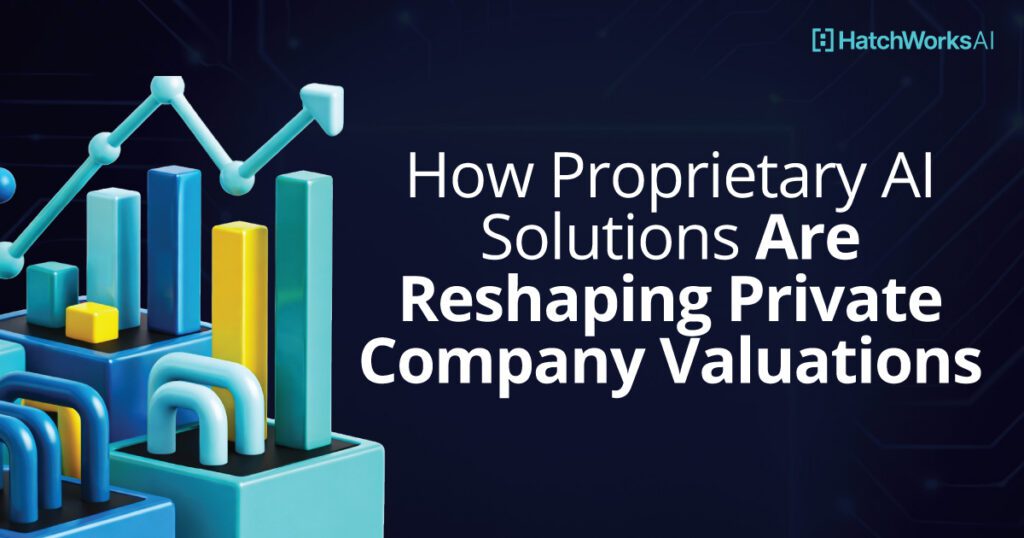
Investment bankers are sending a clear message to their clients right now: valuation multiples are declining for any software or services business that is not generating AI intellectual property as part of what they do.
That is not speculation. It is what deal advisors are telling founders and CEOs in active M&A conversations, and it is what we are hearing directly from partners at some of the most respected CEO coaching and advisory firms in the country. The signal is loud, consistent, and increasingly urgent.
For private equity firms managing portfolios of mid-market companies, this shift has massive implications. The traditional value creation playbook, built on operational efficiency, margin expansion, and revenue growth, is no longer sufficient on its own. The companies commanding premium multiples at exit are the ones that own proprietary AI technology, built into their operations, embedded in their products, and defensible as intellectual property.
This article breaks down exactly how proprietary AI solutions are impacting private company valuations, why this matters for PE portfolio strategy, and what firms can do right now to capture this value before their next liquidity event.
The Valuation Landscape Has Fundamentally Shifted
The numbers tell a compelling story. According to FTI Consulting's 2026 Private Equity AI Radar, which surveyed 200 fund and operating leaders, 95% of funds report that their AI initiatives are meeting or exceeding their original business case criteria. AI is no longer experimental for the firms that have committed to it. It is delivering measurable returns.
At the same time, FTI's 2025 Private Equity Value Creation Index found that 65% of respondents marked AI as a top priority for portfolio value creation. And an earlier FTI survey found that 59% of PE funds now view AI as one of the key drivers of value creation, outstripping traditional factors like historical growth, customer retention, and cyclicality.
That last data point is worth sitting with. For the first time, a majority of PE funds are saying that AI matters more than the metrics that have defined deal evaluation for decades.
But there is an important distinction hidden in these numbers. The value is not coming from generic AI adoption. Using ChatGPT for email drafts or plugging a chatbot onto a website does not move the needle on valuation. What moves the needle is proprietary AI, custom-built solutions that are deeply embedded in how a company operates, sells, or delivers its product.
"Proprietary AI assets in a company can command significant valuation premiums by being valued as intellectual property, creating competitive barriers to entry." — EisnerAmper, How AI Is Shaping the Valuation of Private Companies
Why Proprietary AI Commands a Valuation Premium
To understand why custom AI solutions create outsized value, you need to understand how buyers and investors think about defensibility.
When a company uses off-the-shelf AI tools, they gain efficiency. That is real and valuable. But their competitors can adopt the exact same tools tomorrow. There is no moat. There is no differentiation. And there is certainly no intellectual property a buyer can acquire.
Proprietary AI is different. A custom-built AI solution, trained on a company's unique data, integrated into its specific workflows, and purpose-built for its industry, becomes a defensible asset. It can be valued as intellectual property in an M&A transaction. It creates barriers to entry that competitors cannot simply license from OpenAI or Google. And it signals to buyers that the company has a durable competitive advantage.
EisnerAmper, one of the largest accounting and advisory firms in the U.S., published an analysis on this exact topic. Their research found that companies with proprietary AI technology are securing meaningfully higher multiples. In one client example they shared, a healthcare analytics company with a proprietary patient database powering a machine-learning engine secured a 12x revenue multiple in a PE deal because the technology was defensible and difficult for competitors to replicate.
Meanwhile, companies on the other side of this equation are getting punished. EisnerAmper cited a marketing agency that relied on copywriting and design. Buyers pushed for a lower multiple specifically because AI tools like Jasper and Midjourney could replicate much of the firm's core service at scale. The company's work was commoditized, and the valuation reflected it.
The Premium Is Not Theoretical
The data on valuation premiums is increasingly concrete. According to FE International's 2026 AI Business Valuation Model report, companies with strong IP documentation and proprietary AI technology are commanding dramatically higher multiples. They cited a B2B AI SaaS platform that achieved a 28x ARR multiple at exit, driven by robust IP protection and exclusive customer contracts. Conversely, an AI product company with unclear data rights and weak compliance documentation faced a 25% valuation discount despite strong topline growth.
More broadly, their analysis shows that companies with proprietary technology enjoy a 15-20% valuation premium because it signals protection from market commoditization.
For PE firms evaluating portfolio companies, the takeaway is straightforward: proprietary AI that is well-documented, defensible, and embedded in the business model is one of the fastest paths to a higher exit multiple.
What PE Firms Are Seeing on the Ground
Mark Moses, Founding Partner and Executive Chairman of CEO Coaching International, one of the most respected CEO advisory firms in the country, wrote a widely shared piece on LinkedIn in early March 2026 that captures the urgency of this moment. He said he has been coaching CEOs for 18 years and has never seen a month like February.
His observations were striking. PE firms are treating AI disruption as an existential portfolio risk. They are convening emergency CEO sessions and running rapid-fire risk assessments. Small teams, sometimes a single person with AI agents, are replicating work that used to require entire departments. Complex AI projects are coming in ahead of schedule. And investment bankers are explicitly telling clients that multiples are falling for any software or services business not generating AI intellectual property.
That last point deserves emphasis. The market is repricing in real time. The profit pool is shifting from selling SaaS tools toward selling AI-driven outcomes that augment or replace expensive labor. Companies are moving their budgets from IT to labor budgets, from buying software to buying outcomes.
What Moses is describing is not a gradual shift. It is a compression event. And PE firms that are not positioning their portfolio companies to be on the right side of this shift are leaving significant value on the table.
"What used to require a large development team can now be accomplished with far fewer resources because of AI. In many cases, mid-market companies that previously would have had to 'buy' software can now realistically build something proprietary that they own."
The Build-vs-Buy Calculus Has Changed
One of the most important structural shifts happening right now is the economics of building custom software.
For years, mid-market companies had no realistic path to building proprietary technology. Custom development required large teams, long timelines, and budgets that only enterprise-scale companies could justify. The practical answer was always to buy off-the-shelf software and configure it.
AI has fundamentally changed that equation. What once required a team of 12 engineers working for 18 months can now be accomplished with a team of 3 in a fraction of the time. AI-native development methodologies, where AI is embedded in every stage of the software delivery lifecycle, have compressed timelines and reduced costs to a point where building proprietary technology is realistic for companies that would never have considered it before.
This is a massive unlock for PE portfolio companies. A mid-market business that was previously stuck licensing someone else's software can now build something it owns, something that becomes intellectual property, something that differentiates the business at exit. AI is the sling David can use to compete with Goliath.
For PE firms, this changes the value creation conversation entirely. It is no longer just about operational optimization or commercial acceleration. It is about building proprietary technology that directly increases enterprise value.
If you are a PE firm or portfolio company leader evaluating whether to build proprietary technology or continue licensing off-the-shelf solutions, we put together a detailed framework to help you think through that decision. It covers the key factors that determine when building makes sense, when buying is the right call, and how to evaluate the long-term impact on enterprise value. You can read the full guide here: Build vs. Buy: A Framework for AI Decision-Making.
Four Ways Proprietary AI Drives Exit Value
Strategic buyers in the services sector pay meaningful premiums for companies that demonstrate a specific set of attributes. Each of these attributes can be directly enhanced through proprietary AI.
1. Scalable Operating Models
Technology-enabled growth without proportional cost increases is one of the most valuable characteristics a buyer can find. Proprietary AI solutions that automate high-cost processes, whether that is underwriting, customer service routing, demand forecasting, or quality inspection, allow a company to grow revenue without linearly scaling headcount. This directly improves the unit economics buyers are evaluating.
The impact shows up clearly in the data. According to EisnerAmper, companies leveraging AI-driven logistics achieved approximately 15% cost reductions, 35% inventory improvements, and 65% service-level gains. These efficiency gains translate directly into higher EBITDA margins and more attractive acquisition profiles.
2. Embedded Intellectual Property
Proprietary algorithms, decision systems, and AI models that drive business performance are valued as IP in M&A transactions. Unlike goodwill, which is subjective and often discounted, AI intellectual property is a tangible, transferable asset. It can be documented, audited, and protected. It raises barriers to entry for competitors and reduces the integration risk buyers worry about.
Ocean Tomo, the leading IP-focused advisory firm, has argued extensively that AI assets should be formally recognized as intellectual property on balance sheets. Their research highlights a growing disconnect: companies with billions in enterprise value are carrying AI assets that do not appear on financial statements, which means the true asset value is being systematically underreported. For PE firms, this creates an opportunity. Building and documenting proprietary AI before exit surfaces value that would otherwise remain hidden.
3. Predictable Margins
AI-driven optimization reduces volatility and leakage across operations. When a distribution company uses AI demand forecasting to optimize inventory, the result is not just a one-time efficiency gain. It is a structural improvement to margin predictability. Buyers underwrite predictability. Lower volatility in margins means lower perceived risk, which means a higher multiple.
EisnerAmper shared a client example where a regional distribution company that implemented AI demand forecasting improved inventory turnover by 15%. The EBITDA increase moved the company's valuation multiple from approximately 7x to approximately 9x EBITDA. That is a 28% multiple expansion from a single AI initiative.
4. Data Maturity and Competitive Moats
Enterprise-grade analytics infrastructure signals to buyers that a company has the data foundation to support AI-driven value creation going forward. But more importantly, proprietary AI systems that are trained on a company's unique data create competitive moats that are extremely difficult to replicate. A competitor cannot simply buy access to your customer interactions, operational history, or domain-specific patterns.
FTI Consulting's research emphasizes that harnessing proprietary datasets can transform what a company sells into differentiated products and services that protect market share and maintain profits. These data-powered AI capabilities increase a customer's willingness to pay and create switching costs that make revenue more durable.
The Risk of Doing Nothing
The flip side of the AI valuation premium is the AI valuation discount. Companies that are not integrating proprietary AI are not just missing upside. They are actively losing value.
EisnerAmper's analysis was direct on this point: valuations are being reduced by the risk that AI poses to existing business models. White-collar professional services firms in areas like basic tax prep, legal research, or content production face downward pressure if AI can automate their service offerings. Buyers explicitly discount valuations where the risk of commoditization is high.
The 2026 FTI Private Equity AI Radar reinforces this with a sobering finding: while most funds report positive financial impact from AI initiatives, adoption remains low and the performance gaps are large. Many portfolio companies are still stuck in experimentation. The gap between isolated AI success and enterprise-scale advantage is wide, and the companies that are not closing that gap are being left behind.
For PE firms approaching a liquidity event in the next 12 to 36 months, the window to act is closing. Building proprietary AI takes time, even with compressed modern timelines. A company that starts today can have demonstrable, defensible AI assets by the time they go to market. A company that waits will be selling into a market that is increasingly unforgiving to businesses without them.
What Leading PE Firms Are Doing Differently
The most forward-looking PE firms are not waiting for their portfolio companies to figure this out on their own. They are driving AI transformation from the fund level, creating repeatable playbooks that can be deployed across multiple portfolio companies.
FTI Consulting's research highlights this trend: greater centralized AI coordination at the fund level is emerging as a competitive differentiator. Firms are hiring dedicated AI talent and leadership, building infrastructure patterns that scale, and embedding AI into their standard value creation process.
Bain's 2025 Global Private Equity Report found similar patterns. The firms getting ahead are making significant investments in capabilities, sharing learnings across portfolios, and helping portfolio companies stay focused by applying AI to their most important strategic priorities. They view AI as a tool in service of strategy, not a strategy on its own.
Accenture's 2026 analysis goes further, noting that global PE deal value in the AI and ML category more than tripled from $41.7 billion in 2023 to $140.5 billion in 2024, representing 8% of total deal value, up from 3%. The firms that are building and acquiring AI-powered portfolio companies are pulling away from those that are not.
But here is the challenge: most PE firms do not have the internal bench to build proprietary AI solutions for their portfolio companies. They need partners who understand both the technology and the business context. Partners who can move fast, build production-grade AI systems, and deliver IP that the portfolio company owns.
How to Build Proprietary AI That Increases Enterprise Value
Not all AI initiatives are created equal. To actually drive a valuation premium, the AI needs to meet a specific bar.
It must be proprietary. The portfolio company must own the intellectual property outright. If the AI was built using a vendor's platform where the vendor retains rights, or if it is a configuration of off-the-shelf tools, it will not be valued as IP in a transaction.
It must be embedded. The AI needs to be deeply integrated into the company's operations, products, or services. Surface-level AI that does not touch core business processes will not withstand buyer diligence.
It must be documented. IP protection, data rights, model architecture, training data provenance, and performance metrics all need to be clearly documented. Companies with unclear data rights or weak documentation face significant valuation discounts.
It must be measurable. Buyers want to see quantified impact. What did the AI do to margins? To customer retention? To throughput? To cost structure? The companies that can tell a clear, data-backed story about their AI's impact are the ones that command premium multiples.
It must be governed. As regulatory scrutiny intensifies, AI governance is becoming non-negotiable. Responsible AI frameworks covering bias, transparency, and compliance reduce risk for buyers and protect against valuation-eroding incidents post-close.
What HatchWorks AI Is Seeing in the Market
At HatchWorks AI, we are seeing this play out in real time. Several companies, including those in the CEO Coaching International community and a growing number of PE-backed mid-market firms, have come to us with a specific ask: they want to build custom AI solutions that create proprietary intellectual property. Not just operational efficiency, but a genuine valuation multiplier. Every AI solution we build results in unique intellectual property owned entirely by the client.
Our approach, which we call Generative-Driven Development (GenDD), embeds AI into every stage of the software delivery lifecycle. It is not just about building AI features. It is about using AI-native development practices to build faster, more efficiently, and with higher quality. Our clients are seeing 75% productivity gains in development, 3.2x delivery multipliers, and sub-3% defect rates. That compression in timeline and cost is what makes proprietary AI realistic for mid-market companies for the first time.
For PE firms evaluating where to deploy value creation capital, the math is compelling. A relatively modest investment in proprietary AI development can yield a disproportionate impact on exit valuation, especially when that AI creates defensible IP, improves margins, and positions the company as a technology-enabled operator rather than a traditional services business.
The Bottom Line for PE Firms
The market is sending an unmistakable signal. AI is not just an operational efficiency play. It is a valuation play. The companies that own proprietary AI technology are commanding premium multiples. The companies that do not are being discounted.
For PE firms with portfolio companies approaching a liquidity event, the question is not whether to invest in AI. It is whether to invest in the right kind of AI: proprietary, embedded, documented, and defensible.
The window is open now. The technology exists to build proprietary AI faster and more cost-effectively than ever before. The buyers are already pricing it into their valuations. And the firms that move first are capturing a disproportionate share of the value.
Ready to Build Proprietary AI for Your Portfolio Companies?
HatchWorks AI partners with PE firms and their portfolio companies to build custom AI solutions that create defensible intellectual property and directly increase enterprise value.
What we do:
- Build proprietary AI solutions owned entirely by the portfolio company
- Embed AI into core business operations, products, and workflows
- Deliver production-grade systems using our GenDD (Generative-Driven Development) methodology
- Document and protect AI intellectual property for M&A readiness
- Deploy proven playbooks across multiple portfolio companies
Start a conversation: hatchworks.com
Sources & References
EisnerAmper, "How AI Is Shaping the Valuation of Private Companies," September 2025
FTI Consulting, "2026 Private Equity AI Radar," March 2026
FTI Consulting, "Four Predictions for Private Equity in 2026," February 2026
FTI Consulting, "Three Plays for Driving Value Creation in 2025," December 2024
Bain & Company, "Field Notes from the Generative AI Insurgency," Global PE Report 2025
Accenture, "Agentic AI Is Redefining Private Equity in 2026," December 2025
FE International, "AI Business Valuation Model 2026," January 2026
Ocean Tomo, "AI as IP: A Framework for Boards, Executives, and Investors," December 2025
Mark Moses, CEO Coaching International, LinkedIn, March 2026