A comprehensive guide for executives evaluating AI leadership models, with a detailed look at what a fractional CAIO engagement actually delivers.
The AI Leadership Gap Is Widening
Every enterprise leader in 2025 understands that AI is no longer optional. The strategic question has shifted from “should we adopt AI?” to “who is responsible for making AI work across our organization?”
For most mid-market companies—those generating between $10 million and $500 million in annual revenue—the answer to that question is either “nobody” or “our CTO, sort of.” Neither answer is sustainable.
The result is predictable: a growing portfolio of disconnected AI experiments, no governance framework, unclear ROI, and an executive team that cannot answer the board’s increasingly pointed questions about AI strategy.
A Chief AI Officer (CAIO) solves this problem. But the economics of hiring one full-time create a different problem entirely.
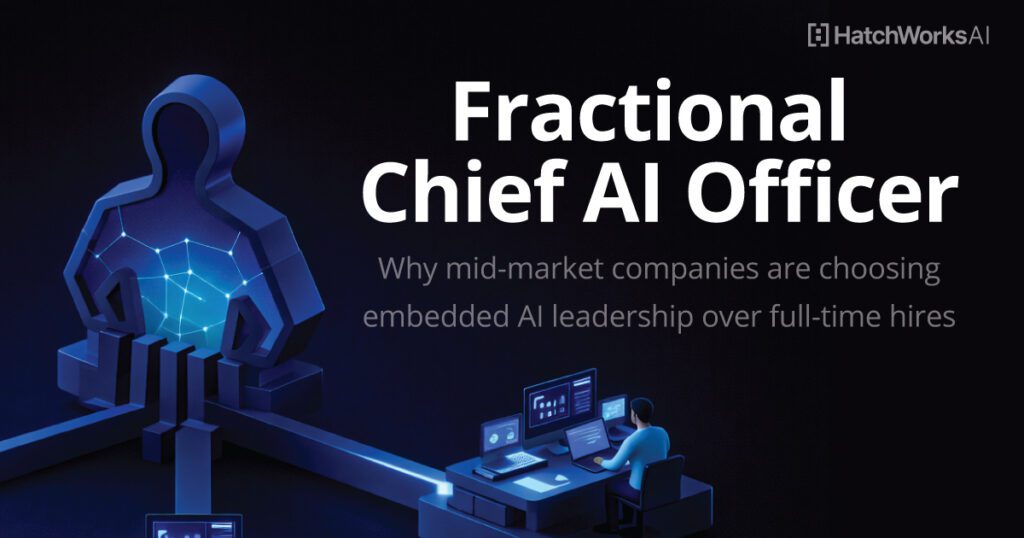
This is the gap that a Fractional Chief AI Officer is designed to fill—and it’s rapidly becoming one of the most important leadership models in enterprise AI.
Why Your Organization Needs a Chief AI Officer
AI adoption without executive-level leadership creates a pattern that is remarkably consistent across industries. Understanding this pattern is the first step in recognizing why the CAIO role has become essential.
The Five Symptoms of Leaderless AI Adoption
1. Fragmented Experimentation
Individual departments adopt AI tools independently. Marketing uses one platform for content generation. Sales deploys a different tool for lead scoring. Engineering experiments with code assistants. There is no shared infrastructure, no common data strategy, and no way to measure aggregate impact. The organization is spending on AI but cannot articulate what it’s getting in return.
2. Governance Vacuum
Without a designated leader, there is no AI or data governance framework. Questions about data ownership, data quality standards, model bias, regulatory compliance, and acceptable use remain unanswered—or worse, are answered inconsistently across teams. Data—one of the organization’s most valuable assets—is often siloed, poorly cataloged, and governed by informal tribal knowledge rather than structured policies. As AI regulation accelerates globally (the EU AI Act, proposed U.S. frameworks, and industry-specific standards), this dual governance vacuum in both data and AI becomes an active liability.
3. Unsure Where to Start with AI
AI’s potential is so broad that it becomes paralyzing. It can impact marketing, sales, operations, finance, customer service, product development, HR—virtually every department and business unit in your organization. When everything is a potential AI use case, nothing gets prioritized. Leadership teams spend months debating where to begin, cycling through vendor demos and internal brainstorming sessions without committing to a path. Meanwhile, individual teams start pursuing their own initiatives based on what’s technically interesting rather than what moves the business forward. The result is scattered effort, diluted resources, and no measurable progress. What’s missing isn’t ideas—it’s someone with the cross-functional visibility and strategic judgment to evaluate the full landscape of possibilities and chart the best path forward given the organization’s specific business goals, data readiness, and competitive position.
4. Stalled Pilots
The organization accumulates proof-of-concept projects that never reach production. This “pilot purgatory” is one of the most common failure modes in enterprise AI. The problem is rarely technical. It’s organizational: no one has the authority, cross-functional influence, or dedicated mandate to move an AI initiative from prototype to production deployment.
5. Talent Attrition
Strong AI and data science talent leaves organizations where they perceive a lack of strategic direction. Engineers and data scientists want to work on initiatives that ship, not on experiments that stall. The absence of AI leadership directly contributes to retention challenges in a highly competitive talent market.
The Core Problem:
AI adoption without executive ownership doesn’t just underperform—it actively damages organizational trust in AI, making future transformation harder and more expensive.
The Full-Time CAIO Cost Problem
The role of Chief AI Officer has emerged as one of the most in-demand C-suite positions in the market. But the compensation expectations reflect both the scarcity of qualified candidates and the strategic importance of the role.
What a Full-Time Chief AI Officer Actually Costs
A comprehensive view of full-time CAIO compensation includes far more than base salary:
| Component | Estimated Annual Cost |
|---|---|
|
Base salary
|
$250,000 – $400,000
|
|
Performance bonus (15–25%)
|
$40,000 – $100,000
|
|
Equity / stock options
|
$50,000 – $150,000+
|
|
Benefits (health, retirement, etc.)
|
$30,000 – $60,000
|
|
Executive recruiting fees (amortized)
|
$25,000 – $50,000
|
|
Onboarding & ramp time (3–6 months)
|
Opportunity cost
|
|
Total Annual Investment
|
$400,000 – $750,000+
|
For a company generating $20 million in revenue, a full-time CAIO represents 2–4% of total revenue before they’ve delivered a single initiative. For a $50 million company, it’s still a significant line item that requires board-level justification—often for a role the board doesn’t yet know how to evaluate.
The Hidden Costs Beyond Compensation
The financial commitment extends beyond the hire itself. A full-time CAIO will need to build a team, which typically includes AI/ML engineers, data engineers, and program managers. They’ll request budget for tooling, infrastructure, and external partnerships. Within 12 months, the total AI leadership investment can easily exceed $1.5–$2 million.
None of this is inherently wrong. Mature AI programs require these investments. But for organizations that are still determining their AI strategy, committing this level of capital before the roadmap is clear represents significant risk.
The Fractional Chief AI Officer Model: How It Works
A Fractional Chief AI Officer provides the same strategic leadership, governance oversight, and execution accountability as a full-time CAIO—structured as a focused, time-bound engagement at a fraction of the cost.
This is not consulting in the traditional sense. Consultants typically deliver assessments, recommendations, and slide decks. A fractional CAIO embeds with your executive team, owns measurable outcomes, and is accountable for results in the same way any C-suite leader would be.
What a Fractional CAIO Actually Does
The scope of a fractional CAIO engagement mirrors what a full-time hire would own, concentrated into focused leadership time:
Strategic AI Roadmap Development. Aligning AI initiatives to the organization’s most impactful business objectives—revenue growth, margin improvement, operational efficiency, customer experience—rather than pursuing technology for its own sake.
AI Governance Framework. Establishing policies for data usage, model evaluation, risk management, regulatory compliance, and acceptable use. This includes drafting governance charters, defining approval workflows, and creating the organizational scaffolding that responsible AI deployment requires.
Use Case Identification and Prioritization. Auditing the organization’s operations, data assets, and technology stack to identify the highest-ROI AI opportunities. Critically, this includes identifying which use cases to say “no” to—a discipline that prevents resource dilution.
Data Strategy and Readiness. Data is one of the most valuable assets an organization owns—yet most companies significantly underleverage it. A fractional CAIO evaluates the organization’s data landscape to determine readiness for AI initiatives, identifies gaps in data quality, accessibility, and integration, and develops a data strategy that ensures AI investments are built on a solid foundation. This includes assessing data pipelines, storage architecture, and data governance maturity. Because nearly every AI initiative has a significant—and sometimes even larger—data component, getting the data strategy right is often the difference between AI projects that deliver ROI and those that stall.
Data Governance Maturation. Closely related to data strategy, a fractional CAIO helps organizations mature their data governance practices to support AI at scale. This includes establishing data ownership and stewardship models, defining data quality standards, creating data cataloging and lineage practices, and ensuring compliance with privacy regulations. Many organizations discover that their AI readiness challenge is fundamentally a data governance challenge—and addressing it creates value far beyond AI alone.
Vendor and Technology Evaluation. Assessing build-vs-buy decisions, evaluating AI platforms and tools, negotiating with vendors, and ensuring technology choices align with the organization’s long-term architecture rather than creating technical debt.
Organizational Change Management. Driving AI adoption across the organization through stakeholder alignment, training programs, communication strategies, and cultural change initiatives. AI transformation fails more often from organizational resistance than from technical challenges.
KPI Definition and Measurement. Establishing clear metrics for AI initiative success and reporting on outcomes to the executive team and board. This transforms AI from an opaque cost center into a measurable business function.
Team and Capability Assessment. Evaluating existing talent, identifying skill gaps, and developing hiring and upskilling plans. This includes determining what should be built internally versus engaged through external partners.
The Cost Comparison
| Full-Time CAIO | Fractional CAIO | |
|---|---|---|
|
Monthly investment
|
N/A (salaried)
|
$5K – $15K / month
|
|
Annualized cost
|
$400K – $750K+
|
$60K – $180K (12-mo. equivalent)
|
|
Time to value
|
3–6 months (ramp)
|
30 days (Phase 1 deliverables)
|
|
Commitment
|
Multi-year
|
Quarterly / engagement-based
|
|
Scope flexibility
|
Fixed headcount
|
Scalable by phase
|
|
Execution support/strong>
|
Must build team
|
Access to delivery org
|
|
Risk
|
High (wrong hire)
|
Low (defined scope)
|
At a monthly retainer of $5,000–$30,000, the fractional model typically represents 20–40% of the all-in cost of a full-time hire on an annualized basis—while delivering measurable outcomes within the first 90 days. And because engagements are structured quarterly or by phase, organizations only pay for the level of leadership they need at each stage of their AI maturity.
Inside a 90-Day Fractional CAIO Engagement
Effective fractional CAIO engagements follow a structured methodology that delivers tangible value at each phase. At HatchWorks AI, we’ve refined this into a three-phase framework that ensures organizations see measurable progress from day one.
Phase 1: Discover & Align (Days 0–30)
The first phase is diagnostic and foundational. The fractional CAIO embeds with the executive team and key stakeholders to build a comprehensive picture of the organization’s AI readiness, data landscape, and strategic priorities.
Activities
Executive and team interviews to understand strategic priorities, pain points, and existing perceptions of AI across the organization. These conversations surface both opportunities and organizational resistance that must be addressed.
Data, pipeline, and tooling audit to assess the current state of data infrastructure, existing AI/ML initiatives, data quality, and technology investments. This audit evaluates data readiness across dimensions including accessibility, completeness, integration maturity, and governance posture—identifying both assets to leverage and critical gaps that must be addressed before AI initiatives can succeed.
Data strategy assessment to understand how data flows through the organization, where it resides, who owns it, and how effectively it’s being leveraged. Most organizations discover that data is siloed across departments, inconsistently governed, and significantly underutilized. This assessment creates the foundation for a data strategy that supports AI while unlocking broader business value from the organization’s data assets.
Quick win identification to surface high-confidence, low-complexity AI use cases that can deliver value within weeks rather than months. Early wins build organizational confidence and executive buy-in.
Strategic AI use case mapping to create a comprehensive inventory of potential AI applications across the organization, ranked by business impact, technical feasibility, and data readiness.
Deliverables
- AI Maturity Scorecard — a structured assessment of organizational readiness across dimensions including data infrastructure, talent, governance, and culture
- Data Readiness Assessment — an evaluation of data quality, accessibility, governance maturity, and integration capabilities, with a clear gap analysis identifying what must be addressed to support priority AI use cases
- Asset Inventory — a catalog of existing data sources, models, tools, and initiatives that can be leveraged or consolidated
- ROI-Ranked Use Case List — a prioritized portfolio of AI opportunities with estimated business impact, implementation complexity, and resource requirements
Phase 2: Design & Operationalize (Days 31–60)
With the diagnostic complete, Phase 2 shifts to architecture, governance, and pilot design. This is where strategy translates into executable plans.
Activities
Target data and AI architecture definition to establish the technical foundation for AI initiatives. This includes data pipeline design, data integration strategy, model hosting decisions, storage architecture, and security requirements. Critically, this phase addresses the data infrastructure work that AI initiatives depend on—because most AI projects are as much data projects as they are model projects. Without a sound data architecture, even the best AI models will underperform or fail entirely.
Data governance framework development to mature the organization’s data governance posture. This includes defining data ownership and stewardship models, establishing data quality standards and monitoring, creating data cataloging and lineage documentation, and aligning data practices with privacy regulations. For organizations with limited existing data governance, this often becomes one of the highest-value workstreams—creating benefits that extend well beyond AI.
AI governance model drafting to create the organizational policies, approval workflows, and accountability structures that ensure AI is deployed responsibly. This covers model evaluation criteria, bias monitoring, acceptable use policies, and regulatory compliance. The data governance and AI governance frameworks are designed to work together as a unified system rather than operating as separate initiatives.
Top pilot use case design to define the scope, success metrics, data requirements, and implementation approach for the highest-priority initiatives. These typically include business intelligence enhancements, retrieval-augmented generation (RAG) implementations, AI agent deployments, or workflow automation.
Deliverables
- Strategic AI Roadmap — a phased plan spanning 6–18 months with clear milestones, dependencies, and resource requirements
- Architecture Blueprint — technical documentation for the target-state data and AI infrastructure, including data pipeline design, integration points, and storage architecture
- Data Governance Framework — a comprehensive data governance model including ownership structures, quality standards, cataloging practices, and compliance requirements
- AI Governance Draft — organizational policies, approval workflows, and accountability structures for responsible AI deployment, designed to integrate with the data governance framework
- Pilot Stack — fully scoped pilot projects with defined success criteria, timelines, and resource plans
Phase 3: Enable & Execute (Days 61–90)
The final phase focuses on organizational enablement, measurement frameworks, and transition planning. The goal is to ensure the organization can sustain AI momentum beyond the initial engagement.
Activities
Stakeholder training delivery to build AI literacy across the organization. This isn’t generic “AI 101” training—it’s role-specific enablement that helps individual teams understand how AI applies to their work and how to engage with AI tools effectively.
KPI and milestone framework definition to establish the metrics, measurement cadences, and reporting structures that will govern AI initiatives going forward. This includes both leading indicators (adoption rates, pipeline velocity) and lagging indicators (revenue impact, cost reduction).
Transition planning to ensure continuity. Depending on the organization’s needs, this may involve transitioning leadership to an internal hire, extending the fractional engagement, or handing off execution to internal or external delivery teams.
Deliverables
- Training Kit — role-specific training materials and enablement resources
- Measurement Framework — a KPI dashboard design with defined metrics, data sources, and reporting cadences
- Operating Model — documentation of roles, responsibilities, decision rights, and processes for the ongoing AI function
- Execution Plan — a detailed implementation plan for the next 6–12 months of AI initiatives
Key Insight:
The 90-day structure is designed to deliver quick wins that build organizational confidence while simultaneously laying the strategic, data, and governance foundation for long-term AI transformation. Because AI initiatives almost always have significant data components—often larger than the AI work itself—the framework treats data strategy and data governance as first-class priorities, not afterthoughts. This dual-track approach is what separates effective fractional CAIO engagements from traditional consulting.
Who Benefits Most from a Fractional Chief AI Officer?
The fractional CAIO model is not right for every organization. Understanding where it delivers the most value helps executives make better decisions about AI leadership.
Ideal Fit
Mid-market companies ($10M–$500M revenue) that need AI leadership but cannot justify the full-time cost. These organizations are large enough to have complex operations that benefit from AI, but not so large that they can absorb a $500K+ hire without careful deliberation.
Organizations in “pilot purgatory” that have invested in AI experiments but haven’t been able to move initiatives into production. The fractional CAIO brings the cross-functional authority and execution discipline needed to break through organizational gridlock.
Companies facing board or investor pressure on AI that need to demonstrate a credible AI strategy quickly. The 90-day framework delivers board-ready deliverables within a single quarter.
Private equity portfolio companies where operational efficiency and scalable growth are imperative. AI-driven value creation is increasingly part of PE operating playbooks, and a fractional CAIO can be deployed across portfolio companies for maximum impact.
Organizations evaluating a full-time CAIO hire that want to de-risk the decision by first defining the role’s scope, building the initial strategy, and proving the value of AI leadership before committing to a permanent hire.
Less Ideal Fit
Large enterprises with mature AI programs that already have established AI teams, governance, and infrastructure. These organizations typically need a full-time leader who can manage ongoing operations and a growing team.
Very early-stage startups where AI is the core product. These companies need a full-time technical co-founder or CTO with deep AI/ML expertise, not a fractional strategic leader.
What to Look for in a Fractional CAIO Engagement
Not all fractional AI leadership is created equal. When evaluating potential engagements, executives should assess several critical factors.
Execution Capability, Not Just Strategy
The most common failure mode in AI consulting is what we call the “deck drop”: a firm delivers a strategy presentation and then disappears. A credible fractional CAIO engagement should include direct access to delivery capabilities—engineering teams, data architects, and implementation specialists who can execute on the strategy. At HatchWorks AI, our Fractional CAIO practice is backed by our full AI engineering organization, which means strategy and execution are unified rather than siloed.
Industry-Specific Experience
AI strategy is not generic. The highest-value use cases, data challenges, regulatory requirements, and organizational dynamics vary significantly across industries. A fractional CAIO who has worked in financial services will bring different insights than one who has worked in manufacturing or healthcare. Ensure the engagement team has relevant industry context.
Proprietary Frameworks and Accelerators
An experienced fractional CAIO practice will have refined its methodology through repeated engagements. Look for proprietary frameworks, assessment tools, and implementation accelerators that reflect accumulated learning. At HatchWorks AI, our Generative-Driven Development (GenDD) methodology and proprietary AI accelerators allow us to compress timelines and reduce implementation risk.
Measurable Outcomes and Accountability
Demand clarity on how success will be measured. A fractional CAIO should be accountable for defined KPIs—not just activity metrics (meetings held, documents delivered) but business outcomes (cost reduction achieved, revenue impact measured, time-to-production for AI initiatives). If the engagement doesn’t include a measurement framework, it’s consulting, not leadership.
Clear Transition Path
The best fractional CAIO engagements are designed to eventually end—either by transitioning to a full-time internal hire, evolving into an ongoing advisory relationship, or handing off execution to a trained internal team. Avoid engagements that create permanent dependency.
The Fractional CFO Parallel: Why This Model Works
The Fractional CAIO model follows the same trajectory as the fractional CFO movement that transformed financial leadership in the 2010s.
A decade ago, mid-market companies recognized they needed sophisticated financial leadership—capital allocation strategy, financial modeling, investor relations, audit readiness—long before they could afford or justify a full-time CFO. The fractional CFO model filled that gap and grew into a multi-billion dollar industry.
The parallels to AI leadership are striking. Organizations need AI strategy, governance, and execution oversight today. The talent pool for qualified AI executives is small and expensive. The role itself is still being defined, making it risky to commit to a full-time hire. And the cost of waiting—while competitors operationalize AI—compounds every quarter.
The fractional model resolves all of these tensions simultaneously: it provides leadership at sustainable cost, with defined scope, measurable outcomes, and the flexibility to scale up or transition as the organization’s AI maturity evolves.
Addressing Common Objections
“Won’t a fractional leader lack the context of someone who’s here full-time?”
This concern is valid and is precisely why the engagement structure matters. A well-designed fractional engagement includes a rigorous discovery phase (Phase 1) that builds deep organizational context within 30 days. Additionally, because the fractional CAIO brings cross-industry experience from multiple engagements, they often identify patterns and opportunities that a first-time internal hire would miss. The concentrated nature of fractional leadership—1–3 days per week of focused, high-level work—often delivers more strategic value than a full-time executive who gets pulled into operational minutiae.
“How do we ensure continuity when the engagement ends?”
Continuity is built into the engagement design, not left to chance. Phase 3 specifically focuses on transition planning, training, operating model documentation, and knowledge transfer. The deliverables from all three phases create an institutional knowledge base that persists regardless of whether the fractional CAIO continues. The best engagements also include options for ongoing advisory relationships that maintain strategic continuity at minimal cost.
“Our CTO can handle AI strategy.”
In many organizations, the CTO is already overextended managing existing technology operations, security, infrastructure, and product development. Adding AI strategy, governance, and transformation leadership to an already full plate almost guarantees that AI gets treated as a side project rather than a strategic priority. Furthermore, the CAIO role requires a fundamentally different skill set—one that bridges business strategy, organizational change management, data governance, and emerging technology evaluation. These are complementary to, not redundant with, a strong CTO.
“We’re not ready for AI yet.”
This is the most common—and most costly—objection. The idea that an organization needs to “get its data in order” before pursuing AI strategy is a misconception that delays action by years. A fractional CAIO helps the organization understand its current data landscape, identify what’s needed, and build a pragmatic roadmap that accounts for data maturity as a variable, not a prerequisite. In fact, one of the highest-value contributions a fractional CAIO makes is helping organizations realize that improving their data strategy is itself a massive unlock—one that creates value well beyond AI. Companies that wait for perfect data readiness before establishing AI leadership are like companies that wait to be in perfect health before hiring a doctor. The leadership is what creates the path to readiness.
Frequently Asked Questions
What is a Fractional Chief AI Officer?
A Fractional Chief AI Officer (CAIO) is a senior AI executive who provides part-time strategic leadership to an organization. Rather than working full-time for a single company, a fractional CAIO typically engages 1–3 days per week, delivering the same strategic planning, data strategy, governance oversight, and execution accountability as a full-time hire at a significantly lower cost. The model is especially suited for mid-market companies that need enterprise-grade AI and data leadership but cannot justify or afford a full-time C-suite AI hire.
How much does a Fractional Chief AI Officer cost?
Fractional CAIO engagements typically range from $5,000 to $30,000 per month depending on scope, complexity, and the level of execution support included. This represents approximately 20–40% of the all-in cost of a full-time CAIO, which typically ranges from $400,000 to $750,000 or more annually when including salary, equity, benefits, and recruiting costs.
How long does a Fractional CAIO engagement last?
Initial engagements typically span 90 days, structured in three 30-day phases: discovery and alignment, design and operationalization, and enablement and execution. Many organizations extend into ongoing advisory or second-phase engagements depending on their evolving needs.
What is the difference between a Fractional CAIO and an AI consultant?
The critical distinction is accountability. AI consultants typically deliver assessments, strategies, and recommendations. A fractional CAIO owns outcomes. They embed with the executive team, chair governance boards, define and track KPIs, and are measured on business results—not on deliverables. They function as a member of the leadership team, not an external advisor.
When should a company hire a full-time CAIO instead of a fractional one?
A full-time CAIO is appropriate when an organization has established its AI strategy, built a multi-person AI team, and has ongoing operational AI initiatives that require daily executive oversight. Many organizations use a fractional engagement as a bridge: establishing the strategy and governance foundation, proving the value of AI leadership, and then transitioning to a full-time hire once the role’s scope and requirements are clearly defined.
Your Competitors Are Not Waiting
The organizations that are winning with AI in 2025 are not the ones with the largest technology budgets. They are the ones that established AI leadership early—giving someone the mandate, authority, and accountability to turn AI from a collection of experiments into a strategic business function.
If your board is asking about AI and you don’t have a credible answer, if your AI pilots are stalling in proof-of-concept, if your CTO is stretched too thin to own another strategic initiative, or if you know you need AI leadership but the math on a full-time hire doesn’t work—a Fractional Chief AI Officer may be exactly what your organization needs.
HatchWorks AI’s Fractional Chief AI Officer Practice
We embed senior AI leaders with your executive team to deliver strategic AI roadmaps, governance frameworks, and measurable business outcomes within 90 days. Backed by our full AI engineering organization and proprietary GenDD methodology, we don’t just advise—we execute.